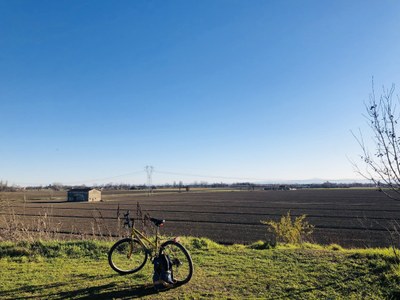
Discover the hidden gems of the Lower Reggio Plain, a fascinating corner of Italy's Po Valley.
Ride through endless fields, charming villages, and peaceful country roads, where every turn reveals a new experience in the heart of Emilia's most authentic landscapes.

The Little Capitals of the Po by bike

A cycling route along the Po River to discover the towns of the lower Reggio Emilia plain, to be explored by bike through historic and natural landscapes.

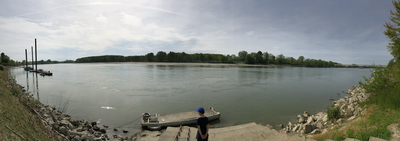
The route is part of the well-known EuroVelo 8, Ciclovia del Po, and VenTo (Venice–Turin) itineraries, and follows the course of the river, crossing floodplain areas and connecting the five municipalities overlooking the Po.
Along the way, it is easy to reach the historic centres of the towns involved and admire numerous natural and cultural highlights without even getting off your bike: the river “beaches”, the mouth of the Enza River, the Boretto tourist harbour, and much more.

Central Plain Ring

A circular route in the heart of the Bassa Reggiana.
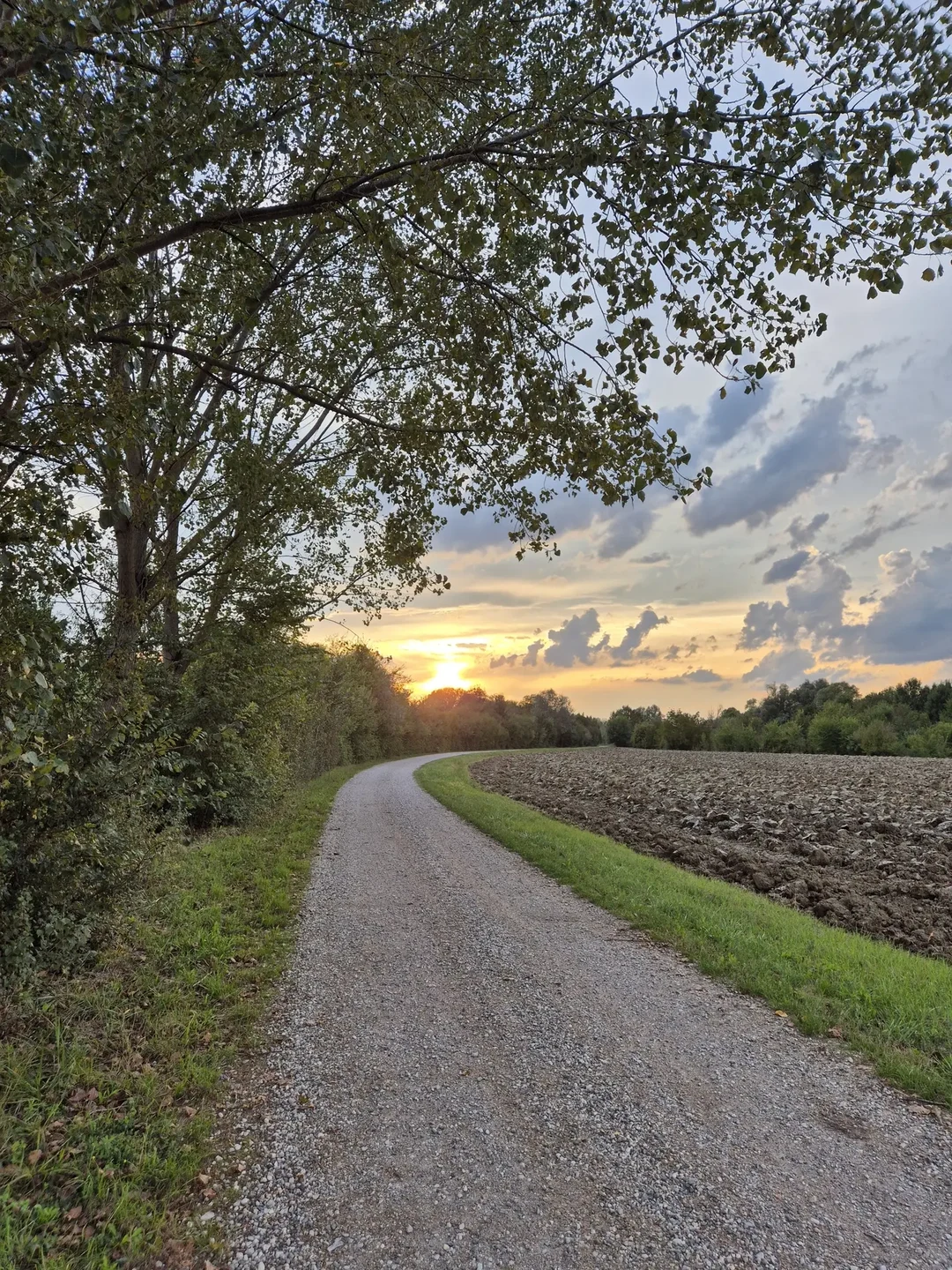
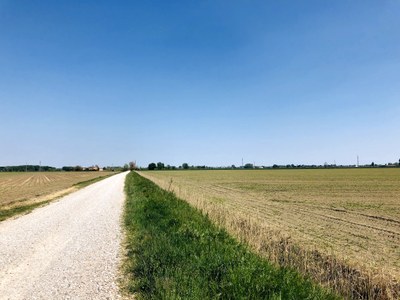
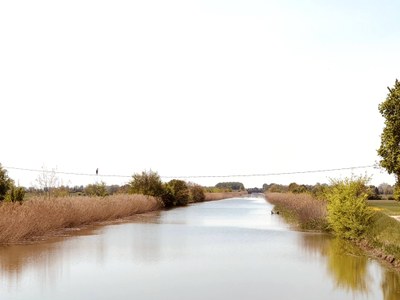
Not a single mountain, not a single hill in sight.
A horizontal line separating the chaos of the earth from the serenity of the sky.
We are in the heart of the Emilian plain, or as we call it round here, ‘the Bassa’, this stretch of flat land that stretches as far as the eye can see and makes everything seem so close, yet so far away.

This route takes us into the heart of the Bassa Reggiana, between Correggio, Novellara, Campagnola Emilia and Rio Saliceto, through fields, narrow lanes and quiet villages.

The Bassa Reggiana Cross-Country Route

A diagonal route across the plain from Correggio to Guastalla, as far as Lido Po, following the ‘strade basse’: narrow country lanes that run alongside and follow the winding course of the ditches and the surrounding countryside.

Along these roads, it is certainly not uncommon to come across wildlife, centuries-old trees and farmhouses frozen in time.

This route along these ‘strade basse’ links the two main towns of the Bassa Reggiana – Correggio and Guastalla – and extends as far as Lido Po, which from April to October becomes a popular gathering place for everyone to celebrate the warmer months.

Aquarum Terrae - Reclaimed Lands by Bike

A 65 km circular route spanning the entire width of the province, taking in canals, rivers, reclaimed land and small villages, and showing how human endeavour has fostered harmony between society and nature.

Ever since Roman times, there had been a desire to regulate the waters and the unhealthy wetlands of this stretch of the plain, but the impermeable, marshy soil made the task impossible, thus limiting Roman engineers to the centuriation of a few areas close to the Via Emilia, leaving vast tracts of marshland along the course of the River Po, which had not yet been regulated.

Over the course of history, the villages that sprang up on higher ground relative to the plain flourished, thanks in part to the courts of the Gonzaga family and the villages of the Duchy of Este, which brought great culture to the area.

Gonzaga Ring

First came the Corradi, a feudal landowning family of Polirone in San Benedetto Po (MN), who had already been appointed by Countess Matilda of Canossa in 1096 as trusted men to whom land was entrusted; then came the Gonzagas, who took their name from the town of the same name, now in the province of Mantua, and went on to become one of the most powerful families in Europe over the course of nearly five centuries of Italian and European history.

This circular route will take you to the Gonzagas’ ancestral home, straddling Mantua and Reggio Emilia, where members of the family maintained strong roots even after moving to Virgil’s city.

The ring between the Enza and the Po River

A circular route between the Enza and Po rivers, amidst the echoes of history.
In these places, the bond between land and water is inseparable, and was already a defining feature of this area 3,500 years ago.
Bronze Age peoples along the course of the Po settled in communities known as Terramare – areas of land raised above the water where the first stilt houses, huts and dwellings were built.
This enabled the Terramare civilisations to develop their cultures and produce artefacts of significant historical value, helping us to understand what the past was like before the arrival of the Celts, the Etruscans and the Romans.

Plainlands – from the Bassa to the Centre

A cycle route through the municipalities of the Bassa Reggiana, taking in fortresses and small towns, from the outskirts of the province to the heart of Reggio.
A route suitable for everyone, with a low level of difficulty and rich in cultural and natural heritage, passing through wetlands, country lanes and town centres.

Eastern Plains Ring

We are on the very edge of the province, so much so that even the local dialect here is influenced by that of Modena, as this is the province’s easternmost municipality, wedged between the provinces of Mantua and Modena.
Rolo is the home of tarsia, the centuries-old art of creating works of art inlaid in wood.
Creations by master inlay artists from Rolo have found their way to the Palace of Versailles, the Royal Palace of Caserta and the stately homes of the ruling monarchical families across half of Europe.
On this itinerary, we will discover the eastern border of the Bassa region, rich in culture and a crossroads of histories, people and traditions.

Reggio-Cavriago by bike

From the historic centre of Reggio Emilia, follow Via Emilia all’Angelo, pass the Santo Stefano roundabout and the bridge over the Crostolo, then turn left into Via Giacomo Puccini. Along the way, you can admire: the Church of Santo Stefano (dating back to the 11th century, it was once one of the properties of the Knights Templar and houses the city’s oldest Romanesque artefact: a capital depicting Jesus, an angel and a headless female figure) and the roundabout featuring Marco Gerra’s sculpture, an abstract work of art 10 metres high and weighing 90 quintals.

After turning right onto Via Vincenzo Gianferrari, pass under Via Chopin and follow the cycle path that cuts through Nilde Iotti Park to Via dei Templari. The park marks the southern boundary of two imposing villas in Reggio Emilia: Villa Terrachini (private) and the Maramotti Collection, the first factory of the Max Mara fashion house, now converted into a ‘museum’ of contemporary art and open to visitors free of charge.

Continue along Via Gorizia and Via Carlo Teggi, following Cycle Route 7 of the Municipality of Reggio Emilia. Pass the beautiful Villa Angela (private property), a stately 19th-century residence surrounded by a park and enclosed by an imposing fence. At the rear, hidden from view from the road, is a small oratory dedicated to Saints Grisante and Daria, the city’s patron saints.

Near the Church of Codemondo, turn left onto Via Pantaleone, ride alongside the cemetery and turn right onto Via Socchi. Continue straight on along Via Pigoni until you rejoin Via Teggi. From here, continue straight on towards the centre of Cavriago.

After a short stop, between the gardens of the Multiplo and Piazza Zanti, resume the route by taking Via Matteotti, continue along Via Paterlini and you will arrive near Parco della Pianella (shopping centre). Pass under the SP28 and continue along the narrow road until you reach the SP72: follow Via Nemo Sottili and Via Quaresimo to the centre of San Bartolomeo. Around the ancient church, which is home to the parish centre and the sports ground, there is a playground and some recent buildings. Continue along Via Aldemo Tirabassi and turn right onto Via Giovanardi. Turn right onto Via Zanichelli, cross the Rio Moreno and continue straight on to the hamlet of Ghiarda. Carry on along Via Ghiarda and Via Ruozzi until you reach the Modolena stream and the imposing Villa Levi. 

The route continues through the hamlet of Coviolo, following the Modolena Greenway until it rejoins Via Gorizia. From here, carry on straight ahead to the historic centre of Reggio Emilia.

Crostolo River Tour - From Reggio Emilia to Guastalla

A ‘historic’ cycle route running from Reggio Emilia to Lido Po in Guastalla, also passing through the municipalities of Cadelbosco di Sopra, Castelnovo Sotto and Gualtieri. The route, just over 30 kilometres long, winds mainly along the banks of the Crostolo (over 24 km), with sections on quiet roads (just over 4 km) and cycle paths. The route is of great natural and environmental value and effectively forms an ecological corridor from Reggio Emilia to the River Po.

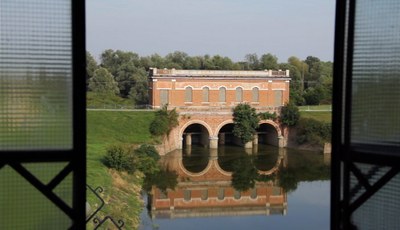
At kilometre 25.8, you can alter the main route by turning left, crossing the Crostolo via the footbridge serving the Torrioni/Botte Bentivoglio hydraulic plant of the Emilia Centrale Land Reclamation Consortium, and continuing on to the historic centre of Gualtieri. This route allows you to visit the historic centre of Gualtieri with its beautiful Piazza Bentivoglio and the Palazzo Bentivoglio of the same name, a building of considerable architectural value and the venue for various cultural events such as the exhibition dedicated to the painter Ligabue. Along the route leading from the historic centre, via Viale Po, to Lido Po, you will encounter areas of considerable environmental and naturalistic value, such as the ‘I Caldaren’ Ecological Rebalancing Area and the ‘Isola degli Internati’ nature reserve. Before reaching Lido Po, you will also cross the suspension bridge over the Crostolo as it flows into the River Po.

The landscape you encounter is that of the Parmigiano-Reggiano region, set within a context characterised by a network of canals managed by the Consorzio di Bonifica dell’Emilia Centrale, which ranks among the most important in Italy both for its engineering achievements and its historical significance. The route runs lengthways through an area which, thanks to the fertility of its soil, local biodiversity and cultural heritage, is ideally suited to the production of ‘Anguria Reggiana IGP’ watermelons.

The municipality of Guastalla is also home to religious buildings of great historical importance, as is the area around Reggio Emilia, where there are also several monuments linked to the history of the Resistance.


The Duchies Ringroad

Over the centuries, many noble families have left their mark on history to a greater or lesser extent, but the Este family, together with the Gonzaga family, have shaped the artistic and cultural heritage not only of the city of Reggio, but of the entire province.

This circular route traces the places where these families lived and sought to leave their mark on history, starting from Scandiano at the ancient Rocca dei Boiardo, passing through Reggio Emilia, where the Este family’s influence is particularly evident in the Basilica della Ghiara; it then passes through Bagnolo in Piano with its Torrazzo, the sole surviving remnant of the Gonzagas of Bagnolo following the French destruction; on to Correggio, where first the County and later the Principality fostered a flourishing culture; finally to Rubiera, where the Ospitale and the Fort stand as symbols of the Este and Boiardo families’ presence in this village, before returning to Scandiano.

Our tour begins in Scandiano, right in front of the Rocca dei Boiardo, the residence of the family of the same name. Built during the 12th century by the Da Fogliano family, it was taken over by the Boiardo family in 1423 and was inhabited continuously for 137 years.

We then arrive in the provincial capital, Reggio Emilia. During their stay of more than two centuries, the Este family brought great cultural splendour and a refinement in craftsmanship that is still very much appreciated today. You can follow an itinerary entirely dedicated to the Este family’s presence in the city via the ‘Passeggiata Estense’, from the centre to the Reggia di Rivalta and beyond, towards Villa d’Este and the Vasca di Corbelli. 

An absolute must-see in the city is the Basilica of the Madonna della Ghiara, a jewel and masterpiece of 17th-century art. Named after the ‘ghiara’ (gravel, rocky sediment) of the Crostolo stream, which once flowed here before being diverted in 1226, it was originally a friary, later expanded into a church dedicated to the Nativity.

A Greek cross-plan church elevated to the rank of minor basilica, its foundation stone was laid on 6 June 1597 and it was inaugurated on 12 May 1619 with a lavish ceremony, accompanied by allegorical floats: this marked the beginning of the Giaréda, Reggio Emilia’s historic festival.

In the Parco del Rodano, you can admire the Mauriziano, the summer residence of Ludovico Ariosto and a 17th-century civil architecture masterpiece featuring faunal decorations in the courtly style of the period.

Leaving the city, we arrive at Bagnolo in Piano, where the ancient Gonzaga buildings were destroyed by the French during the Napoleonic Wars, sparing only the Torrazzo in the town centre – the last remaining vestige of the Gonzaga court, which had one of the many cadet branches of the great Mantuan family here.

Travelling through the countryside, we arrive at Correggio, once the capital of the county and later of the principality, before it too was absorbed into the Duchy of Este. Here we find the Palazzo dei Principi, commissioned in 1508 by Francesca of Brandenburg, widow of Prince Borso da Correggio. Continuing on, we also come across the remains of the Rocchetta, demolished in the 19th century to make way for the railway line.

If you veer off the route towards San Martino in Rio, you can admire the Rocca Estense. 

Originally belonging to the Canossa family, it was razed to the ground by Frederick Barbarossa and later passed to the Roberti family of Reggio. Today it hosts many cultural events, and visitors can explore the interior free of charge.

Returning to the route, we cross the A1 motorway and the high-speed rail line, arriving at Rubiera. Here, the Ducal presence has been greatly diminished, leaving few traces still visible. The Ospitale and the remains of the Fort bear witness to this history; the former is open to the public and hosts cultural events and much more, whilst the latter are ruins that have, sadly, been left to fall into disrepair and are visible only from the outside.

Heading back towards Scandiano, we pass through the hamlet of Arceto, where the castle of the same name was once one of the grand residences of the Da Fogliano family and, later, the Boiardo family. The municipality of Scandiano is a partial owner, and access is by booking only.