
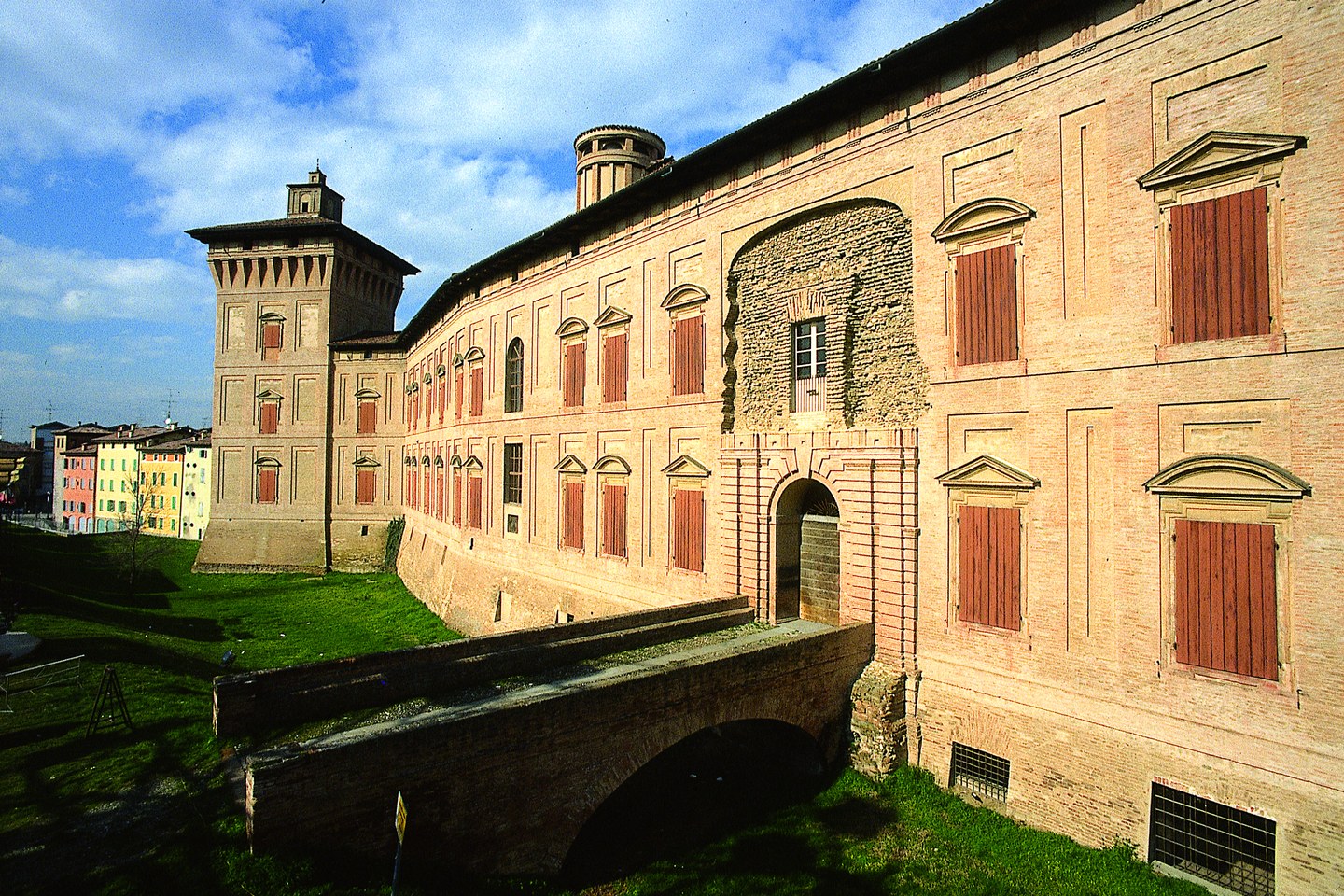
Over the centuries, many noble families have left their mark on history to a greater or lesser extent, but the Este family, together with the Gonzaga family, have shaped the artistic and cultural heritage not only of the city of Reggio, but of the entire province.
This circular route traces the places where these families lived and sought to leave their mark on history, starting from Scandiano at the ancient Rocca dei Boiardo, passing through Reggio Emilia, where the Este family’s influence is particularly evident in the Basilica della Ghiara; it then passes through Bagnolo in Piano with its Torrazzo, the sole surviving remnant of the Gonzagas of Bagnolo following the French destruction; on to Correggio, where first the County and later the Principality fostered a flourishing culture; finally to Rubiera, where the Ospitale and the Fort stand as symbols of the Este and Boiardo families’ presence in this village, before returning to Scandiano.
Our tour begins in Scandiano, right in front of the Rocca dei Boiardo, the residence of the family of the same name. Built during the 12th century by the Da Fogliano family, it was taken over by the Boiardo family in 1423 and was inhabited continuously for 137 years.
We then arrive in the provincial capital, Reggio Emilia. During their stay of more than two centuries, the Este family brought great cultural splendour and a refinement in craftsmanship that is still very much appreciated today. You can follow an itinerary entirely dedicated to the Este family’s presence in the city via the ‘Passeggiata Estense’, from the centre to the Reggia di Rivalta and beyond, towards Villa d’Este and the Vasca di Corbelli.
An absolute must-see in the city is the Basilica of the Madonna della Ghiara, a jewel and masterpiece of 17th-century art. Named after the ‘ghiara’ (gravel, rocky sediment) of the Crostolo stream, which once flowed here before being diverted in 1226, it was originally a friary, later expanded into a church dedicated to the Nativity.
A Greek cross-plan church elevated to the rank of minor basilica, its foundation stone was laid on 6 June 1597 and it was inaugurated on 12 May 1619 with a lavish ceremony, accompanied by allegorical floats: this marked the beginning of the Giaréda, Reggio Emilia’s historic festival.
In the Parco del Rodano, you can admire the Mauriziano, the summer residence of Ludovico Ariosto and a 17th-century civil architecture masterpiece featuring faunal decorations in the courtly style of the period.
Leaving the city, we arrive at Bagnolo in Piano, where the ancient Gonzaga buildings were destroyed by the French during the Napoleonic Wars, sparing only the Torrazzo in the town centre – the last remaining vestige of the Gonzaga court, which had one of the many cadet branches of the great Mantuan family here.
Travelling through the countryside, we arrive at Correggio, once the capital of the county and later of the principality, before it too was absorbed into the Duchy of Este. Here we find the Palazzo dei Principi, commissioned in 1508 by Francesca of Brandenburg, widow of Prince Borso da Correggio. Continuing on, we also come across the remains of the Rocchetta, demolished in the 19th century to make way for the railway line.
If you veer off the route towards San Martino in Rio, you can admire the Rocca Estense.
Originally belonging to the Canossa family, it was razed to the ground by Frederick Barbarossa and later passed to the Roberti family of Reggio. Today it hosts many cultural events, and visitors can explore the interior free of charge.
Returning to the route, we cross the A1 motorway and the high-speed rail line, arriving at Rubiera. Here, the Ducal presence has been greatly diminished, leaving few traces still visible. The Ospitale and the remains of the Fort bear witness to this history; the former is open to the public and hosts cultural events and much more, whilst the latter are ruins that have, sadly, been left to fall into disrepair and are visible only from the outside.
Heading back towards Scandiano, we pass through the hamlet of Arceto, where the castle of the same name was once one of the grand residences of the Da Fogliano family and, later, the Boiardo family. The municipality of Scandiano is a partial owner, and access is by booking only.


