
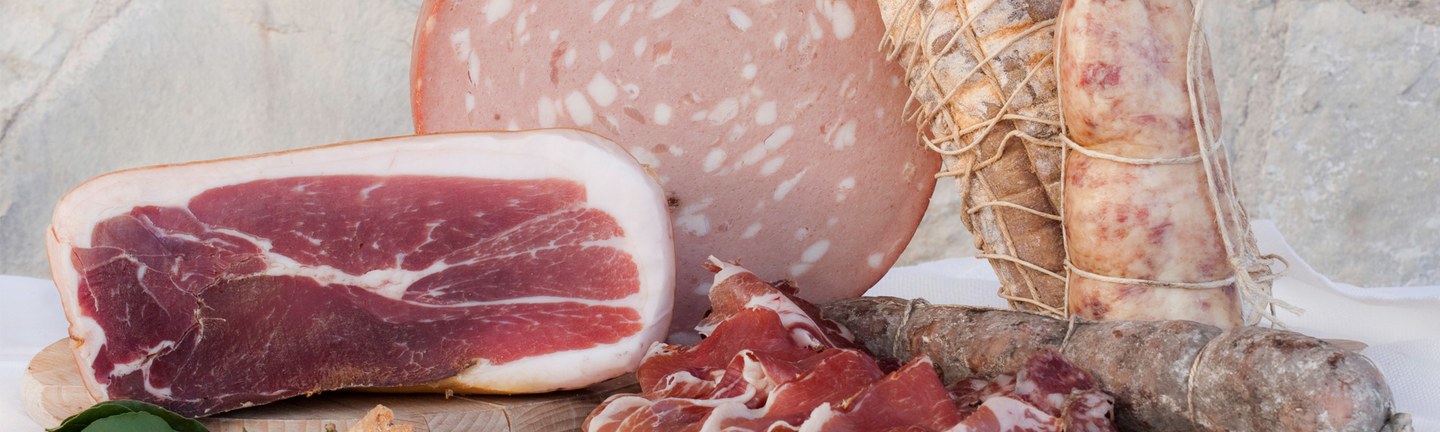
Reggio Emilia Cured Meats
Intense aromas and authentic flavours tell the story of a region where every cured meat has its own identity, deeply intertwined with local history and traditions.
On tables in Reggio Emilia, a platter of cured meats finds its natural pairing in warm, fragrant gnocco fritto and a glass of Lambrusco – indispensable companions to Emilian conviviality.
From prosciutto crudo to salami, from coppa to mortadella, right through to festive staples such as cotechino and cappello del prete, Reggio Emilia’s cured meats represent one of the most recognisable and cherished expressions of Emilian cuisine.
Prosciutto crudo
One of the best-known symbols of Italian cured meats, prosciutto crudo is a product that combines tradition and refinement.
Among the most highly regarded varieties, Parma ham stands out, recognisable by its rounded shape, the absence of the hoof, and a weight that can reach up to nine kilograms.
The long curing process enhances its delicate, natural flavour, making it one of the best-known and most appreciated Italian cured meats in the world.
Cooked ham
Tender, well-balanced and easy to digest, cooked ham is one of the most common cured meats on Italian tables.
Its popularity lies in the simplicity of its production and the quality of its raw ingredients, which guarantee a light yet flavourful product.
Enjoyed by people of all ages, it is now also considered a suitable food for balanced diets.
Mortadella
Originally created to make the most of the less prized cuts of pork, mortadella has evolved into a product of great gastronomic merit.
The meat is finely minced and processed to produce a soft, uniform mixture, increasingly made from selected pork.
The result is a cured meat with a delicate flavour, now less spicy than in the past and perfectly in keeping with contemporary tastes.
An interesting fact links this product to the Reggio Emilia area: according to tradition, mortadella is said to have originated in Salvaterra in 1556.
Coppa
Made from the muscles of the pig’s neck, coppa is one of the most representative specialities of the Emilian tradition.
Although its historical production areas are in the provinces of Parma and Piacenza, it is also widely available and appreciated in the Reggio Emilia area.
Its distinctive feature lies in the production process, which combines the salting typical of prosciutto with a long curing period similar to that of salami.
This process gives it a delicate aroma and a full, lingering flavour, making it ideal both on its own and paired with vegetables and traditional dishes.
Salame
The term ‘salami’ derives from the Latin salumen, which refers to salted meats in general, evoking one of the oldest preservation techniques.
Various cuts of pork are used in its production, skilfully balanced between lean and fatty parts.
Over time, each salami develops a unique flavour profile, thanks to the use of spices and natural curing processes.
Rich in flavour and nutritious, it is suitable for a wide range of occasions, from starters to a main course.
Cotechino
A staple of festive meals, cotechino is made from lean pork, fat and pork rind, finely minced to form a smooth mixture.
It is stuffed into natural casings, in keeping with a tradition that preserves its authentic character.
Its soft texture and rich flavour make it one of the stars of Emilian cuisine on special occasions.
Cappello del prete
Closely related to cotechino, cappello del prete is distinguished by its characteristic triangular shape, which resembles the clerical headdress from which it takes its name.
The production process involves filling the casing through a specific opening and then sealing it by hand, using artisanal techniques handed down through the generations.
How to enjoy them
Cured meats from Reggio Emilia have always been a staple of traditional local gatherings.
They are ideal as an appetiser, perfect for filling gnocco fritto, focaccia and sandwiches, and are also widely used in traditional Emilian cuisine, enhancing both first and main courses.
An experience not to be missed.


About us
Where to find us
Opening hours
Press and TV enquiries
Leave us your feedback
