
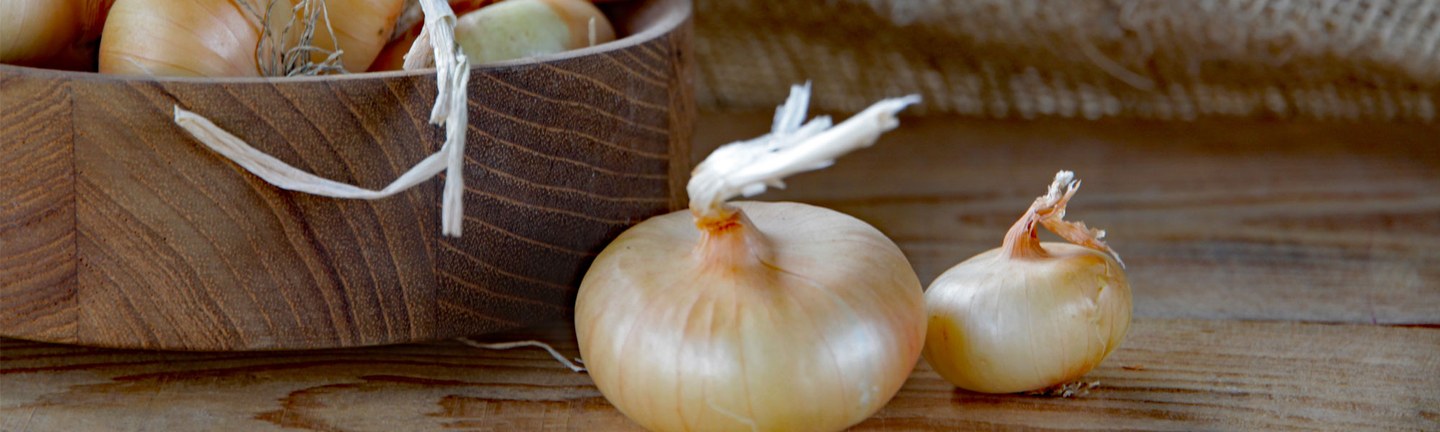
Borettana Onion De.C.O.
The Borettana onion (Allium cepa) has its roots in an ancient history that spans civilisations and continents.
Native to the regions between Turkey, Iran and India, it was already known in Ancient Egypt, where it had been cultivated since the 4th millennium BC and was a staple food for farmers and labourers.
Over time, thanks to its extraordinary adaptability, it has spread throughout the world, taking on different forms and characteristics depending on the region.
In Emilia, and in particular in the lower Reggio Emilia area, this variety has found an ideal environment, becoming an agricultural symbol deeply linked to the community of Boretto.
From the 15th century onwards, and for over five centuries, it was one of the region’s most representative crops, sustaining the local economy and farming families.
Following an agricultural crisis in the early 20th century, its cultivation entered a new phase even outside its original territory, whilst retaining its identity intact.
Today, the Boretto onion is distinguished by its small bulb, flattened at both ends, its straw-coloured skins and a delicate yet distinct flavour profile.
Rich in minerals such as calcium and phosphorus and in vitamin C, it is also prized for its diuretic and antiseptic properties, as well as for its versatility in cooking and the preserving industry.
Its recent history has also been marked by official recognition: since 17 September 2005, it has been protected by the De.C.O. (Municipal Designation) label and listed among the species of biodiversity to be preserved by the Province of Reggio Emilia.
A symbol of tradition and rural ingenuity, the Borettana onion finds its finest expression in the famous sweet-and-sour baby onions, the star of starters and aperitifs, capable of conveying – in a single taste – the heritage and identity of an entire region.


About us
Where to find us
Opening hours
Press and TV enquiries
Leave us your feedback
