Palazzo Pratonieri
Timetable
The palace can be visited during the bank’s public opening hours.
View opening times.
Palazzo Pratonieri over time
Built in the 16th century at the behest of the Pratonieri family, perhaps by Bartolomeo Spani (architect and sculptor).
In the sixteenth century, the urban layout of the area where the palace stood was very different from today.
Historical documents show that there was a dense network of open-air canals running through the city, which was exploited by numerous mill wheels.
The first renovation of Palazzo Pratonieri took place at the beginning of the nineteenth century, based on a design by Domenico Marchelli.
On this occasion, the main entrance, originally on Via del Torrazzo, was moved to its current position on Via Toschi.
In 1880, the last descendant of the family, Alessandro Vezzani Pratonieri, sold the property to the Cassa di Risparmio di Reggio Emilia, which made it its headquarters. In the early years of the 20th century, the building's interior spaces were completely renovated.
The designers were assisted by an art commission chaired by the painter Gaetano Chierici.
The works, delayed due to the war, were completed in 1916, the year of the official inauguration.
From 1916 to 2006, Palazzo Pratonieri remained the headquarters of the Cassa di Risparmio. Following damage caused by seismic events, the building became unfit for use and remained vacant for a few years.
In 2016, exactly one hundred years after the great twentieth-century renovation, UniCredit launched a new and meticulous restoration intervention, returning the palace to its former glory.
Architecture and Spaces
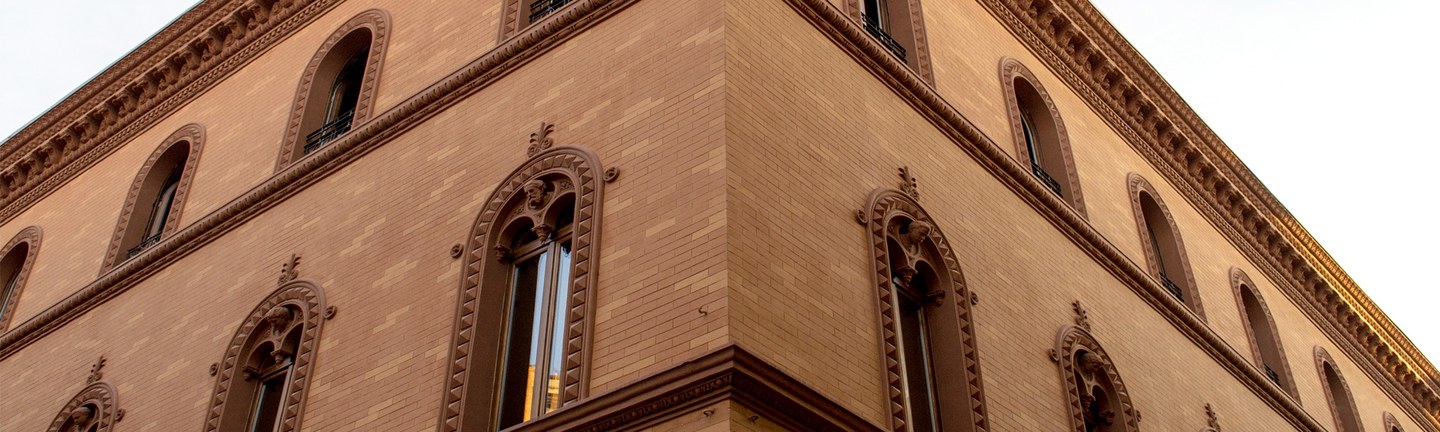
On the outside, Palazzo Pratonieri preserves intact the elegant late nineteenth-century appearance acquired with the renovation commissioned by the Cassa di Risparmio di Reggio Emilia in 1882, based on a design by the engineer Pio Casoli.
The façade is characterized by a refined architectural arrangement: smooth rustication lines engraved into the plaster follow one another regularly, while the round-arched windows are embellished with diamond-point terracotta frames.
On the noble floor, hanging small arches and ornamental heads further enrich the front.
At the top, an elegant cornice decorated with panels depicting bees - a symbol of industriousness and saving - recalls the historical identity of the Cassa di Risparmio.
The monumental entrance hall
The great renovation of 1916, judged by some critics of the time to be excessively invasive, actually represented an extraordinary moment for Reggio's art and craftsmanship.
The palace became the largest monumental construction site in the city, a true School of Arts and Crafts.
The entrance hall welcomes the visitor with a precious wooden coffered ceiling, refined stuccos, marbles, wooden window frames, and a monumental entrance portal, all crafted by the best artisans of the time.
On the sides of the central hall stand two bronze half-busts on marble pedestals depicting Matteo Maria Boiardo and Ludovico Ariosto, a tribute to the great figures of Reggio's culture.
The Room of the Victories
The Room of the Victories (Sala delle Vittorie) is one of the most striking rooms in the palace.
Its architecture is designed to correct the irregular shape of the space, creating the illusion of a perfectly rectangular hall.
The side walls are decorated with sculptures by Enrico Prampolini: at the four corners, the Telamons symbolize the hardship of human labor, while the winged Victories, which give the room its name, represent the success achieved through commitment and saving.
The glass ceiling, decorated with the recurring motif of the bee, reinforces the strong symbolic value linked to industriousness.
The Room of the Pyramid
The Room of the Pyramid (Sala della Piramide) constitutes the link between the original core of Palazzo Pratonieri and the former House of the Congregation of Charity, purchased in 1924 and incorporated between 1925 and 1927.
The marble pilasters decorated with gold leaf inserts support a mirror vault adorned with hexagonal motifs, evoking a beehive and collective work.
The spheres above, which turned out to be leaded glass lamps, contribute to the refined illumination of the environment.
The room takes its name from the spectacular glass pyramid above, added during the most recent restorations, which gives light and breathing space to the entire area.
Also of great interest is a sixteenth-century sandstone column, testimony to the pre-existing building.
The Public Hall
The monumental heart of the palace, the Public Hall (Sala del Pubblico) is a neo-Renaissance masterpiece, designed by Professor Collamarini and inspired by Orlando Furioso by Ludovico Ariosto, who was born in Reggio Emilia.
The hall is embellished with painted glass lacunars and bronze bas-reliefs by Cirillo Manicardi, featuring capitals and friezes dedicated to Ariosto's fantasies and to the theme of human labor as the foundation of civilization.
A unique element is the continuous epigraphic inscription running below the architrave, readable without interruption from wherever one begins reading.
Below the skylight develops a continuous pictorial frieze, also by Manicardi, composed of twelve panels: a story told through images that ranges from the allegory of peace to work in the fields, from village life to the railway, a symbol of modernity and progress.