Ex Caserma Zucchi
Timetable
The palace can be visited inside during the opening hours of the University.
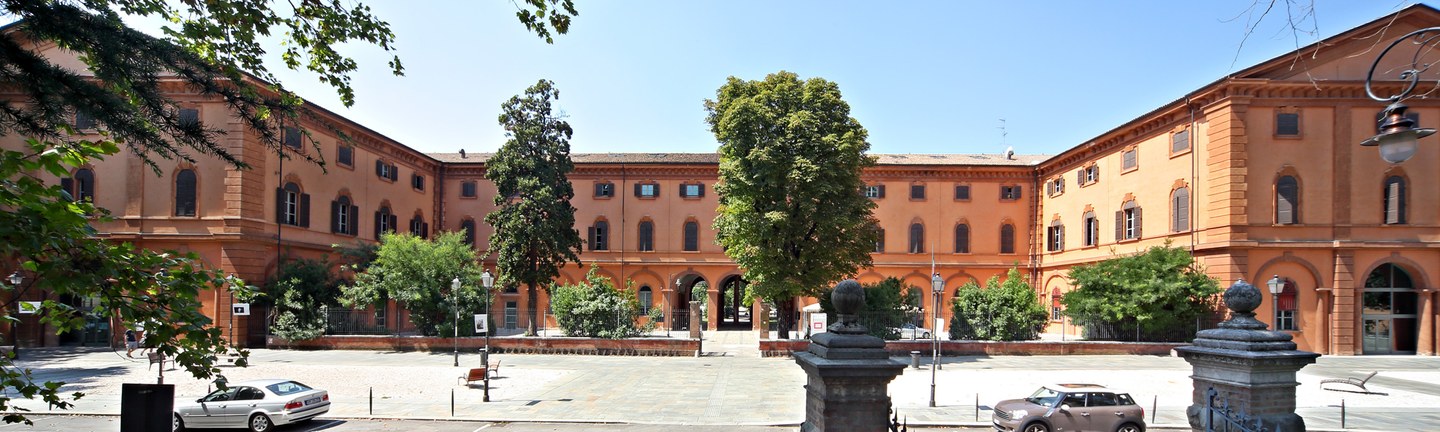
In the heart of Reggio Emilia, the Ex Caserma Zucchi (former Zucchi Barracks), now named after Giuseppe Dossetti, tells centuries of history spanning architecture, education, and art.
Historical Background
Designed by Pietro Marchelli and built between 1845 and 1853 in the Neoclassical style, the building overlooks Viale Allegri.
It originated as the Foro Boario for the livestock market and the storage of food supplies (annona), commissioned by the Duke of Modena, Francesco IV.
The Caserma Zucchi remained occupied by the military until 1975, shaping the city's civic and urban life for over a century.
In the years following its military decommissioning, the complex was progressively converted by the Municipality of Reggio Emilia, which designated it as an exhibition space for the Civic Museums, the headquarters of the "Achille Peri" Musical Institute, and the "Catomes Tôt" Social Center, anticipating its cultural and educational vocation.
The Ancient University Tradition of Reggio Emilia
The presence of the university in Reggio Emilia is part of an ancient cultural tradition.
Already in the Middle Ages, the city hosted a Studium, as recalled by the Reggiano jurist Alessandro Squadroni, who in his Fasciculum Laudum Regii Lepidi (1619) traced the foundation of the University back to the era of Charlemagne.
In reality, as in many European cities, the origin of higher education is linked to episcopal schools, which were established to train officials capable of managing urban administration.
As early as the 12th century, rectors, politicians, and philosophers studied in Reggio Emilia: among them was Anselmo di Besate, an official of the imperial court and student of Sichelmo, one of the city's earliest masters.
With the rise of the Free Commune and the rediscovery of Justinian's Corpus Iuris, Reggio - also thanks to its proximity to Canossa and the rule of Matilda of Canossa - became one of the first centers for the dissemination of the new legal teaching.
Traditionally, the foundation of the University is traced back to 1188, when Jacopo da Mandra moved to the city with his students to teach law.
In 1752, by official decree of Duke Francesco III d’Este, the University of Reggio Emilia was established.
It began its activities in November of the same year at Palazzo Busetti, offering four faculties: Theology, Law, Medicine, and Philosophy.
The university experience came to an end in 1772 when the right to confer degrees was revoked, although the institution maintained a high school level function.
The University Today
Since 1998, with the birth of the networked University of Modena and Reggio Emilia, university activity has permanently returned to the city.
Now, the faculties active in Reggio Emilia include Agriculture, Engineering, Communication Sciences and Economics, and Education Sciences, alongside degree courses in Nursing and Medical Radiology Techniques.
Contemporary Art under the Portico
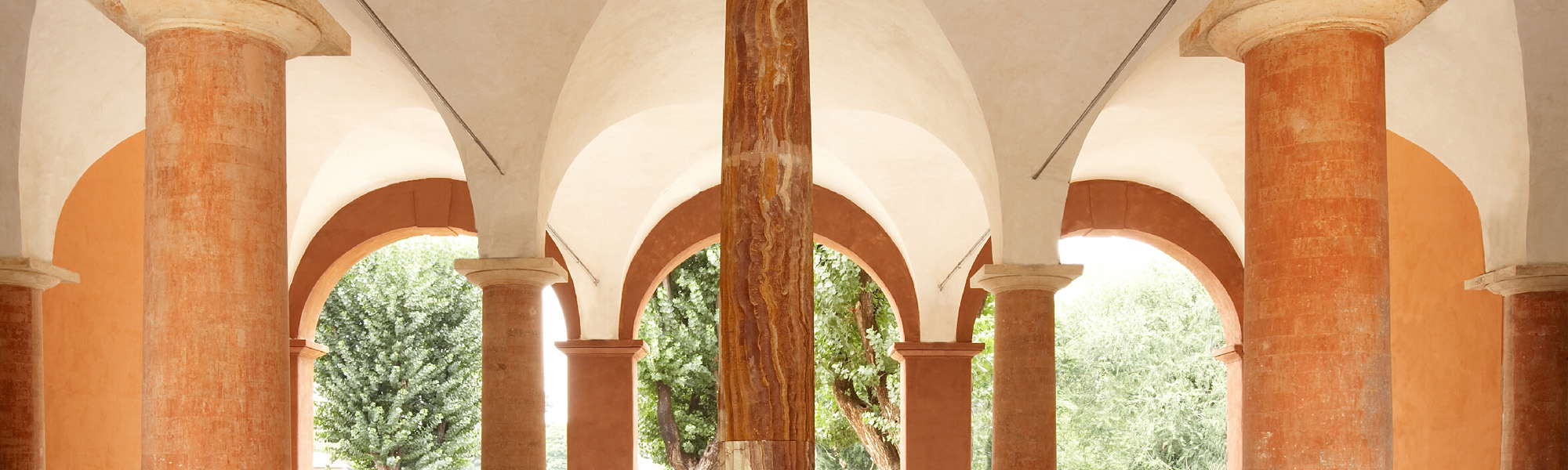
Sheltered beneath the building's portico is the Phoenix (Araba Fenice) by Luciano Fabro, one of the works from the contemporary art project Invito a..., symbolizing rebirth and transformation - a perfect image to convey the long and complex history of this site.
Keep exploring