
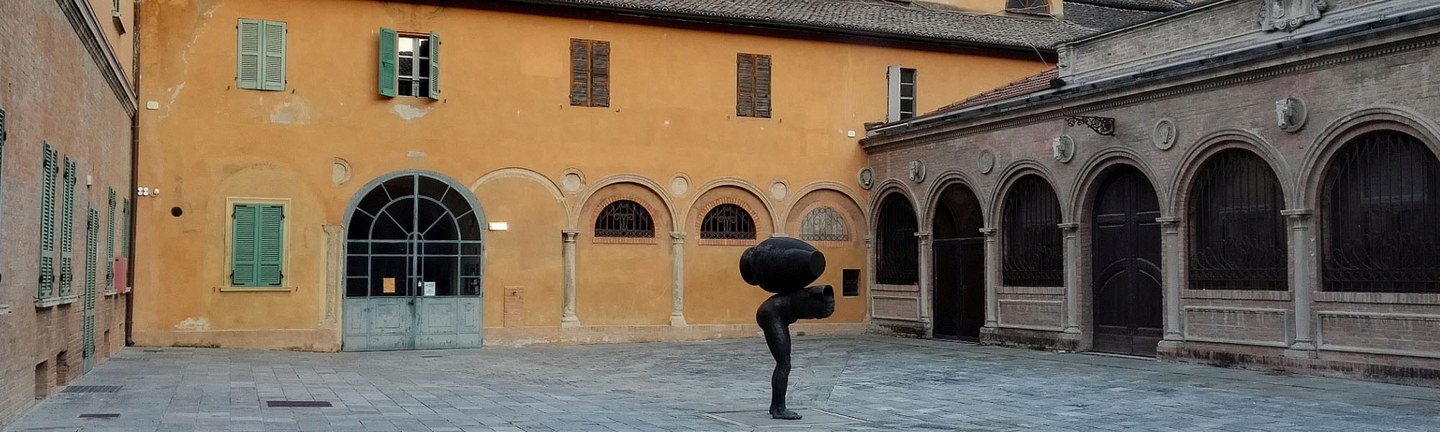
San Domenico Cloisters
Timetable
Large Cloister
Monday to Saturday
7:00 am - 8:00 pm
Special opening hours for exhibitions and events.
Small Cloister
Open for exhibitions or events.
Prices
Free admission to the Great Cloister.
Admission fees for the Small Cloister vary depending on the exhibitions and/or events taking place.
In the heart of Reggio Emilia, the former Convent of San Domenico, also known as ‘degli Stalloni’, holds centuries of history and collective memory.
It all began on 25 July 1233, when the citizens, inspired by the sermons of Fra Giacomino da Reggio, laid the foundations of a church and a Dominican convent, completed in just three years thanks to the enthusiasm of the community.
In the 15th century, based on a design by Girolamo Casotti, the church was enlarged and enriched with a library, a focal point for the city’s cultural life.
In 1509, the Tribunal of the Inquisition was established for the dioceses of Reggio and Parma, and some rooms overlooking Piazza San Domenico were converted into prisons.
In the 16th century, the convent expanded further with the construction of the Chiostro Grande.
However, in 1702, following the occupation of the city by the Franco-Spanish army, the complex was converted into a military hospital, accommodating up to eight hundred patients.
The severe damage sustained led, in 1723, to a major general restoration which provided the church with a vaulted ceiling, a deep choir and two large side chapels, built on the site of the ancient Chiostro dei Morti, which had been used as a cemetery since the 13th century.
During the Napoleonic period, the convent was converted into barracks, and in 1860 it became a stud farm, from which the nickname ‘degli Stalloni’ derives.
The extension works were completed in 1872 with the addition of the west wing, known as Castelnuovo.
At the end of the 20th century, a major restoration and functional rehabilitation project restored the Cloisters to their original identity, highlighting the various architectural phases and the many different uses they have served over the centuries.
Inside, the ancient structures of one of the two cloisters are still visible, whilst in the passageway between the courtyards there are two 17th-century lunettes with fragments of frescoes depicting Christ with a Dominican Saint and the Madonna with several Dominican nuns.
In 2005, as part of the contemporary art project ‘Invito a’, Robert Morris’s work ‘Less Than’, conceived specifically for the quiet and secluded Chiostro Piccolo, became a permanent feature of the complex, marking a new dialogue between the ancient and the contemporary.
Inside, the complex houses the Peri-Merulo Higher Institute of Musical Studies, the Archival Centre and the Historical Institute of the Resistance (Istoreco), creating a space where history, art and culture engage with the city.
Contacts
Via Dante Alighieri, 11 - 42121 Reggio Emilia


