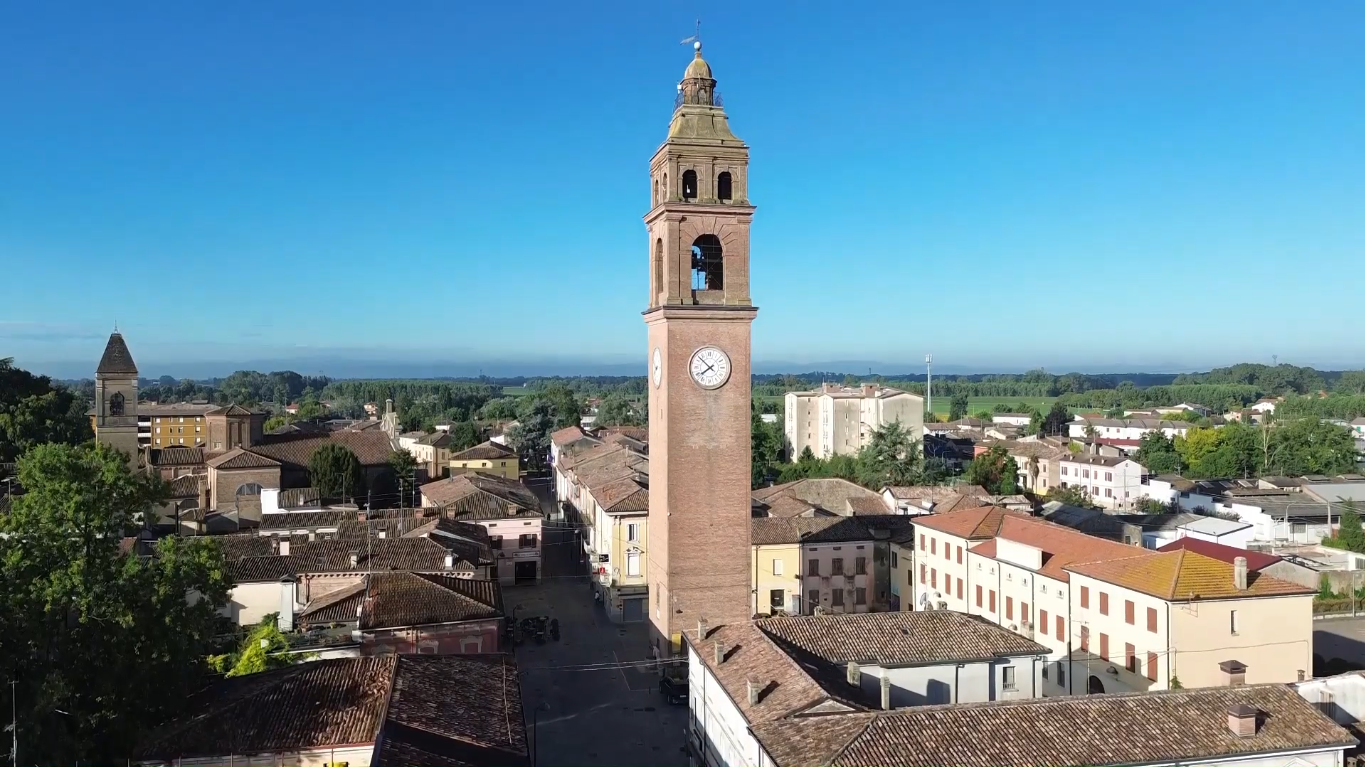
Luzzara offers a landscape typical of the Po Valley; it is located in the far north of the Province of Reggio Emilia, where the Bassa Reggiana merges with the Oltrepò Mantovano.
Luzzara is located on the northernmost border of the Province of Reggio Emilia, about 35 km from Reggio Emilia.
It is a charming village on the banks of the Po River, where nature and history blend harmoniously: wide floodplains, woods and cultivated fields alternate with a historic centre rich in history and traditions. Here you can enjoy the authentic atmosphere of the Bassa Reggiana (Province of Reggio Emilia Lowlands), taste local specialities such as Parmigiano Reggiano and Lambrusco, and discover a cultural heritage spanning from the Lombard era to the Gonzagas, right up to the events of the 20th century, recounted through the figure of the famous writer Cesare Zavattini.
Luzzara is a fascinating destination to explore in any season. Spring and summer offer the perfect opportunity to cycle along the floodplains of the Po, take pleasant walks in the open air and enjoy activities in the nature parks. On the second weekend of July, the village enlivens with the traditional July Festival, which fills the streets with musical performances and entertainment for young and old alike. Autumn and winter also offer evocative experiences, ideal for those who prefer a more peaceful form of tourism, exploring churches, museums and the authentic flavours of local cuisine in the restaurants of the town centre.
What to see
Historic centre with ancient arcades and the imposing Civic Tower, the tallest in the province.
Po floodplain (Golena del Po) natural scenery perfect for walks, birdwatching and river views.
San Giorgio Church a Baroque building with Romanesque features to discover.
Ex Cava Luccio and educational area Landscape restoration with footpaths surrounded by nature.
River Park a nature park in a wood of ancient oak trees, with picnic areas and trails of varying difficulty, ideal for families.
Main events
July Festival - second weekend of July A major event that brings the village to life with musical performances, entertainment and activities to suit all tastes.
Sport and outdoor activities
Cycling along the floodplain and the routes of the Lower Po Valley.
Walks through woods, along the banks of the Po and in green spaces.
River Park offers trails surrounded by nature with rest stops, picnic areas and relaxation spots.
You can also explore the area by mountain bike, on horseback or by canoe along the river.
A starting point for fascinating cycle routes linking the Bassa Reggiana to Emilia and Lombardy, towards historic towns such as Guastalla, Gualtieri, Suzzara and beyond to Lake Garda. Among the most picturesque routes are the ‘Tour of the Three Bridges’ and the route to the mouth of the Secchia. The ‘Terre di Po e dei Gonzaga in bici’ app is also available, featuring 9 routes for exploring the area by bike.
Local history
The town was founded during the Lombard period, following the Battle of Mantua in 604 AD. The name Luzzara appears for the first time in a document from 781, when Charlemagne took the Church of Reggio under his protection. In the following centuries, Luzzara was caught up in disputes between the Church and the Empire until it came under the control of the Gonzaga family in 1354. The town was fortified and became a small Renaissance centre, with squares, palaces and religious buildings arranged according to architectural designs from the 1400s. In the 18th century, there were bloody struggles for political and social independence, but under Maria Theresa of Austria and then Philip of Bourbon, the territory enjoyed stability and economic development. With the French Revolution and the Napoleonic era, new cemeteries and the metric system were introduced. After the return of the Austrians and its assignment to Marie Louise of Austria, Luzzara passed to the House of Este under Francesco V and finally, with the unification of Italy, became part of the Province of Reggio Emilia.
Curiosities
According to Father Ireneo Affò (historian and scholar), Luzzara owes its name to the abundance of pike in its waters. He states that in 604, after the Battle of Mantua, the Lombards settled where Guastalla now stands; finding an abundance of pike off the Luzzara island, they certainly named it “Lucciaia”, which later became “Luciaria” and then “Luzzara”.
According to Cluverius (a German historian and geographer), however, the name Luzzara derives from “Nuceria”, later “Nucera”, “Lucera” and “Luzzara”, an ancient Roman city destroyed during the barbarian invasions, whose ruins were covered by floods.
Famous people
Cesare Zavattini - master of Italian neorealism, born in Luzzara; his work depicted the people and landscapes of these lands, making the rural world and the fields of the Po River a universal symbol of Italian culture.
Altitude 22 m Postcode 42045 Weekly market Monday in Luzzara, Thursday in Villarotta Patron saint St George (Apri 23) Hamlets Casoni, Codisotto, Villarotta