
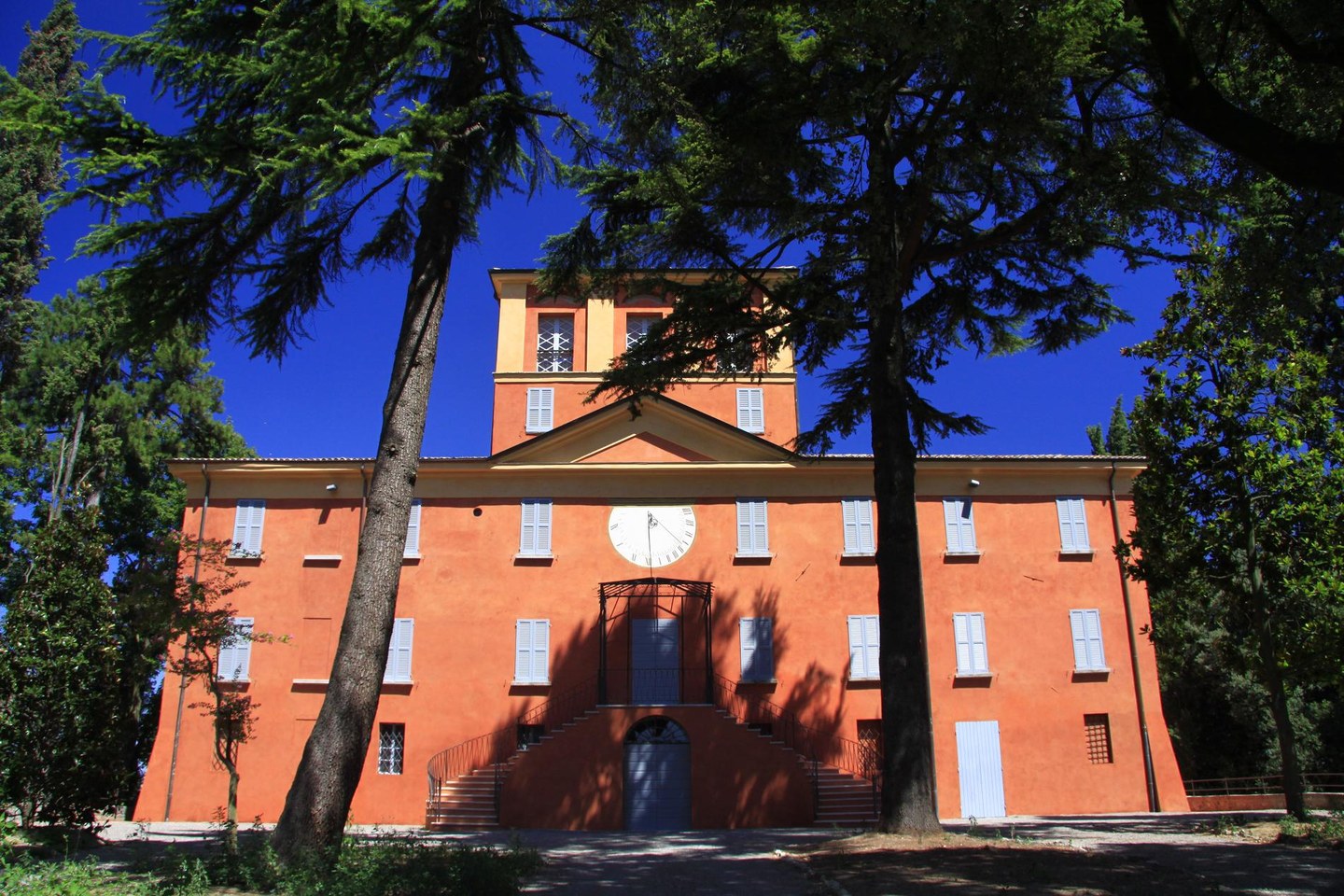
Villa Tarabini
Timetable
The villa can be visited by appointment; please contact us by telephone or email using the details provided in the Contact section.
To visit the Acetaia Comunale, please complete the relevant form and send it to the email addresses provided.
Requests must be received at least 7 days before the desired date to ensure the visit is properly organised.
Nestled in the heart of the Reggio Emilia hills, Villa Tarabini overlooks a panorama stretching from the high plains to the foothills, surrounded by a superb park that makes it one of the most charming historic residences in the area.
The villa is not only a 17th-century architectural gem, but today serves as a vibrant cultural centre, hosting events and open-air concerts.
Since 2010, it has also housed the Acetaia Comunale in its attic.
The history of Villa Tarabini reflects the rich social and cultural fabric of the area.
The main building, with its compact, rectangular layout and three storeys, was probably built between the 15th and 16th centuries.
In 1616, it passed to the Jesuit Fathers of Reggio Emilia, who acquired it on the hill known as ‘Colombarone’.
With the suppression of the order, the villa changed hands several times: from the Greppi family to the Bosisio family, from the Viganò family to the Tarabini family and numerous other owners, until it came into the possession of the Municipality of Albinea in 2010–2011.
Architecture
The building features elegant and harmonious elements, the result of renovation work carried out in the early decades of the 19th century, probably by the Marchelli architects, with a triangular pediment defining the centre of the façade and regular, symmetrical windows.
On the north terrace, an inscription dating from 1627 recalls ancient dates linked to the residence.
The roof is adorned with a raised belvedere, offering views of the entire park and the surrounding valley.
Completing the complex is a neo-Gothic oratory dedicated to St Francis Xavier, which dates back to 1840 in its present form, along with other outbuildings, including a former farmhouse and a greenhouse, which bear witness to the villa’s former agricultural and residential use.
Following restoration work between 2010 and 2011, Villa Tarabini and its park have become a cultural landmark for Albinea and the wider community: a place where history, nature and art come together, where visitors can stroll amongst centuries-old trees, enjoy open-air musical events and discover the traditional art of balsamic vinegar production at the Acetaia Comunale.
Contacts
Via Garibaldi, 17 - 42020 Albinea
Tel. +39 0522 590211 - Albinea Town Hall switchboard
+39 0522 590224 - Albinea Town Hall switchboard
protocollo@comune.albinea.re.it


About us
Where to find us
Opening hours
Press and TV enquiries
Leave us your feedback
