
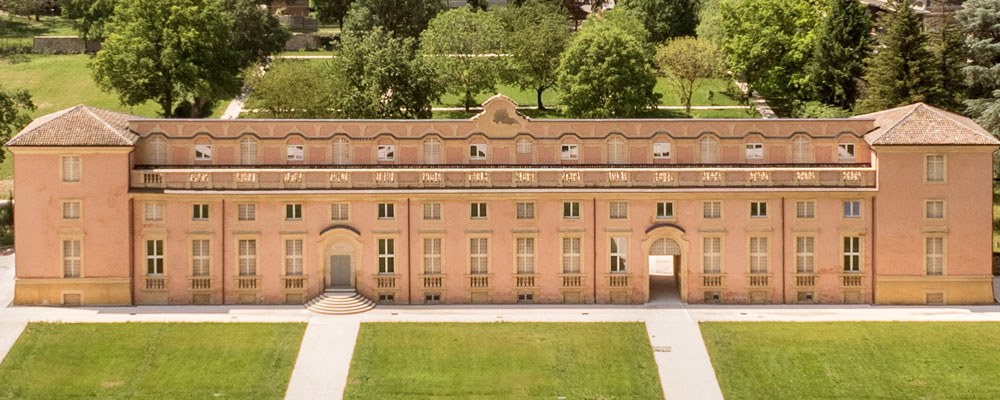
Palazzo Bentivoglio
In the heart of Gualtieri, overlooking the Po river, stands Palazzo Bentivoglio, a symbol of the city's history and cultural life.
The modern building incorporates what remains of the ancient medieval castle, built to control waterways and defend the fiefdom.
The two corner towers and the drawbridge arrow slits still preserve traces of the past today, while the main facade dominates the large square with majestic simplicity.
The castle, built on the right bank of the river, witnessed centuries of alternating rules: from the Este to the Da Correggio, from the Gonzaga to the Visconti, until returning to the Este and, in 1567, the granting of the Gualtieri fiefdom to Cornelio Bentivoglio, who radically transformed the town with the construction of the noble palace.
The architect Giovan Battista Aleotti, known as l'Argenta, completed the work under the guidance of Ippolito Bentivoglio, respecting the classical principles of the Renaissance: a large central courtyard with gardens, porticoes, and loggias connected the reception rooms and apartments, creating a harmonious synthesis of elegance and functionality.
In 1750, the palace was sold to the Municipality, to which it still belongs today.
In 1751, a large part of the palace was demolished to stem the floods of the Po river.
Nevertheless, the building remained a vital center for the city, housing public services, granaries, warehouses, and, in the left section, the Teatro Principe, built by Giovan Battista Fattori at the end of the eighteenth century.
In the twentieth century, the right wing was used as a school, and starting from the 1970s, a series of restorations allowed for the recovery of the entire complex.
Today, the palace houses the Documentary Museum, the Antonio Ligabue Museum Foundation, and the Umberto Tirelli Donation, and its most significant rooms can be visited: the Salone dei Giganti (Hall of Giants), the Sala dell'Eneide (Aeneid Room), the Sala di Giove (Jupiter Room), the Sala di Icaro (Icarus Room), and the private noble chapel.
The latter, adjacent to the Icarus room, treasures an octagonal fresco depicting the Assumption of the Virgin, while the stuccowork celebrates cherubs, scrolls, festoons, and little angels, bearing witness to the artistic wealth and refined elegance of the palace.
Visiting Palazzo Bentivoglio means journeying through centuries of history, from medieval defensive strategy to contemporary cultural life, immersing oneself in the architecture, art, and collective memory of Gualtieri.


About us
Where to find us
Opening hours
Press and TV enquiries
Leave us your feedback
