
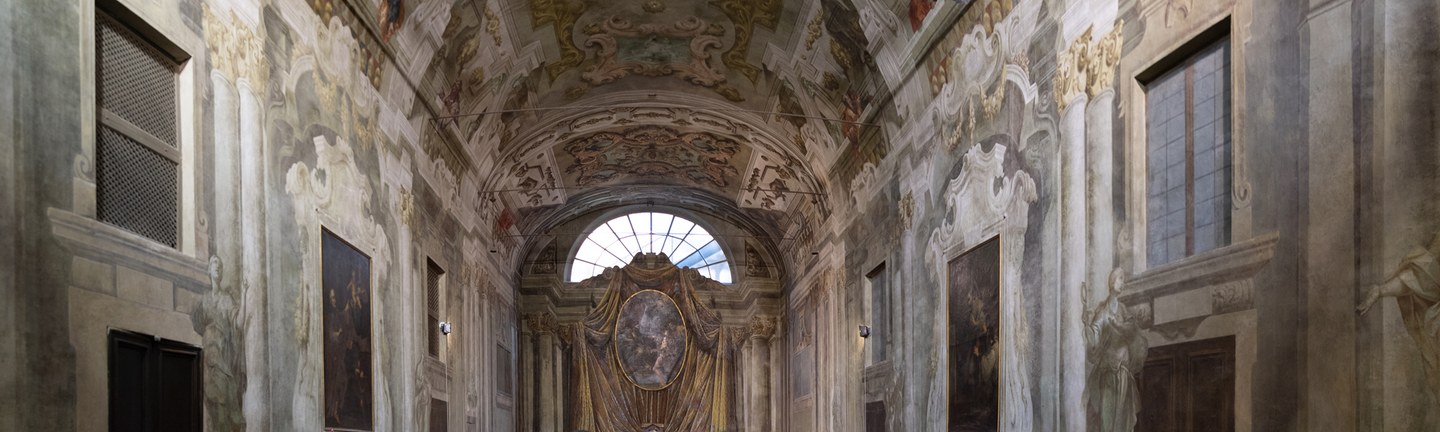
Oratory of San Spiridione
Timetable
The oratory is open during exhibitions or events.
Prices
Depending on the events and/or exhibitions scheduled.
In the heart of Reggio Emilia’s historic centre, tucked away amongst the city’s oldest streets, lies the Oratory of San Spiridione, a true 18th-century gem that remains something of a mystery to many locals.
Today it belongs to the Istituto San Vincenzo and opens its doors only for cultural events or special visits, offering visitors the chance to rediscover one of the most refined and hidden gems of Reggio Emilia’s Baroque heritage.
Its origins: a place of charity and devotion
The oratory stands in an area which, between the 17th and 18th centuries, was home to numerous monasteries, charitable institutions and works of charity.
In particular, this was the site of the Pio Luogo dei Mendicanti, a complex dedicated to sheltering the poor: the men’s section was situated on the north side of Corso Cairoli and Via Franchetti, the women’s section on the south side of the same streets.
The original building was most likely the oratory of the women’s section of the mendicants.
The present building was rebuilt in 1736 at the behest of Andrea Carabusi and frescoed shortly afterwards by the painter Francesco Vellani, one of the most prolific artists of Baroque Reggio, who also created decorations in Palazzo Gabbi, Palazzo Masdoni and the Church of Saints James and Philip.
In 1750, the Pio Luogo was merged with the Albergo dei Poveri and subsequently with the Orphanage, thereby taking on a new role: by the mid-18th century, San Spiridione had become the oratory for the city’s boys’ and girls’ orphanages.
Following the closure of the boys’ section ordered by Duke Francesco IV in 1838, the girls’ institute continued its work under the guidance of the Sisters of St Vincent, who were called to Reggio in 1840.
A Baroque masterpiece of illusions and symbols
The interior of the Oratory of San Spiridione is a striking Baroque theatre hall, where art and spirituality merge in an evocative play of perspectives.
The decorations by Francesco Vellani and the quadraturisti De Benedetti transform the space into a triumph of trompe-l’œil, optical illusions and perspective lines that guide the worshipper’s gaze towards the central vault, frescoed with a majestic Assumption of Mary.
On the walls, amidst painted colonnades and balustrades, the Apostles look out, whilst all around one can recognise the Allegories of the Virtues – Faith, Prudence, Charity, Providence, Justice and Fortitude – which complete the symbolic scheme of the oratory.
The high altar houses the most famous painting, The Alms of Saint Spyridon, framed by an illusionistic faux drapery; on the side altars, meanwhile, are Saint Andrew of Avellino and The Holy Family with Saint John the Baptist, also works by Vellani.


