Novellara Fortress
Timetable
Tuesday to Friday
10.00 am – 1.00 pm
Saturday and Sunday
10.00 am – 1.00 pm
3.00 pm – 7.00 pm
Summer closure
from July 13 to September 1, 2026
Prices
Full price
€ 4.00
Reduced price
€ 2.00
(young adults aged 18–25, university students, visitors on guided tours, seniors over 65)
Free admission
Novellara residents,
youth under 18,
visitors with disabilities and their companions,
ICOM members,
accredited journalists,
licensed tour guides,
visitors on the 1st Sunday of the month, and teachers accompanying school groups
The "Gagliarda Fortezza" of the Gonzaga
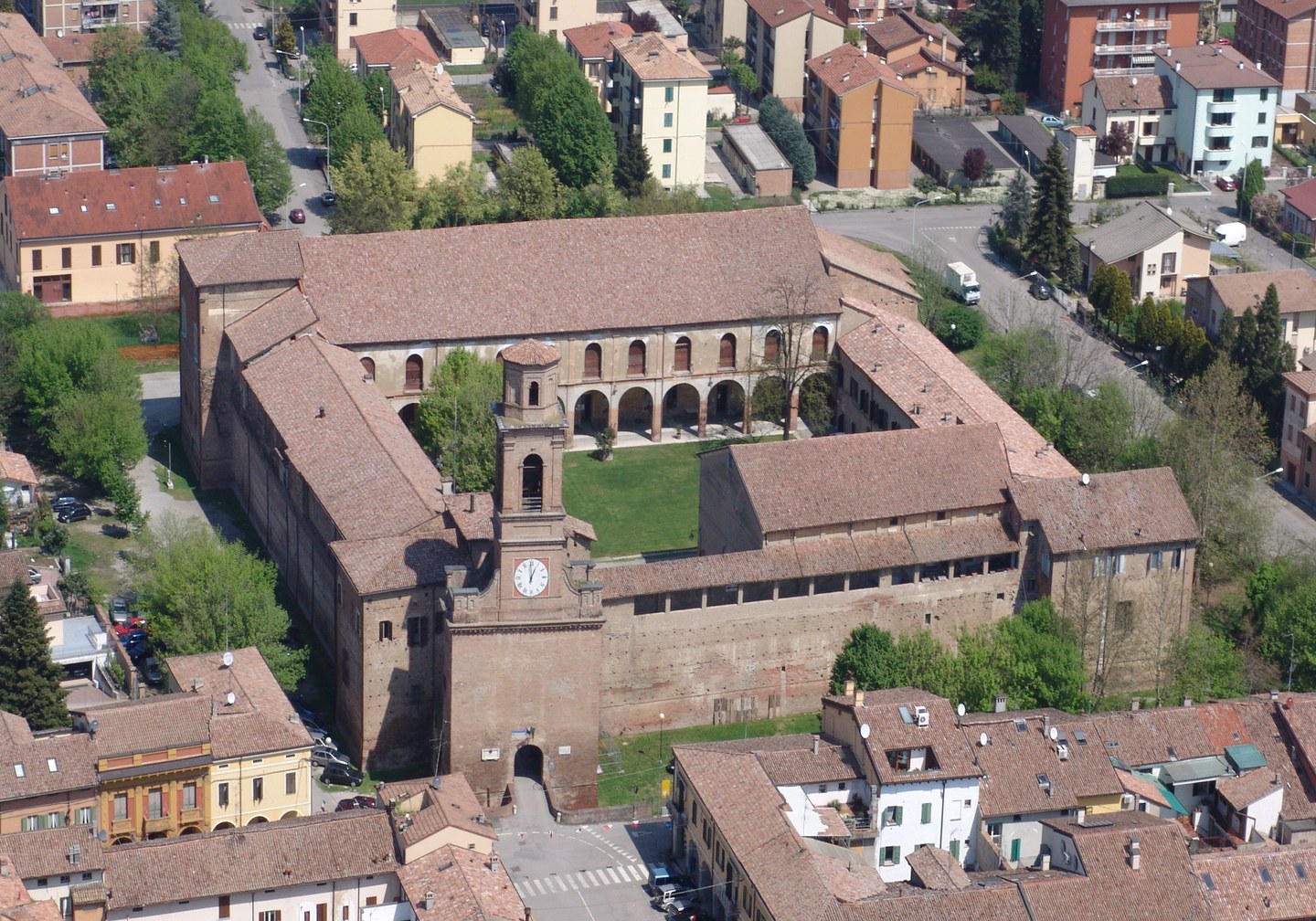
Described in 1520 as a "gagliarda fortezza" (vigorous fortress) by the celebrated historian and papal governor Francesco Guicciardini, the Rocca di Novellara is the town's most representative monument and one of the most fascinating testaments to Gonzaga rule in the Reggio plains.
Construction of the stronghold began in the late 14th century and concluded approximately a century later.
The fortress features a quadrangular layout with thick battlemented walls and four corner towers.
Originally, it was safeguarded by two drawbridges, one at the main entrance and a second on the opposite side facing a wide moat.
Defending the main gateway stood a ravelin (rivellino) equipped with machicolations, of which traces still remain.
Although partially damaged over the centuries, the corner towers retain visible signs of Ghibelline merlons, particularly on the western side.
From military fortress to Renaissance residence
Beginning in the first half of the 16th century, the Rocca underwent a profound transformation.
Costanza Gonzaga, wife of Alessandro, assumed the regency of the fiefdom and initiated a vast program of works starting in 1541.
This included land reclamation, the construction of the Casino di Sopra (known as Bell’Aria), and the addition of a new story to the fortress.
By the end of the 16th century, the building became the permanent seat of the seigniorial court, gradually losing its military function to assume the role of a stately representative residence.
Reflecting the Renaissance taste of the era, Alfonso I Gonzaga and his brother Camillo further embellished the complex with an additional floor and a loggia.
Frescoes by Lelio Orsi and refined interiors
Between 1561 and 1566, under the direction of the painter Lelio Orsi, the halls of the Rocca were decorated with extraordinary sophistication.
Featuring coffered ceilings, the rooms were embellished with paintings, statues, and monumental Verona marble fireplaces, transforming the residence into one of the most elegant in the region.
In 1670, works focused on the servants' quarters and the raising of the watchtower, today known as the Torre del Campanone, where the bell and clock were installed.
The keep (mastio), commissioned by Alfonso II Gonzaga, was partially utilized as a state prison.
Following the death in 1728 of Filippo Alfonso Gonzaga, the last direct heir, the fiefdom passed by marriage to the House of Este.
During this period, the prestigious Salone Gonzaga was created in the northwestern tower, featuring a coffered ceiling decorated with carvings and rosettes also designed by Lelio Orsi.
The Rocca today
With the extinction of the Gonzaga dynasty, the Este family sold the Rocca to the Community of Novellara in 1754.
Today, situated in the heart of the historic center, the building serves as the Town Hall and houses key cultural services.
nside, visitors can admire spaces of immense artistic value, such as the Sala del Fico, decorated with mid-16th-century grotesques, and the Sala del Consiglio, painted in the 19th century with striking theatrical flair.
Contacts
Piazzale Marconi, 1 - 42017 Novellara (RE)
Keep exploring