Montecchio Castle
Timetable
Currently closed to the public.
A Matildic bastion in the Enza Valley
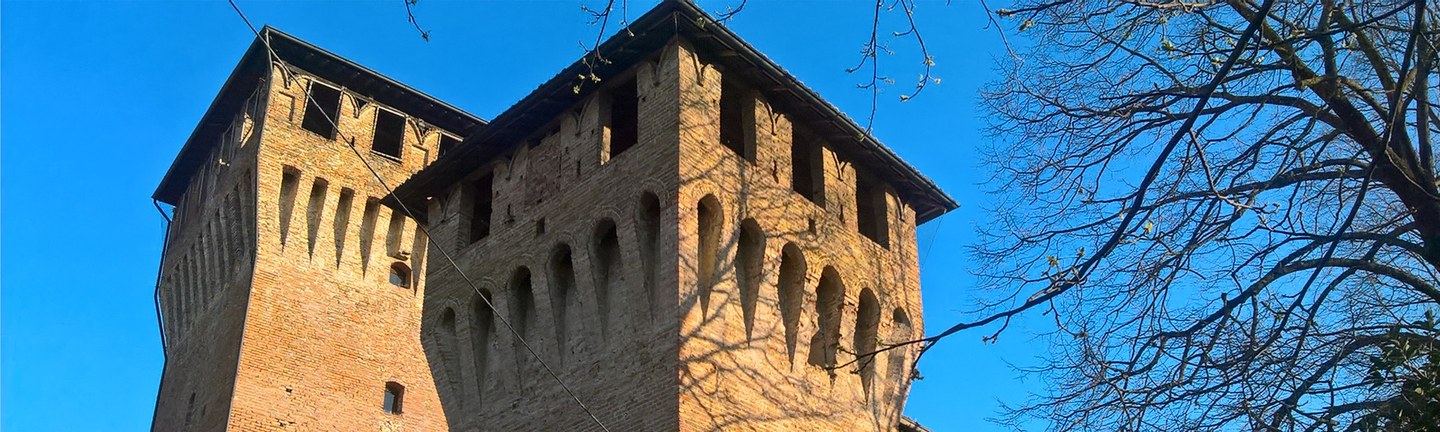
The Castle of Montecchio Emilia traces its origins to the era of Countess Matilda of Canossa: an autographed document dated 1114 confirms its existence beyond doubt.
Its original layout thus dates back to at least the 11th century, though the area was inhabited in even earlier times, as evidenced by numerous Early Middle Age finds, the remains of a burial ground, and Roman and Barbarian artifacts.
Its strategic position in the mid-valley of the Enza River made the castle a crucial watchtower and a primary defensive bastion in the pre-Appenine fortification network created by the Canossa family to control trade routes between the plains and the mountains.
Conflicts, sieges, and lordly domains
During the 13th century, the castle became the center of bitter disputes between the Bishops and the Commune of Parma.
Besieged and captured multiple times, it fell in 1296 under the attack of Azzo d’Este, and subsequently to Gilberto da Correggio.
A period of political instability followed, during which Montecchio passed under the control of various powerful families: the Visconti, Alberigo da Barbiano, Ottobono Terzi, and Muzio Attendolo Sforza.
From 1246 onward, the castle returned under the firm control of the House of Este, who turned it into a privileged fiefdom over the following century.
Between 1482 and 1486, it was occupied by Guido Torelli, who further reinforced the fortress (rocca).
Elevated to a marquisate in 1562, Montecchio shared the fortunes of the Este Duchy through the late 18th century and up until the Unification of Italy.
The Este residence and the "Estensi da Montecchio"
The castle’s current structure dates to the Late Middle Ages, with major building interventions continuing through the 16th century, most notably through the initiative of Prince Luigi d’Este, who established his residence here starting in 1638.
Following the death of Duke Alfonso II in 1598, Montecchio ensured the continuation of the dynasty through the cadet branch known as the "Estensi da Montecchio".
For a long period, the castle was managed by the Vicedomini (vicars), who exercised administrative duties first on behalf of the Bishops of Parma and later for the House of Este.
Structure and interior spaces
The Castle of Montecchio was once surrounded by a system of defensive moats, including the Fosse della Rocchetta, which ran along the entire perimeter of the fortification. These were filled in in 1649 by order of Prince Luigi d’Este.
Passing through the main gate leads into the Cortile della Rocchetta (Rocchetta Courtyard), originally open-air and later roofed after World War II to accommodate social activities.
A staircase, now reopened, connects the courtyard to the subterranean chambers.
Among the ground-floor rooms, the Sala del Bargello stands out: in the 17th century, it was reserved for the captain of the guards and the quarters above, before later being used by Prince Luigi d’Este himself.
The room once housed a fine artistic fireplace, now stored at the Civic Museums of Reggio Emilia, decorated with the coat of arms of the Visconti.
Today, the Castle of Montecchio Emilia remains one of the most significant testaments to the Matildic defensive network and the long Este presence in the Reggio territory.
Contacts
Via Alfonso d'Este, 5 - 42027 Montecchio Emilia (RE)
Keep exploring