Historical Museum of Parmigiano Reggiano and Rural Life in the Enza Valley
Montecchio Emilia
Museo Storico del Parmigiano Reggiano e della Civiltà Contadina della Val d'Enza
Founded in 1977, the museum is housed in a typical farmhouse that recounts rural life in centuries past, from the daily routines of the patriarchal family to the spaces dedicated to the production of the famous Parmigiano Reggiano.
The carts
Upon entering, you're immediately greeted by the impressive display of Reggio Emilia carts, true symbols of rural life. Each cart tells a story: the long, rectangular "bed," the sturdy frame, the massive wheels with shock-resistant spokes, and the front decorated with symbols celebrating the community's customs and traditions.
Some carts were intended for daily transportation, others, like the evocative "Bride's Cart," became the centerpiece of weddings, adorned with suns and flowers to bring fertility and prosperity.
Not just ceremonies: the cart was also indispensable on St. Martin's Day, traditionally dedicated to moving, a time of life and movement that combined work and popular rituals.
Environments and spaces
The stable
Continuing, we enter the beating heart of rural life: the stable.
On the right, the domestic spaces come to life before the visitor: the kitchen, the weaving room, the knitting corner, and the pantry recreate the daily atmosphere of times gone by.
A set table, a flour cabinet, and even the baby walker - known as the "scantador" - evoke the presence of children and family life.
In the center, the fireplace dominates the scene: a symbol of the domestic hearth, a place where people gathered to listen to stories and tales from their grandparents, the warm heart of the home.
There's also a reconstruction of the space under the stairs, used to store furniture and food containers.
On the left, the actual stable takes shape.
The "stalls" house the cows, with enough space to accommodate calves as well.
The milk room
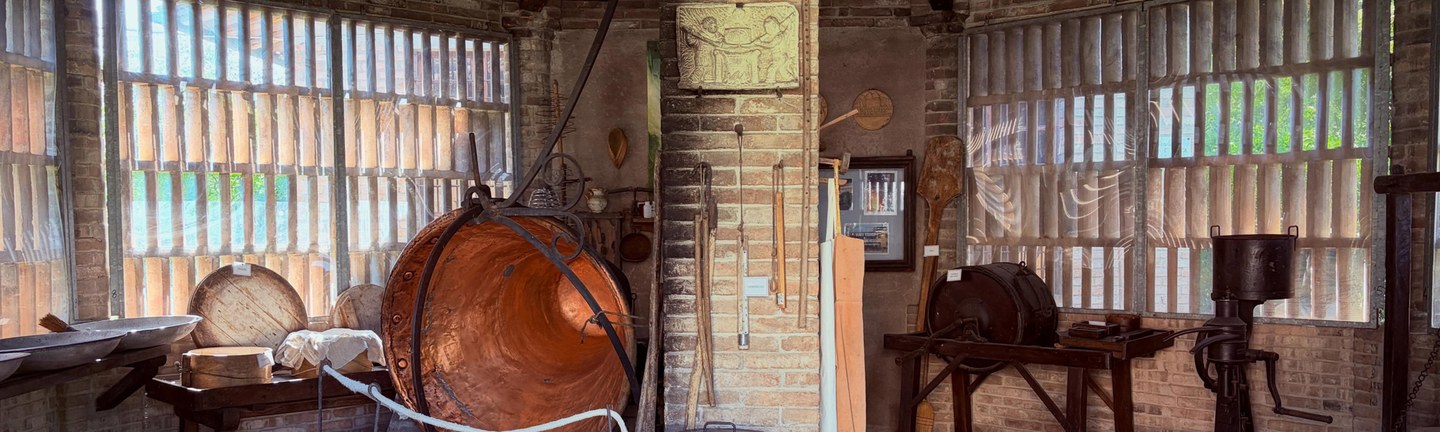
In the milk room, you can discover the tools of cheesemaking: churns, scales, double bottoms, and graters, essential tools for turning milk into Parmigiano-Reggiano.
The artisans who revolved around rural life, such as carpenters, blacksmiths, saddlers, and shoemakers, find their place here, demonstrating how cooperation between trades was essential for survival and rural work.
Artisans’ workspaces
Next to the milk room, the world of artisans who made rural life possible comes to life.
The carpenter and the blacksmith shared the same workshop: their skill and collaboration were essential for building and repairing essential tools, such as the wagon and its wheel, the heart of transportation and work in the fields.
But the rural world was also populated by other masters: the saddler, the shoemaker, the farrier, and even the knife grinder were essential figures, each with a specific role in ensuring the smooth functioning of the community.
Every tool built, every repair performed, speaks of the dedication and mastery of those who, with their hands, supported the life of entire villages.
Hay barn
Going up to the first floor, the space of the old hay barn opens up, located above the stable, where ancient tools used for working the fields and some household utensils are displayed.
The children's games, constructed with ingenuity and imagination, tell the story of the carefree lifestyle of a bygone era.
The cellar
The final section of the museum leads visitors into the cellar, a true treasure trove of the area's winemaking tradition.
Here, visitors can admire the ancient tools used to transform grapes into Lambrusco, the celebrated Emilian wine: from the mostadora, the traditional foot-press, to the fermentation vats, from the press that squeezes the must to the barrels for the initial aging, to the demijohns for final storage and the bottles ready for consumption.
Each object speaks to centuries of rural culture and passion for wine, the fruit of local vineyards cultivated with ancient grape varieties such as Grasparossa, Montericco, Uva d'oro, and Lancellotta.
Wandering among these tools immerses you in the history of Lambrusco, mentally savoring the aroma and taste of a wine that has accompanied the life and celebrations of the Enza Valley for generations.
Contacts
Via Copellini, 13 - 42027 Villa Aiola of Monetcchio Emilia (RE)
Keep exploring