
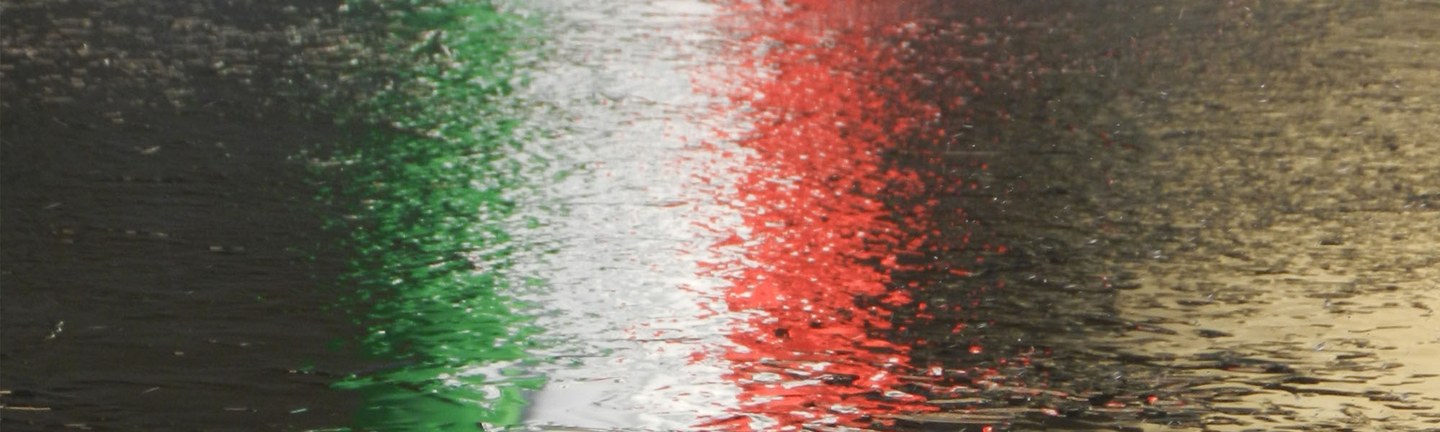
Tricolore's Itinerary
A journey through the places where the Italian flag was born
Transport methods
Reggio Emilia is the birthplace of the Italian Tricolour, the city where, in 1797, the flag that still unites Italians today was chosen for the very first time.
This itinerary takes visitors on a journey through the places, people, and ideals that transformed a small city of the Duchy of Este into the beating heart of Italy’s first national dream.
Itinerary Description
1. The Este Family and the Arts of the City
At the end of the 18th century, Reggio Emilia was part of the Duchy of Este, whose capital was Modena. Wars and economic crises had severely weakened the city, which had once prospered thanks to its thriving silk and wool industries.
It was Lucrezia Borgia who, during the 16th century, introduced the art of silk production, helping transform Reggio Emilia into a renowned manufacturing centre. Yet none of this would have been possible without the Canale Maestro, the waterway that powered spinning mills, dye works, and many of the city’s most important industries.
Evidence of this thriving industrial past can still be found in the buildings once occupied by the city’s ancient trade guilds:
Palazzo dei Mercanti del Panno, with its elegant ram-shaped capital;
Palazzo Busetti, an elegant 17th-century building inspired by Roman architectural models, built by a wealthy family of silk merchants.
These places tell the story of a city shaped by hard work, craftsmanship, and innovation—a community that has long thrived through its artistic talent and entrepreneurial spirit.
2. Winds of change
By the end of the 18th century, political discontent was growing in Reggio Emilia. In 1796, with the arrival of Napoleon’s troops, the Duke of Este fled Modena, and the people of Reggio embraced the new spirit of freedom and change.
A symbol of this transformative period is the Arco del Follo, built between 1797 and 1805 to a design by architect Domenico Marchelli in celebration of Napoleon’s passage through the city.
Its elegant neoclassical decorations—laurel garlands, festive swags, and two magnificent angels—capture the enthusiasm and optimism of an era when Reggio Emilia began to look towards the future with renewed hope.
3. The tree of Liberty
On 26 August 1796, the “Tree of Liberty” appeared in Reggio Emilia’s main square, symbolising the end of ducal rule and the birth of the Reggio Republic.
On the façades of the buildings, the Este eagle was replaced by the new civic emblem, still visible today on the building of the former girls’ orphanage (now the Istituto San Vincenzo).
It is the only surviving painted testimony of that founding moment, when Reggio Emilia became a free and republican city.
4. The Cispadane Republic
A few months later, between October and December 1796, Reggio Emilia and other cities in the region took part in the birth of the Cispadane Republic, the first unified political experiment of modern Italy.
During those days, an act of great symbolic value also took place in Reggio: the removal of the gates of the Jewish Ghetto, marking the beginning of the emancipation of the Jewish community.
he Ghetto, established in 1669 by order of Duchess Laura Martinozzi, occupied the area between Via dell’Aquila, Via Monzermone, Via Caggiati, Via della Volta, Via Gennari, and Via San Rocco.
With Napoleon’s arrival, those gates were opened forever—an enduring sign of freedom and equality that foreshadowed the values of the new century.
5. The birth of the italian flag: Tricolore
On 27 December 1796, the first parliament of the Cispadane Republic met in the Congress Hall of the Town Hall.
And on 7 January 1797, on the proposal of Giuseppe Compagnoni, the Tricolour was chosen as the official flag: green, white, and red, symbolising freedom and unity.
The colours had military origins:
White and red originated from the coat of arms of Milan;
Green it was the colour of the uniforms of the Milan Civic Guard.
That day marked the birth of the Italian flag, destined to become the symbol of an entire nation.
6. The forbidden flag
After the Congress of Vienna (1815), the Tricolour was banned, yet it continued to fly clandestinely as a symbol of freedom.
Art also preserved its memory: in the vault of the Teatro Municipale Valli, painter Domenico Pellizzi concealed a secret tribute to the national flag among the allegorical figures.
It is said that the fresco dedicated to Choreography, painted in shades of green, white, and red, was clearly visible from most of the theatre—except from the Duke of Este’s box, whose view was obscured by the large chandelier.
A small masterpiece of ingenuity and artistic courage, bearing witness to the Risorgimento spirit that animated Reggio Emilia.
7. The Revolutions of 1848 and the Rush Toward Unification
In 1848, the echo of the European revolutions reached Italy as well. Cities rose up, the Tricolour flags returned to wave, and Giuseppe Garibaldi passed through Reggio Emilia in 1859, welcomed by an enthusiastic crowd.
Under the Porta Santa Croce, restored just the year before, the people replaced the Este eagle with the Savoy cross, marking the beginning of a new historical era.
It was the dawn of the Risorgimento, and the dream of a united Italy was becoming reality.
8. The Story Continues… at the Tricolour Museum
The journey concludes at the Museo del Tricolore, located inside the Town Hall (Palazzo del Comune).
Here, the exhibition path tells the story of the birth of the Italian flag and the political events of Reggio Emilia, from 1796 through to the Risorgimento.
It includes a section dedicated to the Reggio Republic and a more recent one focused on contemporary times, enriched by the artistic project “Ninety Artists for a Flag”.
It is an emotional place where Italian history comes to life, and the Tricolour continues to express the values of freedom, unity, and national identity.


