
The Squares route - The living heart of Reggio Emilia
Piazza della Vittoria e Piazza Martiri del 7 Luglio
Transport methods
Itinerary Description
Piazza della Vittoria e Piazza Martiri del 7 Luglio
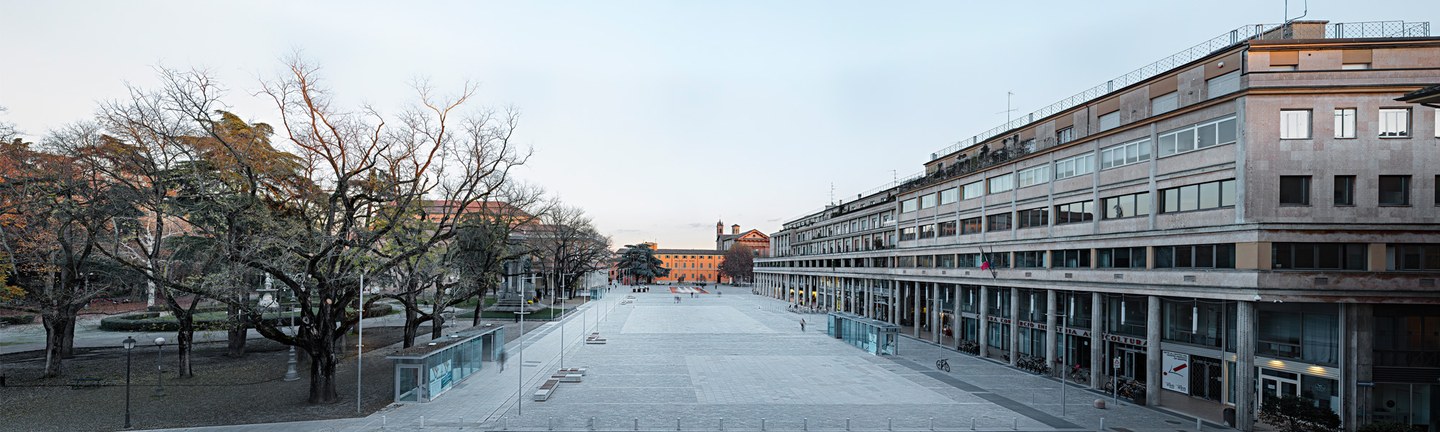
Our itinerary begins in the heart of the city, Piazza della Vittoria, which has recently been restored and is now a hub for socialising and everyday life.
Together with the adjacent Piazza Martiri del 7 Luglio, it forms a single, spacious urban square, surrounded by some of Reggio Emilia’s most iconic monuments: the Teatro Municipale Valli, an elegant symbol of musical culture; the Teatro Ariosto; the Palazzo dei Musei; the Galleria Parmeggiani; and the monuments dedicated to the Resistance and to those who fell in the First World War.
To the north lies the refreshing greenery of Parco del Popolo, an oasis in the heart of the city, where you can walk among statues and ancient trees.
On Tuesday and Friday mornings, part of the square comes alive with the colourful stalls of the city market.
Tip!
Inside Parco del Popolo stands the Monumento ai Concordi, a rare Roman funerary enclosure discovered in Boretto in 1929.
Stop for a few minutes to walk among the flowerbeds and let the statues intrigue you: hidden amongst them are some illustrious figures from Reggio Emilia’s history!
Piazza del Monte
Also known as Piazza Cesare Battisti, this square takes its name from the imposing Palazzo del Monte di Pietà, the earliest part of which dates back to 1188.
Until the 15th century, it was the seat of the ancient municipality of Reggio.
Towering over the square is the Torre del Monte, built in 1216 and once adorned with a famous mechanical clock featuring wooden figures - a masterpiece by the Raineri brothers, the same artists who created the clock of the Moors in St Mark’s Square in Venice.
On the north side stands Palazzo Busetti (1657), an elegant Baroque residence which, according to legend, was designed by Bernini; more likely, it is the work of the ducal architect Bartolomeo Avanzini.
On the east side, however, stands the ancient Palazzo del Capitano del Popolo (1280), now home to the historic Albergo Posta, restored in the 1920s in a refined neo-medieval style.
Tip!
Look out of a window on the first floor of Palazzo Busetti: from there, you can enjoy one of the most charming views of the historic centre!
Just a short walk away, don’t miss the famous Libreria all’Arco, three floors of culture and beauty in an elegant building overlooking the Via Emilia.
Piazza Prampolini
This is the main square of Reggio Emilia, the true institutional and spiritual heart of the city.
It is home to the Cathedral, the Baptistery, the Bishop’s Palace, the Canons’ Palace and the Town Hall.
Inside the latter is the historic Sala del Tricolore, where the Italian flag was born, and the adjoining Museo del Tricolore, an unmissable stop for understanding the origins of national identity.
In one corner of the square stands the statue of the Crostolo, the symbol of the city, which comes from the Reggia di Rivalta.
Tip!
From Piazza Prampolini, walk along Via Farini to the Panizzi Library and the Jesuit church of San Giorgio: inside the library, you can admire the vibrant contemporary fresco Whirls & Twirls by Sol LeWitt.
Piazza Casotti
For the people of Reggio Emilia of yesteryear, Piazza Casotti was the "piasëta di zavai", the scrap metal square, where a picturesque second-hand and antiques market was held until the 1980s.
The square, as we see it today, came into being in the early 20th century after the demolition of old buildings.
The municipal architect Sorgato then designed the 15th-century-style building with mullioned windows and a portico, which still lends the square its medieval charm today.
Historical curiosity
In medieval and Renaissance times, the town prisons stood on this site, where not only criminals but also insolvent citizens were imprisoned.
The executioner even lived opposite the prisons, ready to carry out the sentences.
Every 24 November, the feast day of Saint Prospero, a prisoner sentenced to death was pardoned and led in procession to the basilica of the patron saint: a moving ritual of mercy and hope.
Piazza San Prospero
Passing through the picturesque portico of the Broletto, you arrive in Piazza San Prospero, known to the people of Reggio as “Piasa cèca” (“little square”).
The spectacular opening of the Broletto, built in 1488 and decorated in the 18th century by Francesco Fontanesi, frames the view of the Basilica of San Prospero, a jewel of Renaissance and Baroque art dedicated to the city’s patron saint.
Its octagonal bell tower, designed by the Pacchioni brothers and approved by Giulio Romano, dominates the city skyline with elegance and grandeur.
Piazza Fontanesi
Continuing along Via Prevostura and then Via San Carlo, you’ll discover some hidden gems: the recently restored Oratory of Saints Charles and Agatha, and the Palazzo dei Mercanti del Panno, with its 15th-century terracotta portico, once the headquarters of the wool merchants’ guild.
The route finally opens out onto Piazza Fontanesi, a spacious, tree-lined square once bustling with craft activities that made use of the waters of the Canale del Guazzatoio for silk and leather processing.
Today, the square, dotted with shops and cafés, is one of the most popular spots among the people of Reggio and hosts the farmers’ market on Saturday mornings.
Piazza Roversi
Continuing along Via Ariosto, you reach Piazza Roversi, which the people of Reggio affectionately call “Piazza del Cristo” because of the 18th-century Church of Christ the King.
It is a quiet, harmonious spot where time seems to pass more slowly.
Piazza Gioberti
The tour ends in the elegant and picturesque Piazza Gioberti, overlooked by the Palazzo Ducale – now the headquarters of the Prefecture and the Provincial Administration – and the extraordinary Basilica della Ghiara, a masterpiece of 17th-century Emilian architecture.
The square, recently redeveloped as part of the Ducato Estense project, marks the start of the 18th-century promenade that led the Duke of Este to the Reggia di Rivalta.
In the centre stand an elliptical fountain inspired by the Este family’s water features and the obelisk erected in honour of the marriage between Princess Adelgonda of Bavaria and Prince Francesco V d’Este: a refined touch of history and romance.


