
From Via Emilia to the Ancient Course of the Crostolo
A journey through art, history and wonder in the heart of Reggio Emilia
Transport methods
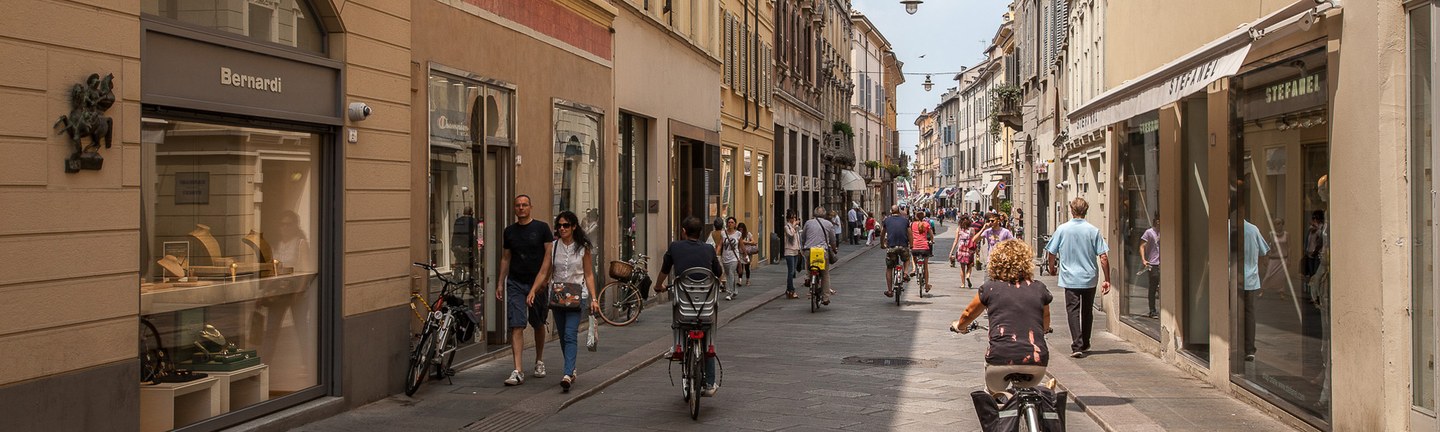
Walking along the Via Emilia Santo Stefano means taking a stroll through one of the most authentic chapters of Reggio Emilia’s history.
This itinerary – which winds its way past stately homes, ancient churches, hidden courtyards and traces of water – follows the ancient course of the Crostolo stream, which once flowed through the city, shaping its streets, atmosphere and destiny.
Itinerary Description
1. From Piazza del Monte to the charm of the historic buildings
The route starts from Piazza del Monte, heading along Via Emilia Santo Stefano towards Parma.
At number 3 stands Casa Venturi, now home to the All’Arco bookshop: it was here that the physicist and mathematician Giambattista Venturi kept his collection of paintings between the 18th and 19th centuries, a testament to a scientific and artistic curiosity that transcended the boundaries of knowledge.
A little further on, at number 6, Casa Camellini still houses the delicate tempera paintings by the young Antonio Fontanesi, who was destined to become one of the great figures of European landscape painting.
Opposite, at number 5, the austere building now housing the National Insurance Institute was built in the late 18th century and renovated in the 19th century by Domenico Marchelli, the architect who left a profound mark on Reggio Emilia’s neoclassical aesthetic.
2. The ancient Jewish synagogue
A short detour down Via dell’Aquila leads to number 3, where the recently restored Jewish synagogue stands.
Designed in 1857 by Pietro Marchelli, it is one of the city’s finest examples of Neoclassical architecture.
Today, quiet and intimate, it bears witness to centuries of history and the Jewish presence within Reggio Emilia’s cultural fabric.
3. Piazza Gioberti and l’Aristocrazia ducale
Returning to the Via Emilia, you reach Piazza Gioberti, graced by the 1843 obelisk dedicated to Adelgonda of Bavaria, wife of Duke Francesco V d’Este.
A symbol of devotion and power that recalls the splendour of a court now in decline.
4. The ancient route of the Crostolo and the Basilica della Ghiara
From here, the wide expanse of Corso Garibaldi opens out; once the bed of the Crostolo stream, it was later filled in and transformed into one of the city’s most elegant thoroughfares.
It was here, on 29 April 1596, before an image of the Virgin Mary, that the miracle of Marchino took place: the young deaf-mute who regained his speech.
The event, hailed as a divine sign, led to the construction of the Basilica of the Blessed Virgin of the Ghiara, one of Italy’s most famous Marian shrines and a treasure trove of art and devotion.
The street, once known as ‘della Ghiara’ due to the gravelly ground left by the stream, soon became the lively heart of city life: here, palios and quintanas were held, processions paraded, and festivals and spectacular displays were staged.
A tradition that still lives on today in the Fiera della Giarèda, held during the first week of September.
5. The palaces of power and art
Opposite the Basilica, construction began in 1784 on the Palazzo del Governatore (now the headquarters of the Prefecture and the Province). Opposite the Basilica, construction began in 1784 on the Governor’s Palace (now the headquarters of the Prefecture and the Province).
Its grandeur reflects the political and administrative role that Reggio was coming to play.
A little further on, at number 29, stands Palazzo Magnani, a venue for major exhibitions and the city’s cultural centre.
The residence, which once belonged to the Becchi family and later to the musicologist Luigi Magnani, holds centuries-old memories: the two-faced il Giano carved on the corner with Via Vicedomini, dated 1576, seems to evoke the transition between the ancient and the modern, just like the city that houses it.
6. Hidden squares and masters of art
Continuing along Via Vicedomini and Via Fiordibelli, you reach Piazza San Lorenzo, a little hidden gem.
Here stands Palazzo Calcagni, a fine example of 16th-century architecture with a beautiful terracotta cornice decorated with ovules and dentils.
A little further on, on the corner with Via San Pietro Martire, stands the house of the architect Antonio Casotti, who designed it himself in the 15th century, decorating it with frescoes by Nicolò dell’Abate.
From here, you reach the small square of San Giovanni, dominated by the church of San Giovannino, with its unfinished façade but an interior rich in Baroque art: illusionist frescoes by Tommaso Sandrini and Lorenzo Franchi, the magnificent canvases by Alessandro Tiarini, and the terracotta ‘Mortorio di Cristo’ from the workshop of Guido Mazzoni.
A veritable treasure trove of faith and talent.
7. Architectural masterpieces and 19th-century atmosphere
Heading back towards Corso Garibaldi via Via Guido da Castello, we come across Casa Paglia (no. 21), built by the famous set designer Giovanni Paglia in the early 19th century: it is recognisable by its balcony with Ionic columns, which almost looks like a small urban stage.
A little further on, Casa Rossi (no. 25) retains the typical medieval ‘collo’, an architectural feature that bears witness to the structure of 14th-century dwellings in Reggio Emilia.
Returning to Corso Garibaldi, on the corner with Via Farini, stands Palazzo Panciroli Trivelli, known as the “Palazzo dell’Imperatore” because it hosted Napoleon Bonaparte during a visit to the city.
Inside, plays on perspective and spectacular courtyards reflect the theatrical taste of an era that loved to impress.
8. Piazza del Cristo and the Church of San Giorgio
The route finally leads to one of Reggio’s most charming squares, Piazza Roversi, also known as Piazza del Cristo, dominated by the Oratory of Christ, designed in 1761 by Giambattista Cattani.
Its facade, crowned by three statues, overlooks the imposing and austere Palazzo Rangoni, built in the Mannerist style, with elegant harmony.
A detour along Via Bardi leads to the Church of Sant’Agostino, where you can admire one of Guercino’s three paintings in Reggio.
Returning to Via Farini, the itinerary concludes with a visit to the Church of San Giorgio, construction of which began in 1638 and which is recognisable by its splendid Baroque dome designed by Alfonso Torregiani.
Opposite stands the Panizzi Municipal Library, once a Jesuit convent, now the beating heart of the city’s cultural life.
Tips for your visit
Duration: about 2 hours and 30 minutes on foot.
Ideal for: lovers of art, history and Baroque architecture.
Recommended time of year: in spring and autumn, when Corso Garibaldi comes alive with events and markets.
Don’t miss:the dome of San Giorgio at sunset and the interior of San Giovannino, true masterpieces of light and colour.


