
Discovering Luzzara: A Historical and Artistic Itinerary
A fascinating journey through the splendour of the Gonzaga family, the pride of the Civic Tower and the neo-realist legacy of Cesare Zavattini.
Transport methods
Welcome to Luzzara, a borderland where the history of the Gonzaga family is inextricably intertwined with 20th-century culture. Famous throughout the world as the birthplace of the brilliant Cesare Zavattini, who brought the legendary American photographer Paul Strand here to document village life in the celebrated book *Un Paese*. This itinerary will guide you from the heart of the historic centre, home to theatres and princely palaces, to the countryside of the hamlet of Maso, where botanical and historical gems of rare beauty lie hidden.
1.The National Museum of Naïve Art
"Cesare Zavattini”
The journey begins against the picturesque backdrop of the 15th-century Convento degli Agostiniani, situated next to the Chiesa dell'Annunziata. This building, whose history is linked to the first lord of Luzzara, Rodolfo Gonzaga, has been converted by the local council into an exhibition space. It is here that Italy’s first and only Museo Nazionale delle Arti Naïves was established, the result of the National Prize conceived by Zavattini himself in 1967.
2. Il Teatro Sociale, un gioiello ottocentesco
Just a short walk away lies the Teatro di Luzzara, a small miracle born of local determination. Constructed around 1813 from an old rustic building that had been used as a granary, it was transformed into a proper theatre and opened in 1852 with Vincenzo Bellini’s opera *I Capuleti ed i Montecchi*. It could seat up to 400 people in its 47 boxes divided into three tiers. Its showpiece? A magnificent hand-painted curtain depicting the Luzzara Fair in the presence of the Gonzaga Princes.
3. Palazzo della Macina and the splendour of the Gonzaga family
As you arrive in the main square, your gaze falls upon the Palazzo della Macina, the ancient palace of the Gonzaga lords of Luzzara. Built towards the end of the 15th century to a design by the famous architect Luca Fancelli, in its heyday it occupied almost the entire square and was adorned with splendid frescoes. Unfortunately, the terrible battle of 15 August 1702 destroyed much of the building.
Interesting fact: the name ‘Macina’ derives from the tax on grain that used to be collected here in the past. The Gonzaga coat of arms, made of coloured porcelain and depicting the symbol of fertility, still stands out above the main door.
4. The Torre Civica and the symbol of the Luccio.
Rising 55 metres above the village skyline is the Torre Civica, the most striking symbol of the pride of the community of Luzzara. Keen to have a very tall bell tower, the villagers began building it in 1724 using materials from the old fortifications and the demolished fortress, funding the work through public collections of fodder, wine and money. In 1780, a large cross featuring a pike—the village’s emblem, which seems to watch over the plain—was placed atop the dome.
5. Villa Paralupi in Maso, nobility and botany
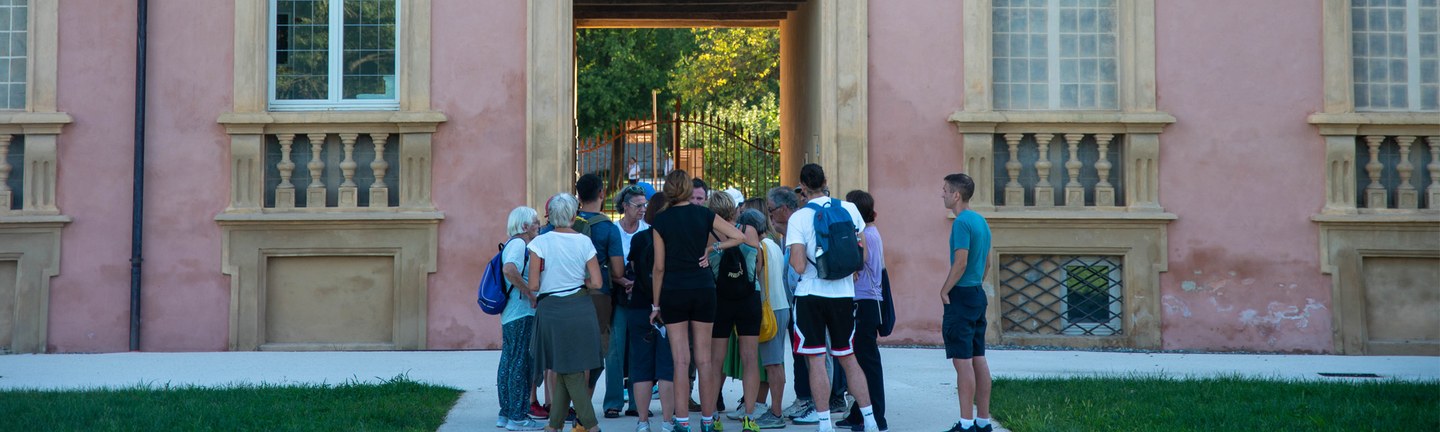
Leaving the historic centre and heading towards the village of Maso, the route ends in front of the magnificent Villa Paralupi. This extraordinary fortified rural estate (curtense) was one of the most famous and beloved residences of the Gonzaga family. Having passed through the hands of various owners over the centuries, it retains the atmosphere of the nobility of yesteryear thanks to its private chapel and, above all, its splendid garden. The latter is a treasure trove of immense botanical value, home to centuries-old trees and rare specimens of extraordinary beauty.


