
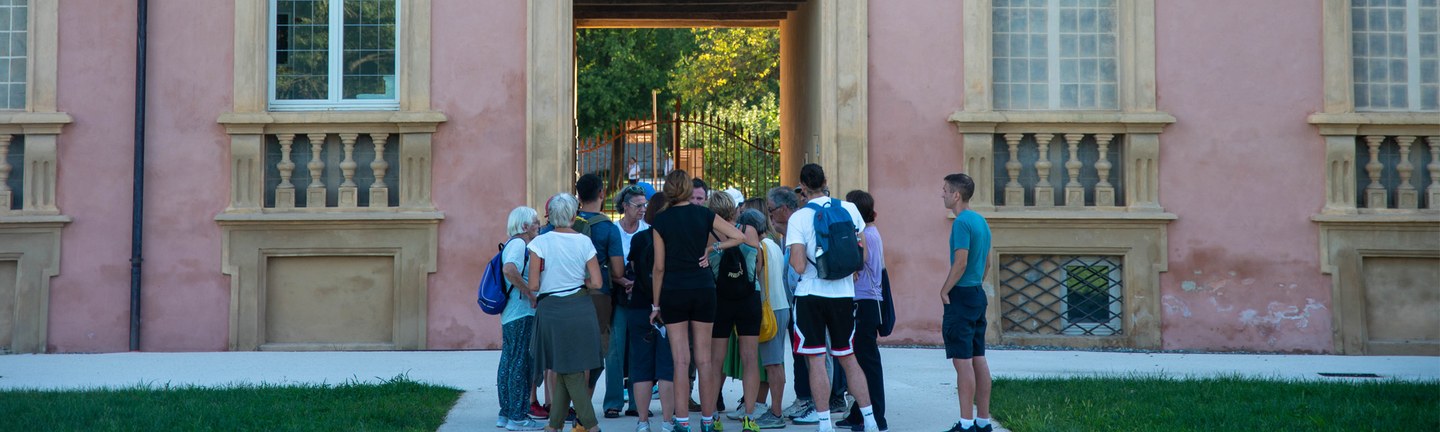
An itinerary through the hamlets of Scandiano: among castles, ancient parish churches and rolling hills.
If you’ve been captivated by Scandiano’s historic centre, its surrounding countryside is sure to surprise you. This itinerary will take you on a journey of discovery through the hillside and lowland hamlets: a route past ancient castles, watermills, historic courtyards and scenic trails that reveal the most authentic and natural side of the Scandiano area.
1.Arceto – The plain castle and its church
The journey begins in Arceto, a hamlet steeped in history whose name first appears in records dating back to 833. At the heart of the village stands the majestic Castello, built by the Bishops of Reggio in the 10th century. Having weathered periods of sacking and reconstruction, it now welcomes visitors with a monumental staircase magnificently decorated with frescoes and adorned with 18th-century statues. A curiosity in the courtyard: look out for the historic ice house! A short walk away is the Chiesa di Arceto (15th century); step inside to admire the fine 17th-century paintings, among which the Assumption and the Dead Christ stand out.
2. Chiozza – The Poncino Mill and the Charm of the “Tomba”
We now move on to Chiozza, where water is the true protagonist of local history. Here you can admire the Mulino del Poncino, a quadrangular stone structure that remained in operation until the 1970s and harnessed water power through large vertical wheels. After a stop at the 17th-century Chiesa di San Giacomo Maggiore , don’t miss the ‘La Tomba’ complex: a splendid 18th-century enclosed courtyard, a perfect example of rural Po Valley architecture, completed by a charming oratory facing the road.”
3. Iano – Medieval Towers and Neo-Medieval Atmospheres
Heading up towards the hamlet of Iano, the landscape becomes increasingly hilly. The Church of the Assumption of the Virgin welcomes visitors with its elegant gabled façade.
Exploring the surroundings, you will come across an 19th-century roadside shrine, two historic 16th-century tower houses, and the old Iano Mill, once powered by the Tresinaro stream.
A View Not to Be Missed: Looking up towards the hills, you will see the silhouette of Castello Dondena Bagnoli. This fascinating 19th-century structure, visible only from the outside, is a perfect example of the neo-medieval style that was popular in that period.
4. Ventoso – The Twin Castles and the Ancient Kiln
We arrive in Ventoso, a hilltop hamlet full of medieval charm. Here you will find not one but two fortifications:
Castello della Torricella: built after 1335 by the Da Fogliano family, Castello della Torricella can be admired from the outside.
It still preserves traces of its drawbridge, arrow slits, and a striking tower crowned with elegant swallow-tailed battlements.Castello del Gesso: not far away, immersed in nature, lie the evocative ruins of this fortress, which takes its name from the mineral abundant in the area.
After visiting the Church of Santa Maria Assunta, with its stone rose window, follow the ancient path to discover the industrial archaeology of the Fornace: a 19th-century complex once used for the production of gypsum and lime, where a large brick chimney still stands today like a rural monument.
5. Il Monte delle Tre Croci (Monte Calvario)
The itinerary concludes at one of the most scenic and spiritual landmarks in the area: Monte delle Tre Croci (349 metres above sea level).
The three large crosses that dominate the summit, symbols of the Redemption, were already the destination of Easter pilgrimages and processions before the 17th century.
From the top, visitors can enjoy breathtaking 360-degree views over the hills of Scandiano and the Reggio Emilia plain. It is the perfect place to relax, take in the landscape, and enjoy a memorable sunset.


