
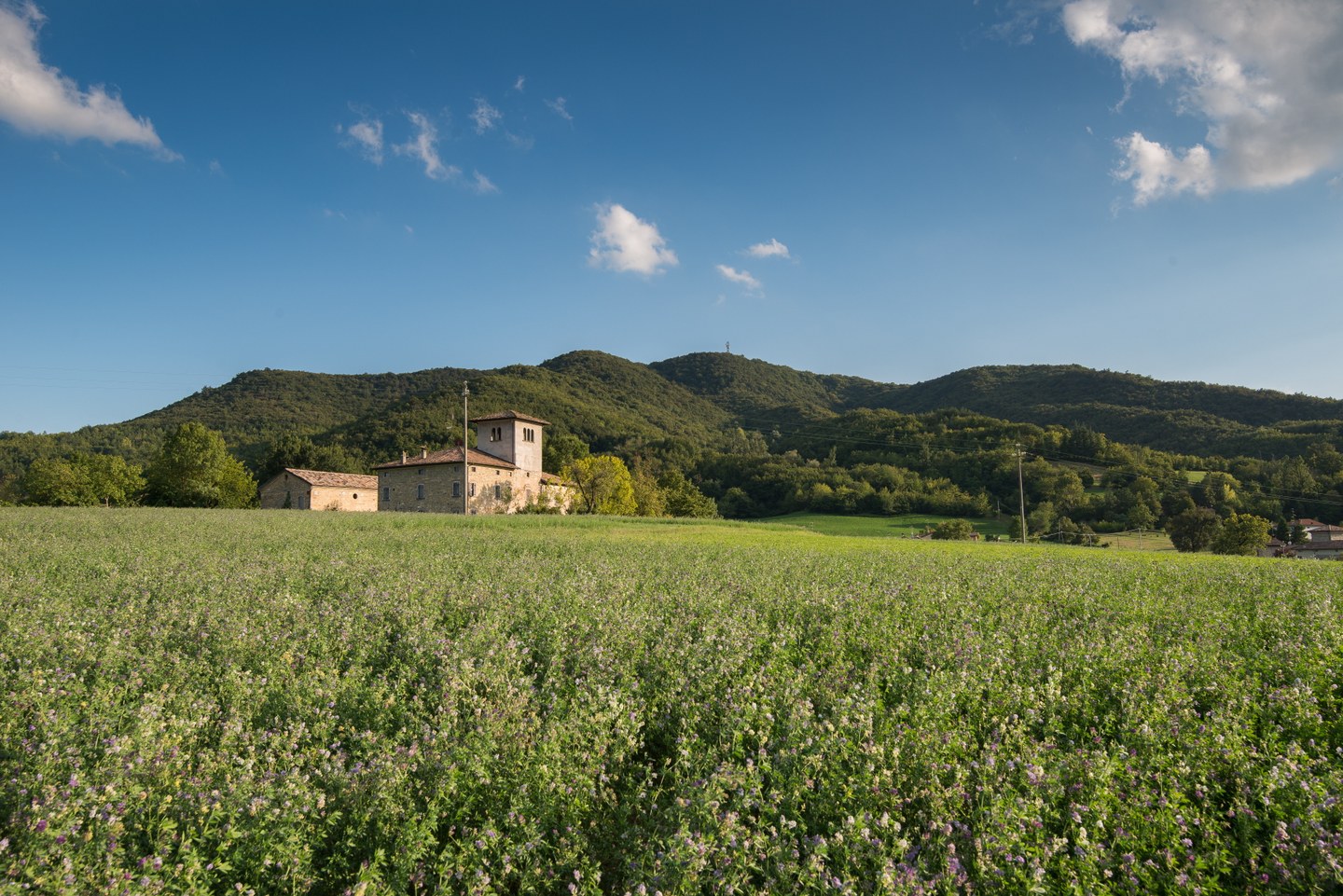
A line of demarcation, a natural boundary that separates the great plain from the soaring peaks of the Apennines.
The foothill and hillside belt just south of Reggio Emilia is an area of striking beauty and profound allure. It is a landscape dotted with hilltop castles—proud guardians of the valleys behind them, their gaze forever fixed upon the immensity of the plains. Here, the first forests and rolling hills offer a sanctuary from the bustle below, making you feel as though you have stepped into another world.
This itinerary winds along the entire foothill ridge from Castellarano to San Polo d’Enza, weaving through sweeping vineyards, medieval fortresses, natural parks, and lush green woods.
Our journey begins in Castellarano, a historic riverside village nestled along the Secchia River. Here, you can catch sight of the 15th-century Rocchetta, the Castle, and the iconic Clock Tower. Before leaving the historic center, a visit to the Romanesque parish church of Santa Maria Assunta is highly recommended.
From our starting point, the route glides along the Secchia cycle path to the locality of Veggia, where we turn left. Following Via Statutaria, we reach the village of Casalgrande Alto. A short detour here allows you to admire (externally) the Castle of Casalgrande Alto, the very first of the foothill fortresses. With its characteristic entrance tower, this stronghold once guarded the plain below and the river's entrance into the lowlands, working in tandem with neighboring Modenese castles like Montegibbio on the opposite riverbank.
Continuing along Via Statutaria, we pass south of Scandiano. At the roundabout between San Ruffino and Ventoso, a detour leads to the Monte delle Tre Croci —an exceptional panoramic terrace offering views that stretch across the entire plain, reaching as far as Bologna and the Oltrepò Mantovano.
Proceeding further, we cross the Tresinaro stream at Ca’ de’ Caroli and arrive at the Lazzaro Spallanzani Astronomical Observatory, a beloved provincial hub for amateur stargazing and educational astronomy.
Passing Borzano, we enter the municipality of Albinea, an elegant enclave nestled in the lower hills. For generations, it has been a favored retreat for locals seeking cool relief from the summer heat. While they are now private residences and can only be viewed from the outside, the Castle of Albinea and the Castle of Montericco still dominate the landscape.
Over the centuries, the aristocratic families of Reggio built magnificent summer estates here, creating a rich tapestry of history and culture:
Villa Moratti
Villa Tarabini Viganò, which houses the municipal Acetaia (traditional balsamic vinegar cellar).
Villa Calvi
Villa Arnò, which hosts renowned jazz festivals every July.
Villa Sidoli-Rossi, a keeper of secrets from Italy’s Unification (Risorgimento) and World War II, when Allied paratroopers launched a daring raid against the German command stationed inside the building.
From Albinea, we veer south along the Crostolo valley until we reach Vezzano sul Crostolo, the province's first entirely hilly municipality. The area boasts a dense network of trails and nature reserves, such as the Vezzano Ecopark and the Matildic Park of Montalto. This area is also traversed by the Via Matildica del Volto Santo, a historic pilgrimage route connecting Mantua, Reggio Emilia, and Lucca across the Apennines, following in the footsteps of the great Countess Matilda of Tuscany.
Climbing up the Costa di Montecavolo, sweeping hillside vistas unfold before us as we reach the village of the same name. Continuing onward, we arrive in Roncolo di Quattro Castella, where the ascent toward the Provincial Parkbegins. This state-owned reserve thrives with endemic biodiversity, characterized by deciduous woods of black hornbeam, turkey oak, maple, and walnut, and populated by birds of prey, ungulates, and wild rodents.
From the park, we reach Monte Airone and descend via a trail to the main road below. As we push forward, the striking calanchi come into view on the right—dramatic clay badlands sculpted by rainwater erosion.
In the distance stands the Castle and Oasis of Bianello. The castle, which can be visited by ticket, boasts baroque-style halls built over a structure dating back to the Matildic era. Every July 24th, to mark the anniversary of the Great Countess’s death, the castle is illuminated in brilliant red, making it visible even from the A1 highway miles away.
Directly below the fortress lies the LIPU Bianello Oasis, established in 1981 as a pristine example of the lower Emilian Apennine environment. It is home to over 130 bird species and a lush, native understory. The oasis offers guided tours by reservation and features a Visitor Center in the hamlet of Monticelli.
Turning right onto Via Ermete Conti, we pass the Rifugio Matildico, a dedicated wildlife rescue and environmental education center.
Following Via Conti, the landscape flattens as we return to the valley. A left turn onto Via Belvedere brings us into San Polo d’Enza, the final destination of our itinerary. Here, the ancient 11th-century fortress (Rocca) and the Museum of the Resistance are well worth a visit. The entrance to the town is uniquely evocative, preserving the structure of the ancient fortified village.
Our journey concludes in front of the San Polo railway station. From here, the FER Reggio-Ciano regional train offers a scenic, 40-minute ride back to the provincial capital.


