
Bridges
by Santiago Calatrava
Timetable
The work can be viewed every day, with no time restrictions.
The Bridges by Santiago Calatrava are among the most iconic symbols of contemporary Reggio Emilia.
True architectures in motion, they are not merely infrastructure but works of art to be crossed and observed, capable of uniting engineering, aesthetics, and urban vision.
Designed by the renowned Spanish architect and engineer Santiago Calatrava, the three bridges mark the city’s northern gateway and accompany residents and visitors through a unique visual experience, where structure merges with form and art engages in dialogue with science.
The bridges are part of a major redevelopment and expansion project for the northern area of Reggio Emilia, launched alongside the construction of the high-speed railway line and the decision to make the city the only high-speed stop between Milan and Bologna.
In 2002, the Municipality of Reggio Emilia commissioned Santiago Calatrava to design an urban-scale intervention capable of combining the functional needs of the area with strong architectural quality.
This led to the creation of an integrated system of infrastructures that includes:
the Mediopadana high-speed railway station
the canopy of the new motorway tollgate
the three bridges along the new road axis connecting the city to the lower Po Valley area.
Today, Reggio Emilia is the only European city to host a complex of three bridges designed by Calatrava, which have become a true hallmark of the region. Built over five years, the works were conceived as symbols of mobility and openness—values long associated with a land devoted to exchange and encounter.
At night, their appeal is further enhanced by a sustainable lighting system powered by renewable energy and designed to minimize energy dispersion.
South Bridge
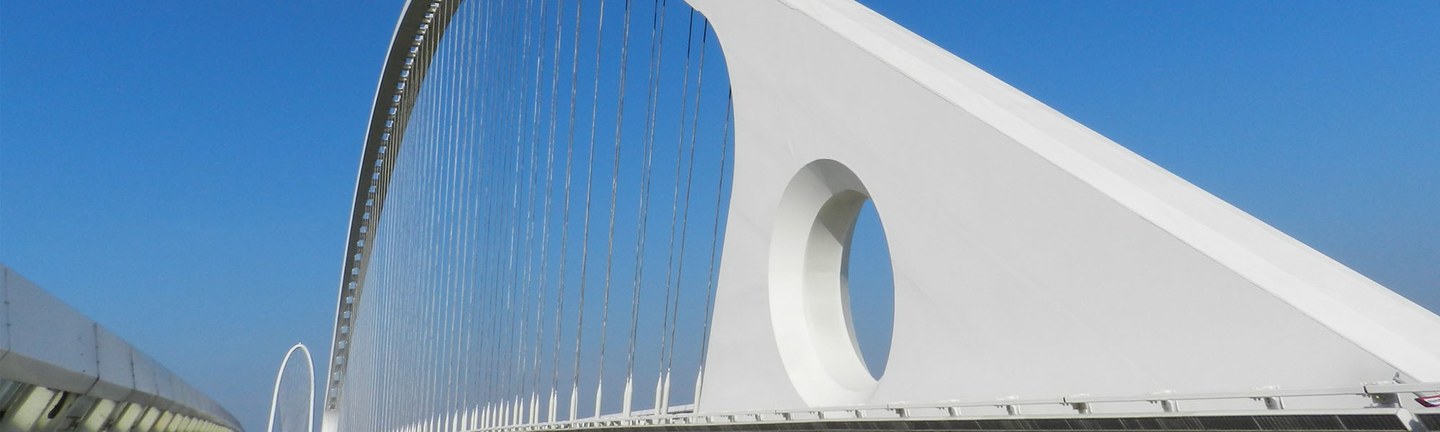
The South Bridge is located along the new ring road connecting the city to the suburb of Bagnolo, near the motorway junction. It is a white steel cable-stayed bridge, 179 meters long and 15 meters wide, recognizable by its 70-meter-high arch pylon set perpendicular to the roadway.
The steel cables trace an elegant and unusual shape, similar to a hyperbolic branch, making the bridge a true urban sculpture.
Central Bridge
Continuing north, one encounters the Central Bridge, the most imposing and visually striking. It spans the A1 motorway and the high-speed railway line and serves as the key element of the entire system.
Measuring 221 meters in length and 50 meters in height, it is characterized by a large longitudinal arch and a white steel structure supported by a central “spine.”
The bridge accommodates two lanes in each direction, a central median, and protected glass-sided pedestrian and cycle paths, also offering a slower, panoramic crossing experience.
North Bridge and the new tollgate
The sequence concludes with the North Bridge, architecturally similar to the South Bridge.
Together with the new motorway tollgate - also designed by Calatrava - it forms a spectacular gateway to the city.
The tollgate structure, with its inclined pylons, steel, and glass, creates a scenic composition designed to impress those arriving in Reggio Emilia from the motorway, offering a powerful first image of the city.
Over the centuries, Reggio Emilia has entrusted its image to great symbolic works: from Renaissance and Baroque basilicas to the Reggia of Rivalta, from the Municipal Theatre to the Reggiane workshops.
Today, this role is played by Calatrava’s bridges - architectural landmarks that express the city’s vocation for renewal and its forward-looking spirit.
As Calatrava himself has explained, these works were created not only to be functional but to mark the territory, engage with the landscape of the Po Valley, and establish a visual and symbolic connection with the urban history of Reggio Emilia.
Contacts
Viale dei Trattati di Roma - 42124 Reggio Emilia


