Romolo Valli Municipal Theatre
Timetable
The theatre can only be visited on scheduled guided tours.
Alternatively, you may contact the Foundation directly by emailing visiteguidate@iteatri.re.it
Prices
Ticket prices vary depending on the scheduled performance or event.
The beating heart of Reggio Emilia’s cultural life, the Romolo Valli Municipal Theatre is one of Italy’s most important Italian-style theatres.
Monumental, elegant and steeped in history, it has been the city’s iconic venue for the performing arts for over a century and a half.
Historical Background
On the night of 21–22 April 1851, a devastating fire destroyed the Teatro di Cittadella, then the city’s main theatre.
The sudden loss of this gathering place prompted the people of Reggio Emilia to respond with extraordinary determination, immediately setting about designing a new, grand theatre capable of meeting the city’s artistic and social needs.
The reconstruction and the birth of the new theatre
The project was entrusted to the Modena-based architect Cesare Costa, and work began with surprising speed, involving numerous local craftsmen and professionals, some of whom came from other cities.
Funding for the project – which was of exceptional scale for a town with fewer than 30,000 inhabitants – was made possible by new municipal taxes, a municipal loan and the sale of boxes, purchased not only by the aristocracy but also by a vibrant middle class of professionals.
The construction of the theatre had a profound impact on the urban landscape: existing buildings were demolished to make way for the new structure and to recover building materials.
The undertaking was so significant that it also introduced major technical innovations, such as gas lighting, for which a gasometer was built; although constructed for the theatre, it actually came to serve the whole city.
Architecture and spaces
The Romolo Valli Theatre follows the classical model of the Italian-style theatre, divided into three main areas: the entrance hall and foyer, the stalls and boxes, and the stage.
The south-facing neoclassical façade is characterised by a stately Doric portico with twelve columns, surmounted by panoramic terraces.
Twenty monumental statues adorn the loggia, evoking the themes of education and entertainment.
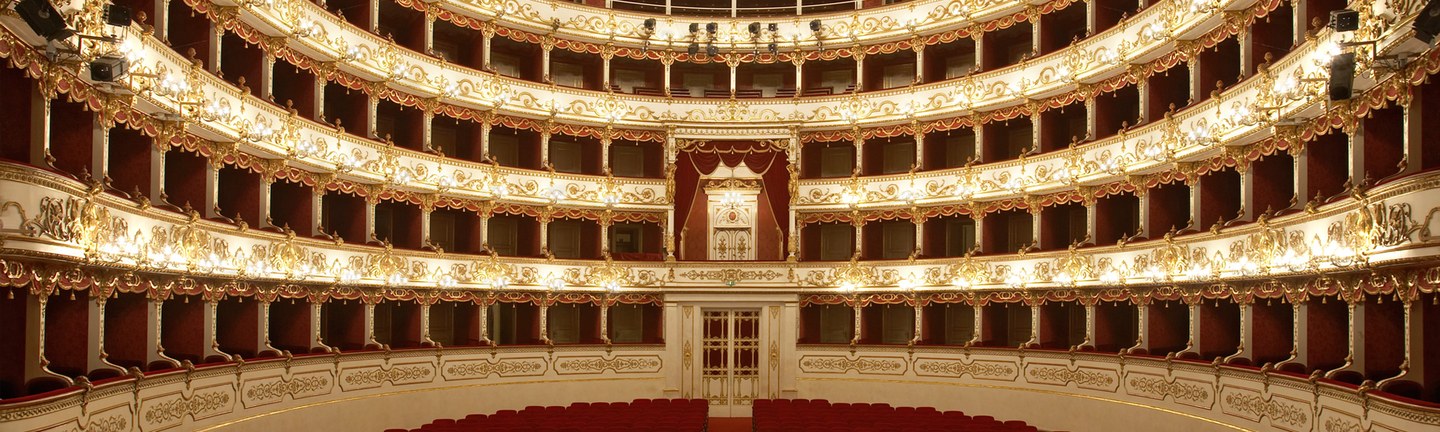
Inside, the horseshoe-shaped auditorium houses 106 boxes spread across four tiers and a tiered gallery, providing a total of around 1,150 seats.
At the centre of the second tier lies the historic ducal box, which later became the royal box and is now reserved for dignitaries.
Behind each box are the characteristic backstage areas, once private salons in their own right, some of which are still decorated with original frescoes.
The Decorations
The auditorium’s vaulted ceiling is embellished with eight medallions painted by Domenico Pellizzi, dedicated to the glories of Italian theatre: Melodrama, Tragedy, Comedy and Choreography.
All the decorative surfaces – from the box balustrades to the gallery – are embellished with pure gold, lending the auditorium a spectacularly magnificent appearance.
The monumental historic curtain, created by Alfonso Chierici, depicts the Genius of the Italian Fine Arts inviting the audience to draw inspiration from the glories of their nation’s history, and is one of the theatre’s most beloved symbols.
Much of the decoration was supervised and executed by Girolamo Magnani, renowned for his work at the Teatro Regio in Parma.
The opening and recent history
The theatre was inaugurated on 21 April 1857 with the opera Vittor Pisanidi by Achille Peri, marking the beginning of a long tradition of musical excellence.
Since then, the Romolo Valli has hosted some of the most significant moments in Italian musical history, including the famous debut of Luciano Pavarotti, who sang La Bohème here in 1961.
In 1980, in memory of the great actor from Reggio Emilia, the theatre took on its current name: the Romolo Valli Municipal Theatre.
Now, visiting the theatre means immersing oneself in a world of history, art and music, walking amongst the gilded frescoes, soaking up the elegance of the boxes and imagining the echo of the voices that have brought this extraordinary auditorium to life over the centuries.
Contacts
Piazza Martiri del VII luglio, 7 - 42121 Reggio Emilia
- +39 0522 458811 - Reception
- +39 0522 458854 - I Teatri Ticket Office
- +39 0522 458938 - Media Library Archive