Asioli Theatre
Correggio
Timetable
The theatre is usually open to the public exclusively during scheduled performances or events.
Prices
Ticket prices vary depending on the scheduled performance or event.
The Bonifazio Asioli Theatre is a historic gem spanning the Renaissance and the 19th century.
Historical Background & Origins
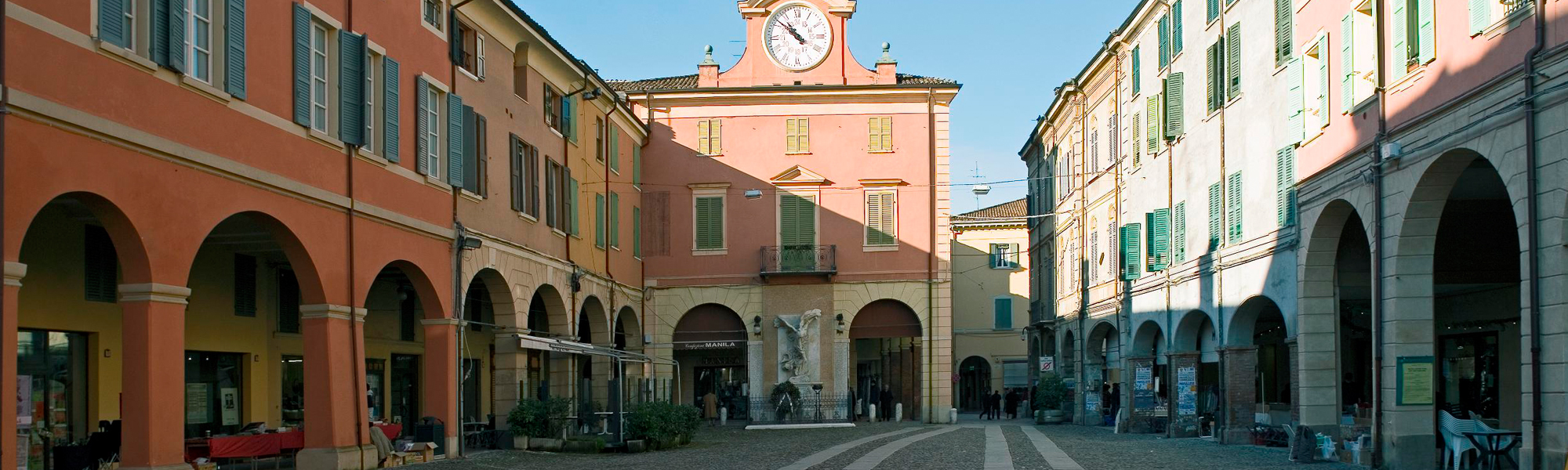
The Teatro Bonifazio Asioli stands in the historic center of Correggio, on the very site where, at the end of the 15th century, Niccolò "Postumo" da Correggio built his palace, which was later transformed into a theatrical space in 1661.
Since the Renaissance, Correggio has been a vibrant cultural hub animated by prominent figures such as Veronica Gambara.
In this refined environment that was highly open to the arts, the theatre quickly became a fundamental point of reference for the city.
From Renaissance Court to Public Theatre
Following the devolution of the Correggio State to the Duke of Modena and Reggio in 1635, theatrical activity not only continued but expanded, increasingly involving the local citizenship.
In May 1661, in the presence of Duke Alfonso d’Este, the first official performance was held in a theatre featuring 95 boxes, marking a milestone in the cultural history of Correggio.
Renovations, Fires, and Rebirths
Over the centuries, the theatre was renovated and expanded multiple times.
Between 1750 and 1754, it was remodeled by Francesco Cipriano Forti, who rebuilt the ceiling and boxes and added new spaces, including a cloakroom, a coffee shop, and a ballroom.
For over a century, the theatre hosted comedies, farces, opere buffe, musical dramas, and dance performances, heavily drawing on the talent of local musicians most notably members of the Asioli family: Quirino, Bonifazio, and Luigi.
By the mid-19th century, the building had become old and unsafe.
It was demolished and rebuilt by Francesco Forti (grandson of Francesco Cipriano) with its characteristic horseshoe-shaped pit (platea).
The facade, designed by engineer Antonio Tegani, was completed in 1873.
Dedicated in 1880 to the composer Bonifazio Asioli - a leading figure in the musical tradition of Correggio - the theatre suffered two devastating fires, first in 1889 and again in 1909.
Reconstruction began in 1890 under the direction of municipal engineer Giuseppe Aimi, and in 1898 the theatre was solemnly inaugurated with Puccini's La Bohème.
During World War II, starting in 1942, the theater was used as a cinema.
In 1962, the Municipality launched a major recovery project to restore the Teatro Asioli to its original function.
The works, concluded in 1973, brought back the 19th-century elegance of the auditorium.
Closed once again for safety upgrades and later damaged by the 1886 earthquake, the theatre was completely restored and reopened to the public in 2002, becoming once again one of the premier venues for plays, concerts, and prose in Emilia-Romagna.
Architecture and spaces
The exterior facade features eight marble columns donated by the Municipality of Modena and is embellished with four marble medallions crafted by sculptor Eusebio Casalgrandi.
These depict Bonifazio Asioli, Claudio Merulo, Nicolò da Correggio, and Samuele Jesi.
Inside, the octagonal foyer leads to the vestibule, where two plaques commemorate the musicians Claudio Merulo and Bonifazio Asioli.
A staircase leads to the elegant foyer (ridotto), a central hall decorated with frescoes by A. Capretti and F. Forti.
This area features a false balcony that illuminates the second hall, preserving the most visible remnants of Niccolò Postumo’s ancient palace.
Here lies the prestigious Sala Grande (Grand Hall), approximately 23 meters long, decorated with a refined falso fresco frieze.
Other fragments of the same cycle depict knights, mythical beasts, and the coats of arms of noble families tied to the da Correggio court, using imagery rich in Este symbolism.
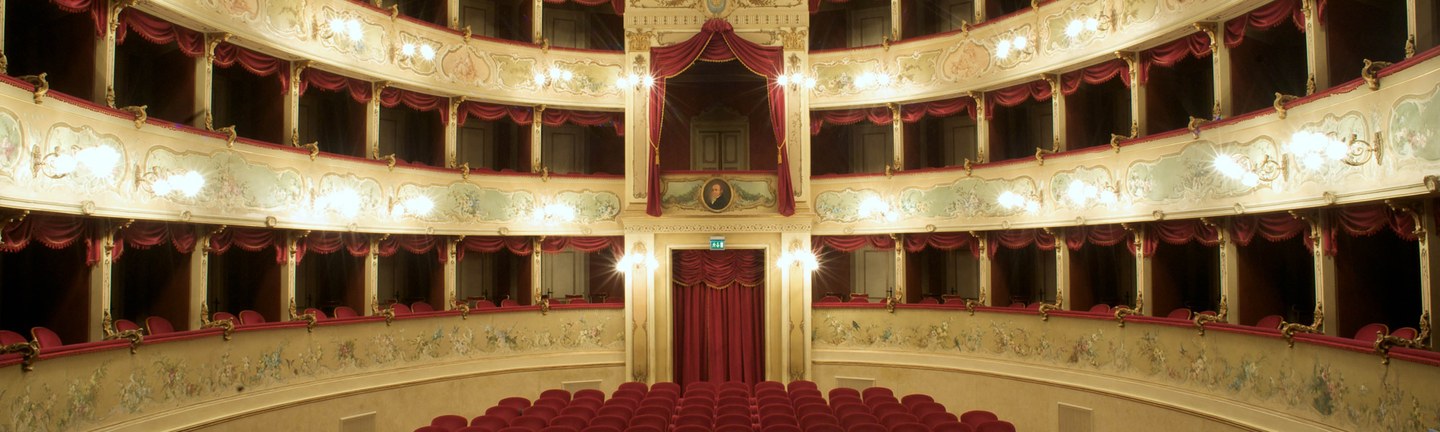
The horseshoe-shaped auditorium overlooks three tiers of boxes (sixty in total) decorated in the Louis XV style.
The royal box (palco d’onore), bearing the likeness of Bonifazio Asioli and the Community coat of arms, alongside the gallery (loggione), completes the hall's layout.
The theatre's vault, painted by Reggio-born artist Giulio Ferrari (1858–1934), is a true masterpiece: toward the proscenium, two winged geniuses hold a large damask fabric, while Tragedy, Comedy, and Dance emerge from the clouds, with Music at the center.
Reggio painter Giuseppe Ponga and Correggio native Emilio Meulli collaborated on the decorations; Meulli created the stuccowork and the magnificent border of the red velvet curtain, which was embroidered by Imélde Levi.
Contacts
Corso Cavour, 9 - 42015 Correggio (RE)
- +39 0522 637813 - Theatre
- +39 0522 630711 - Correggio Municipality
Keep exploring