
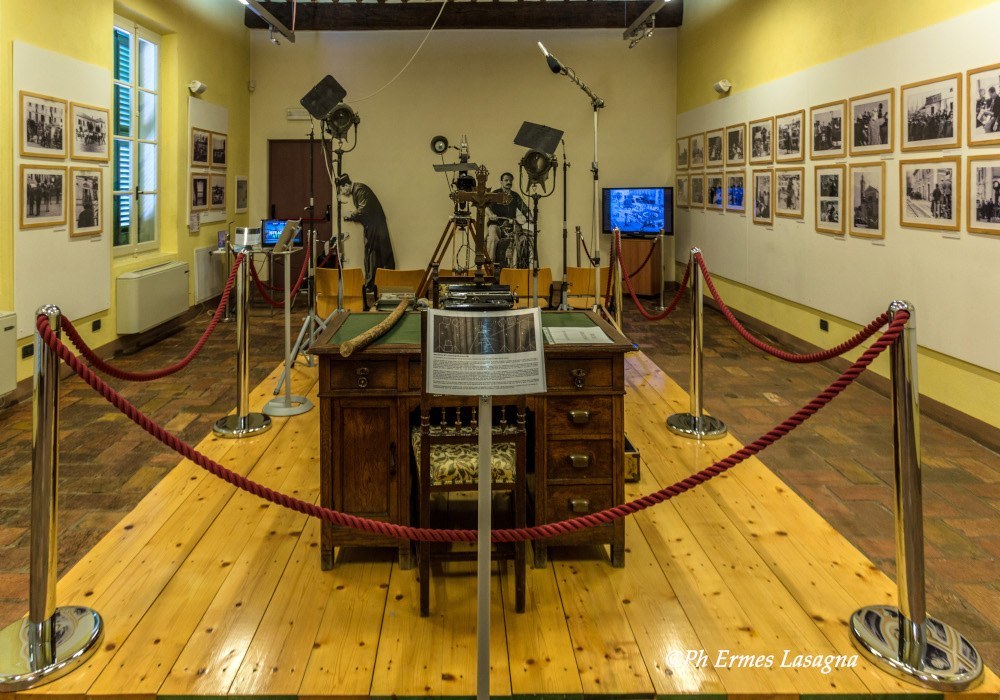
"Brescello e Guareschi, il territorio e il cinema" Museum
Timetable
Every day from 10:00 to 12:30 and from 14:30 to 18:00
Prices
The combined ticket includes admission to the "Brescello and Guareschi, the Territory and the Cinema" Museum, the "Peppone and Don Camillo" Museum, and the "Albino Umiltà" Roman Archaeological Museum.
Full price - €6.00
Reduced price - €4.00 - ages 6 to 18; over 70; university students up to 25; registered journalists with a valid ID.
Free - ages 0 to 5; disabled visitors and one companion; residents of the Municipality of Brescello; visitors on their birthday; and teachers accompanying school visits.
Schools - €4.00 per student. Discounted rate includes local tourist information and an educational workshop.
In the heart of Brescello, housed in the former Casa della Musica, the “Brescello e Guareschi, il territorio e il cinema” Museum offers a unique journey through cinema, history and rural life in the riverine region. Opened in 2009, the museum allows visitors to explore various aspects of local culture through film equipment, reconstructed sets, period photographs and artefacts from rural life.
The exhibition is spread over several floors:
Ground floor: space for temporary exhibitions dedicated to local events, artists and themes
First floor: a faithful reconstruction of a film set from the Don Camillo and Peppone films, accompanied by off-screen photographs that illustrate the connection between cinema and the local area. This section also features a tribute to Raffaele Vaccari, a Brescello-based violin maker renowned for his Stradivarius violins.
top floor: a tribute to the peasant life of the 1950s and to the memory of the Great Flood of 1951, also depicted in the first film of the saga ("Don Camillo", 1952)
The experience is completed by the nearby Guareschi Park, a green space dedicated to the writer, featuring a commemorative bust and spaces for relaxation and reflection on local culture.
The museum is ideal for film buffs, families, school groups, and curious tourists, offering an immersive journey that combines historical memory, rural traditions, and the unmistakable charm of the Emilian plains as depicted in Giovannino Guareschi's novels and films.
Contacts
Via F. Cavallotti, 24 - 42041 Brescello
Tel. +39 0522482564
+39 3513302056 (WhatsApp)
ufficioturismo@comune.brescello.re.it


About us
Where to find us
Opening hours
Press and TV enquiries
Leave us your feedback
