
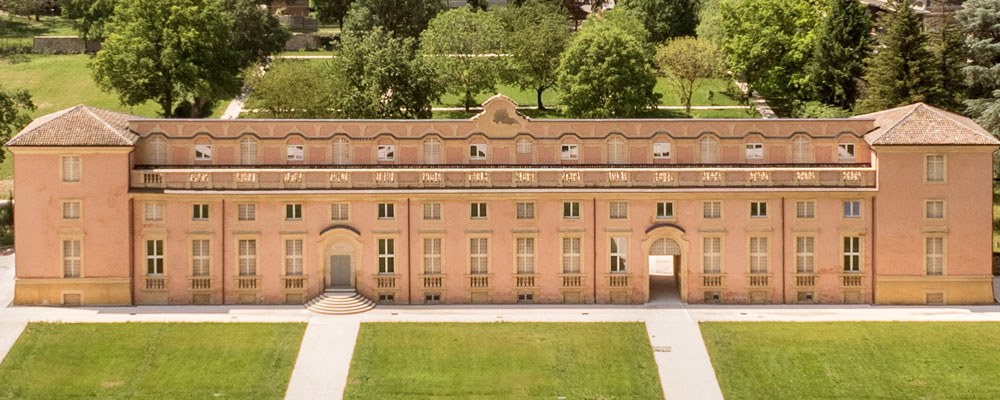
Villa Taparelli
Villa Taparelli stands in a scenic position at the end of an avenue that crosses a wide clearing framed by two rows of cypress poplars, offering a highly evocative landscape view right upon arrival. Tradition has it that, as early as the Renaissance, this site was the famous "Casino delle delizie" (Lodge of Delights) of Nicolò da Correggio, serving as a leisure and representative residence for the local nobility.
The current building, constructed in the first half of the 19th century by remodeling previous structures, features an imposing quadrangular layout organized across two main levels plus an attic. The long main front is flanked by two side wings that once housed stables, rustic outbuildings, and a small chapel, while the facade is topped by a small tower that reinforces its monumental character. Originally, the villa was bordered by a branch of the mill canal, which was used to irrigate the park.
Architectural Details
The main facade is embellished with an arched portal framed by decorations featuring caryatids and heads of noblemen, alongside a regular and symmetrical distribution of windows. On the ground floor, the openings are defined by arched motifs, while on the noble floor (piano nobile), the central window is enhanced by a tympanum. Rising in line with these openings are four tall polygonal chimneys, which serve as architectural elements with a strong visual impact.
A single, low-arched portico topped by a balustraded terrace connects the main body of the villa to the oratory. The rear elevation preserves an elegant portal with a niche housing a statue of the saint, refined architectural decorations, and a characteristic bell-gable (campaniletto a vela).
History and Illustrious Guests
Over the centuries, Villa Taparelli hosted princes, nobles, and illustrious figures of culture, including Ludovico Ariosto, Torquato Tasso, and Emperor Charles V. Historical sources chronicle the villa's role not only as a place of delight, culture, and hospitality, but also as an administrative center for managing landed estates and agricultural supplies.
Numerous comital acts and historical documents were drafted within its rooms, including a 1518 codicil signed in the famous camera philosophorum (philosophers' room), which was frescoed by Antonio Allegri, known as Il Correggio.
The environmental context of Via Carletti, enriched by historic parks and tree-lined hedges, helps make Villa Taparelli a place of great charm, where architecture, history, and landscape blend harmoniously.


About us
Where to find us
Opening hours
Press and TV enquiries
Leave us your feedback
