
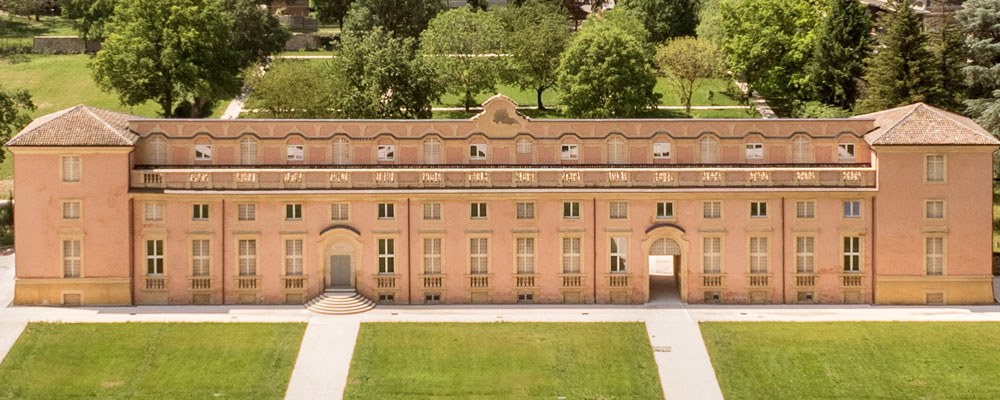
Villa Spalletti Trivelli
Villa Spalletti Trivelli is documented as already existing in the 17th century. Over the centuries, it underwent several renovations inspired by the architectural tastes of different eras, the last of which was carried out by the Milanese architect Luigi Clerichetti around 1860. While maintaining its ancient structure, the villa was decorated in the international eclectic style in vogue at the time, with clear references to French Classicism.
Two highly striking octagonal towers were added to the historic villa, giving the building a grander, more imposing presence. The south and north facades are perfectly symmetrical, differing only in the presence of a large clock on the south side and a bass-relief featuring symbols of abundance on the north side. A highly characteristic element is the belvedere tower located at the center of the building, featuring a wide balcony—a decorative feature drawn from the tradition of grand residences across the Alps.
The Court
An exceptionally large "closed court" (corte chiusa) building, constructed around 1865 also by the architect Clerichetti, was created for leisure and equestrian activities. It is particularly interesting for its artistic features and harmonious dimensions, sharing similarities with the courts of prominent English estates (such as the court at Woburn Abbey). Today, the Court's skillfully restored, spacious vaulted halls are fully equipped to host any type of event, even for a high number of guests.
The Park
The villa and the court are surrounded by a vast park, created through a gradual evolution of spaces that took place between the 17th and 19th centuries. Originally featuring Italian-style gardens, it was transformed into an English-style landscape park starting at the beginning of the 19th century. The initial design is attributed to Carl Huller, superintendent of parks and gardens for the Archduke of Austria and Duke of Modena, around 1480. The layout was given a romantic imprint with Neo-Medieval references, featuring faux ruins, a series of small lakes, water canals, and small islands connected by swivel bridges.
From this early park, the very long tree-lined avenue stretching southward remains. Named the "Provana," it serves as an ideal link connecting the villa to the hills and the lake's small islands. In 1867, the famous botanist and landscape architect Achille Villoresi was commissioned to redesign the park.
Through this project, the park was permanently transformed into its current layout, making it undoubtedly one of the largest private English-style parks in Northern Italy. The renowned botanist took particular care in planting rare and precious tree species, such as the solitary specimen of Zelkova carpinifolia and the bald cypresses by the lake. Among the notable buildings within the park, the imposing greenhouse stands out, designed to house exotic botanical species unsuited to our local climate.
Historical Moments
In 1887, Villa Spalletti Trivelli served as the headquarters for the grand maneuvers of the Italian Army. For the occasion, it hosted the King and Queen of Italy along with a large portion of the General Staff, confirming its significance as a prestigious residence.
Today, the villa and its park represent a flawless combination of history, architecture, and nature, offering the perfect setting for elegant events and ceremonies.


About us
Where to find us
Opening hours
Press and TV enquiries
Leave us your feedback
