Palazzo San Giorgio
Timetable
Open during the opening hours of the Panizzi Library
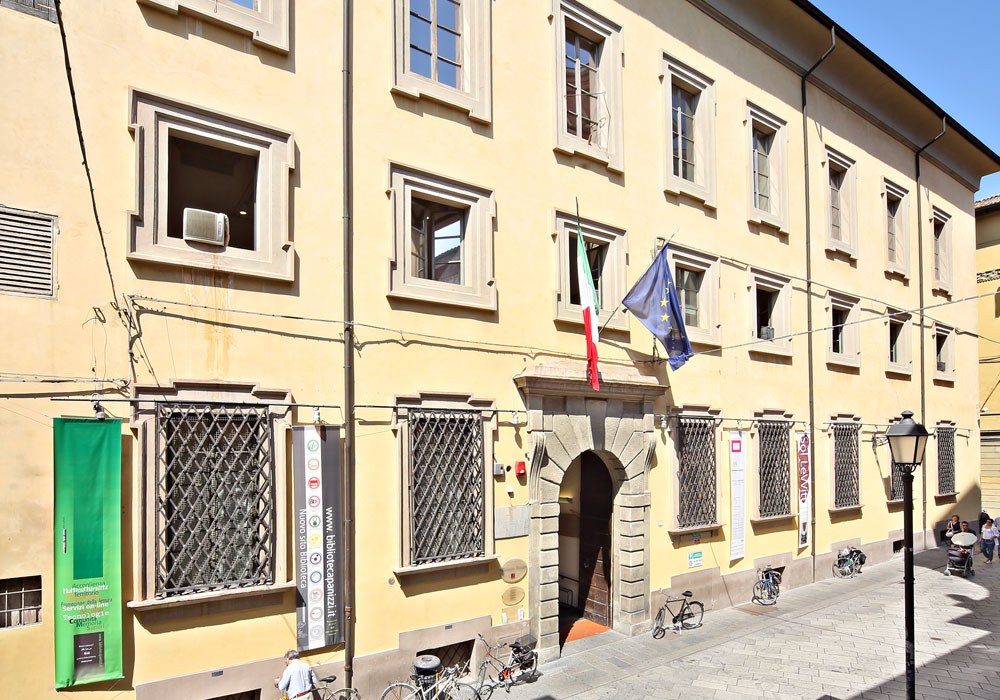
Palazzo San Giorgio is now home to the Antonio Panizzi Library, which houses one of the most important book and documentary heritages in Emilia-Romagna.
From Jesuit college to public library
The history of the building originates at the beginning of the 18th century, when the Jesuit order, already present in Via Farini with the church dedicated to San Giorgio, began the construction of a college in 1701 on a pre-existing house.
The date of construction is still visible today on a cornerstone engraved with Roman numerals (MDCCI), located at the corner of Via Malta and Via Guido da Castello, at the back of the building.
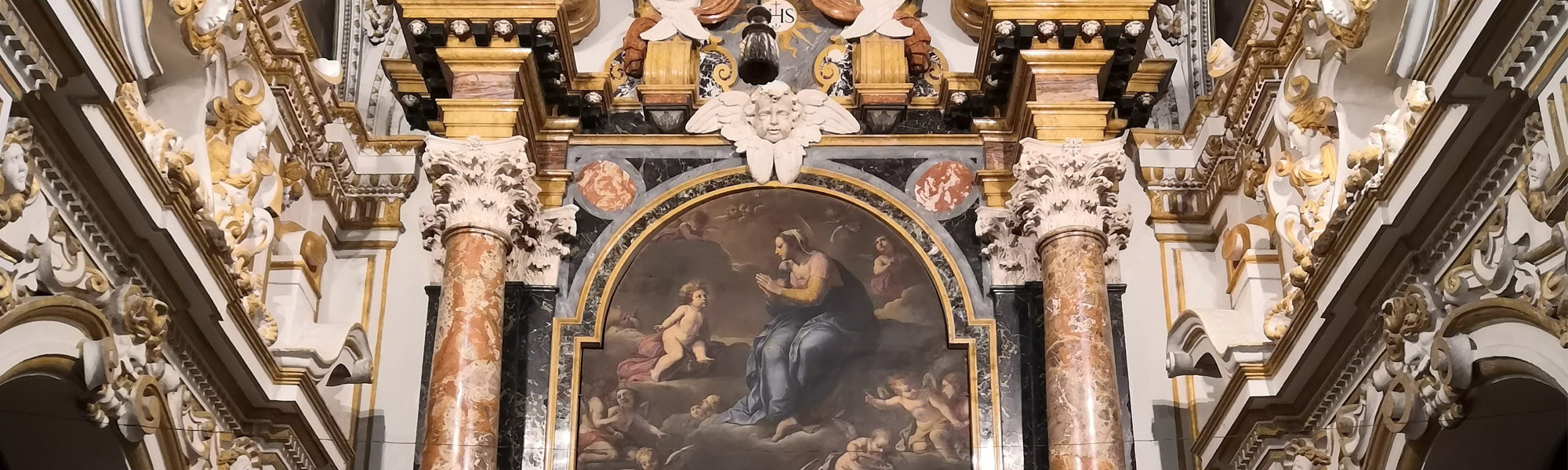
The exterior of the building appears austere and sober, almost monastic, in stark contrast to the rich Baroque façade of the Church of San Giorgio facing it, which was inspired by the famous Church of the Gesù in Rome, the headquarters of the Society of Jesus.
The two buildings, separated by the narrow Via Farini, were once connected by an underground passage, which is no longer in use today.
Inside the college, the study classrooms were located on the upper floor, overlooking Via Farini and Via Malta, while the refectory and service spaces were situated on the side of Via Guido da Castello (the ancient road of San Lorenzo), from which non-resident students also entered.
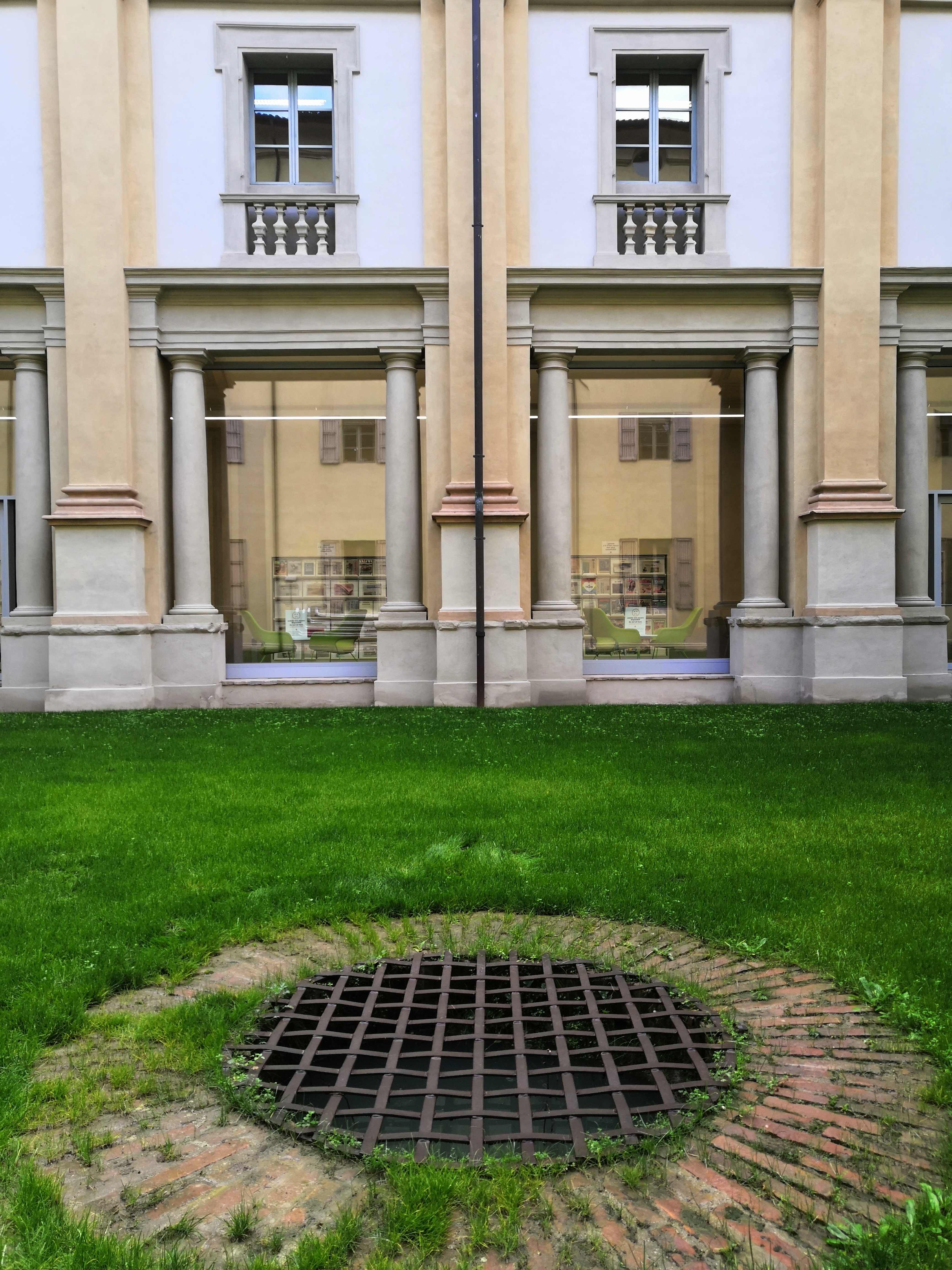
The large rectangular courtyard, of clear monastic inspiration, provided light to the rooms and was probably also used as a cultivated space.
Beneath the garden, a water cistern is still present, originally fed by one of the secondary channels of the Crostolo stream.
A decisive turning point in the history of the building occurred in 1796, with the proclamation of the Reggiana Republic after the fall of centuries-old Este rule.
Among the first acts of the new city government was the establishment of a public Library, created by gathering the book collections of suppressed religious orders and duplicates from the Estense Library in Modena.
In January 1798, the "National" Library opened to the public precisely on the premises of Palazzo San Giorgio, the former seat of the Society of Jesus.
The management was entrusted to Abbot Gaetano Fantuzzi, a refined bibliographer, to whom we owe the scientific organization of the collection and the drafting of the first catalog.
With the Restoration of 1814 and the return of Duke Francesco IV, the Library was transferred to the Chapter of the Cathedral and entrusted to Jesuit librarians and canons.
Difficult decades followed, marked by a scarcity of resources and limited public use.
Only in 1859, with the definitive end of Este rule, did the Municipality reaffirm its competence over public libraries and decide on the return of the Library to Palazzo San Giorgio, which thus became its permanent home.
Historical spaces returned to the city
Thanks to the restoration completed in 2021, the Panizzi Library has returned important historical spaces to the city, which can now be used by the public once again. Among these, the Loggia Ferraroni stands out - an elegant 18th-century environment designed by Giovan Maria Ferraroni, which now houses the periodicals library - as well as the Sala degli Artisti (Artists' Room), a multifunctional space conceived as a modern indoor square for events, meetings, and cultural activities.
The library is also a place where knowledge dialogues with contemporary art: from the monumental wall drawing Whirls and Twirls 1 by Sol LeWitt in the Reading Room, to the recent installation by Elena Mazzi, visible at the entrance and dedicated to a powerful civic message against violence towards women.
Conceived as an open and inclusive space, the Panizzi Library offers services for all ages: from the Young Adults Room for teenagers, to spaces dedicated to toddlers and families, with welcoming areas (Baby pit stop) and accessible services.
Keep exploring