Palazzo Rocca Saporiti
Timetable
During the opening hours of the medical library.
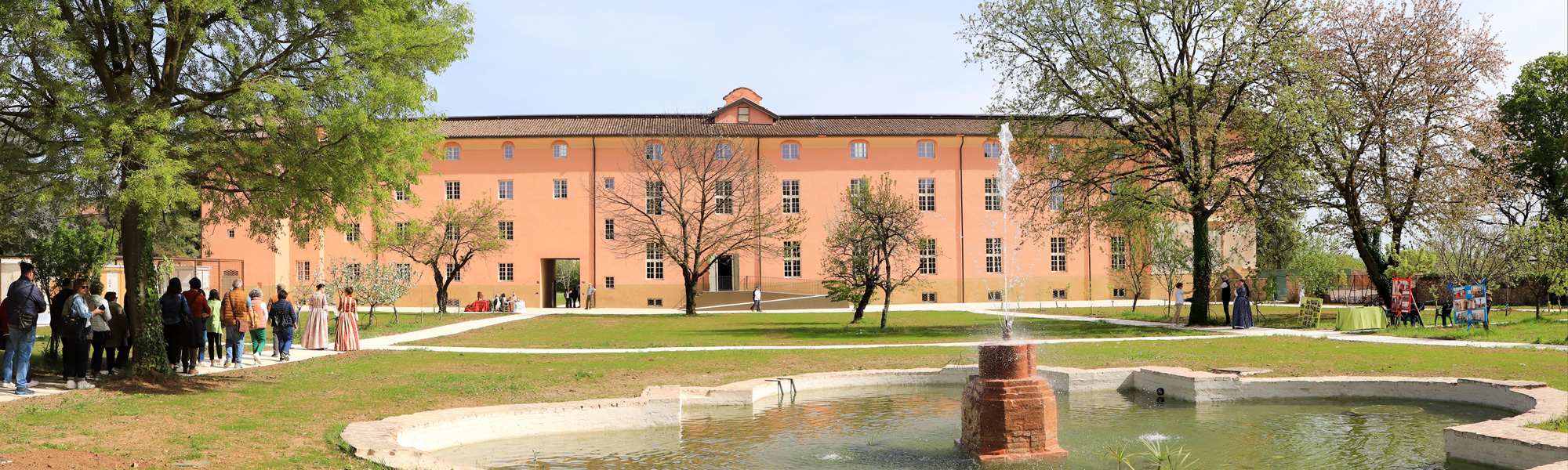
The current Palazzo Rocca Saporiti, which takes its name from the last owning family, originated as a country residence and refined casino delle delizie (pleasure house) for the Ancini family, who in 1498 purchased a plot of land on which a fortified medieval tower stood.
Origins and Architecture
From its origins, the complex was conceived as a place of tranquility and prestige, immersed in the countryside yet strategically close to the city.
Its position perfectly reflects the classical principles of suburban villas, codified in antiquity by Pliny and Vitruvius and revived during the Humanistic era: a residence just outside the walls, close to a watercourse, with a view of the mountains, ideal for otium agreste - intended as a regeneration of the spirit away from the political and civic commitments of urban life.
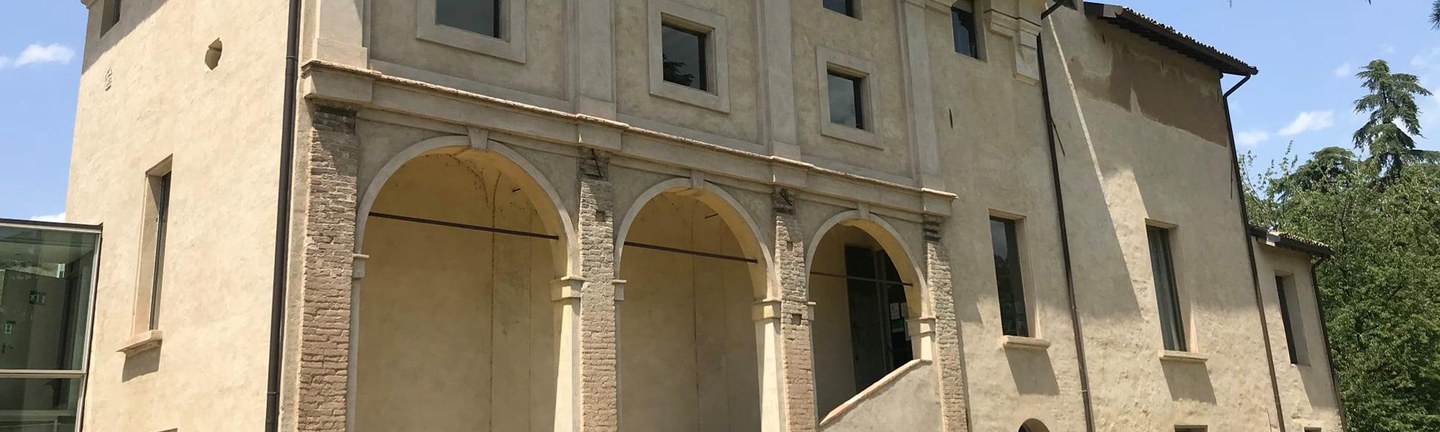
The current architectural appearance is the result of progressive expansions that occurred over time and culminated in the mid-17th century, when the current façade was designed, transforming the original rustic villa into a refined country estate.
A moment of particular prestige is linked to the stay of Cardinal Rinaldo I d’Este, Bishop of Reggio Emilia between 1651 and 1660.
The construction of the external staircase that cuts through the loggia - an architectural element of great scenographic impact - is traditionally attributed to his presence.
During the nineteenth century, Enrichetta Ancini bequeathed the palace to Luigi Ancini, the first mayor of Reggio Emilia in 1859.
This period saw a progressive decline in interest toward the residence, which was also rented out to Bishop Guido Rocca Saporiti, from whom it would take its definitive name.
With the advent of post-unification Italy, maintaining such a luxurious country home became increasingly difficult.
The Napoleonic requisitions that had affected the aristocracy and the rising prominence of bourgeois values made it complicated to justify the existence of such imposing residences, symbols of a world in transformation.
In 1885, with a will destined to mark a turning point in the building's history, Giovanni Ancini, son of Luigi Ancini, left the palace to the Congregation of Charity, reserving only the art gallery, archive, and library for the family.
The institution, however, initially struggled to find a suitable function for this precious complex: in 1891, the Casino and the garden were rented to Count Luigi Rati Opizzoni, before being purchased in 1904 by Count Alessandro Rocca Saporiti, from whom the palace took its final name.
Later passed to Marquis Ippolito Gropallo Rocca Saporiti, the building once again became of interest to the Congregation of Charity, which repurchased it in 1929.
They initially considered transforming it into a tuberculosis sanatorium, a project later abandoned for hygienic and environmental reasons, as it was feared that a sanatorium located at the southern entrance of the city could compromise the air and water.
It was therefore preferred to allocate such functions to the Ospizio area, where the San Lazzaro Institute already stood. In the following decades, the so-called "Casinazzo" experienced a progressive decline.
On the lower floor, a few classrooms of the San Pellegrino Elementary School were temporarily set up, while other parts of the building were subdivided into modest public housing units.
The lack of a stable function inevitably led to an increasing state of neglect, which lasted until 1970, when a protection order by the Superintendency for Environmental and Architectural Heritage of Emilia-Romagna laid the groundwork for the safeguarding and recovery of the building, starting the path that restored Palazzo Rocca Saporiti to the city's historical heritage.
The Frescoes
Of extraordinary interest are the frescoes in the great salon, today attributed to Orazio Perucci and his workshop.
According to recent studies, the pictorial cycle dates back to around 1590, possibly executed on the occasion of the wedding between Girolamo Ancini and Ginevra Patrini, and represents one of the highest points of Mannerist decoration in a suburban residential setting.
Keep exploring