
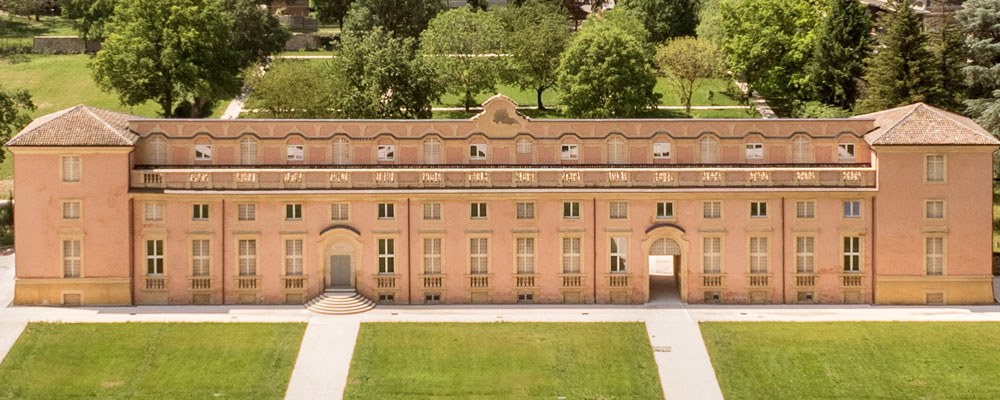
Palazzo Rainusso
Palazzo Rainusso has its origins in the 16th century as a convent of the Conventual Friars of the Madonna, documented as early as 1570.
The original core included the small church and the east and south wings, while the cloister was built in 1635.
Over time, the complex expanded with new buildings around an internal courtyard, meeting the needs of monastic life.
With the ecclesiastical suppressions of 1768, the convent was requisitioned and purchased by Count Greppi of Milan, who transformed it into a summer residence.
The 18th-century interventions led to the renovation of the east facade with large windows, cornices, and balustrades, as well as the construction of an extension on the north-east corner, which involved cutting away the apse of the original church.
Later, the palace passed to Cavaliere Rainusso, from whom it takes its name.
The building, distributed across two levels, preserves an internal cloister with elegant arches, a chapter house, a large 18th-century hall, and numerous doors decorated with ornamental motifs and landscapes.
The historic park, featuring centuries-old trees, is enclosed by wrought-iron gates attributed to Giovan Battista Malagoli (1729-1797).
Following the death of Cavaliere Rainusso in 1906, the property passed to the Pii Istituti Riuniti of S. Margherita Ligure and, in 1979, to the Municipality of Rubiera.


About us
Where to find us
Opening hours
Press and TV enquiries
Leave us your feedback
