
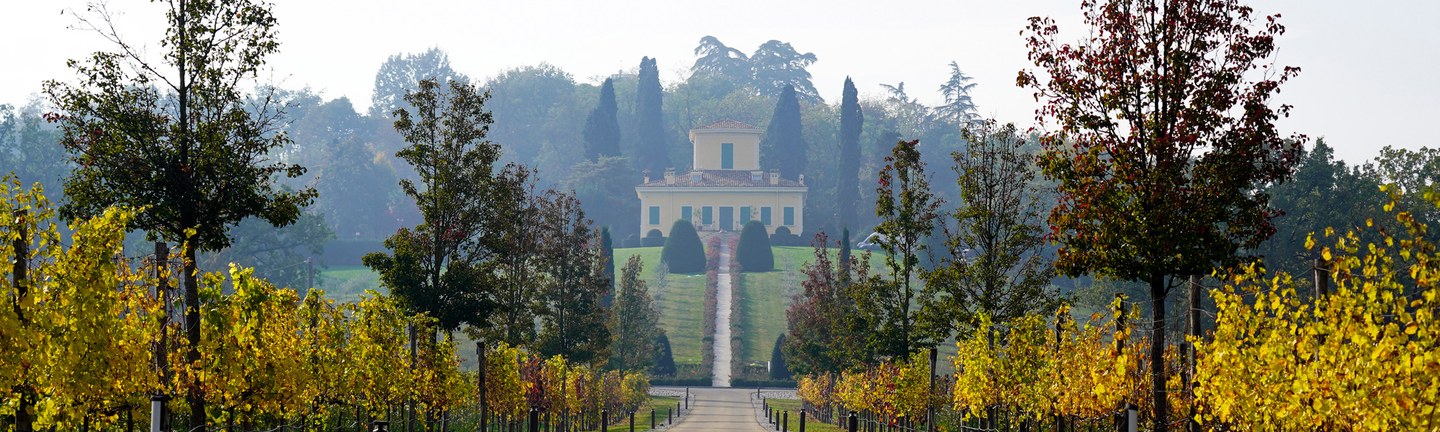
Villa Tacoli (now Villa Giorgia)
Albinea
Nestled in the greenery of the Reggio hills, Villa Giorgia is a refined historical residence that tells the story of over four centuries of history, architecture, and landscape, transforming over time from a vacation home into a prestigious representative headquarters.
From 17th-Century Origins to Neoclassicism
The origins of the villa are ancient: in the early years of the 17th century, it belonged to Cherubino Muti, as evidenced by a 1603 document mentioning a domestic oratory, known as the "Oratory of the Muto."
In 1774, the complex, then defined as a Casino di villeggiatura (vacation villa), was owned by Bartolomeo Ferrari from Reggio.
The current appearance of the villa took shape when Marquis Alfonso Tacoli purchased the building as a summer residence and initiated a major renovation.
The project was entrusted to architect Domenico Marchelli, who created what Umberto Nobili defined as "a small and perfect building, a paradigm of the most cultured and refined Neoclassical architecture," also working on the interior spaces and designing the characteristic Tuscan loggia.
The Garden and Romantic Taste
Marquis Tacoli is considered the true soul of the villa's modernization: he was responsible for the definitive arrangement of the residence and the creation of an English-style garden, conceived as a place of pleasure and prestige for himself and his guests, as recalled by an 1824 epigraph preserved in the chapel.
The villa, developed on a single floor and centered around an ancient tower, remained with the Tacoli family until 1977, when it was purchased by Roberto Gardini, who renamed it Villa Giorgia in honor of his eldest daughter.
From Private Residence to Representative Headquarters
Used for a few years as a restaurant and venue for events, the villa was recently acquired by Enrico Grassi and transformed into the representative headquarters of Elettric80, one of the most prestigious companies in the Reggio area.
Today, Villa Giorgia hosts conferences, meetings, and training courses in a setting that combines historical elegance with contemporary functionality.
A careful restoration has brought the rooms back to the original design, recovering historical frescoes and floors, removing more recent partitions, and restoring the oratory and the underground icehouse, which are now used as reception spaces.
The Park: Three Gardens in One
The vast park surrounding Villa Giorgia is one of its most fascinating elements and is divided into three different styles of gardens:
Italian Garden: To the north of the villa, featuring geometrically pruned yew bushes, cypresses, and green backdrops that frame the staircase.
English Landscape Garden: In the southern part facing the hill, characterized by centuries-old oaks, hornbeams, native species, and wide clearings.
Contemporary Agricultural Landscape: On the slope below, where a vineyard and an olive grove have been planted, crossed by axial paths.
Bounding the area, a long wooded hedge composed mainly of native species, among which monumental oaks stand out, completes a landscape context of great value.


