
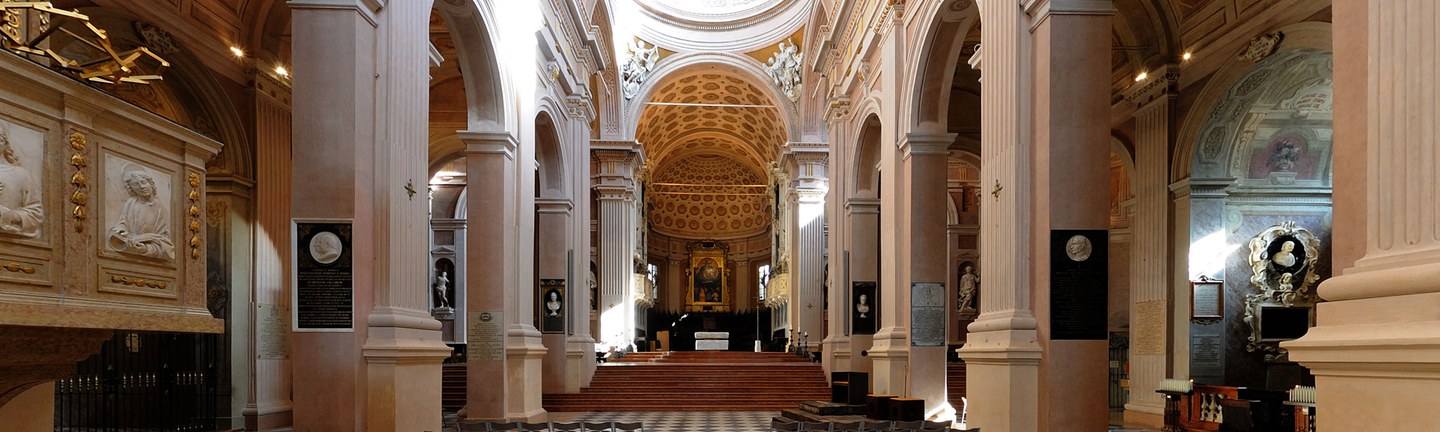
Santa Maria Assunta Cathedral
Timetable
Monday to Sunday
8:00 am – 12:00
4:00 – 7:00 pm
Tourist visiting hours (groups)
Weekdays
from 9:00 to 10:20 am
from 11:15 to 12:00 am
from 4:00 to 7:00 pm
Public holidays
from 8:30 to 10:45 am
from 4:00 to 5:30 pm
Guided tours are not permitted during Masses or other scheduled events.
Guided group tours
To organise a guided group tour, please complete the relevant PDF pdf form and send it to mab@diocesi.re.it at least 10 days in advance of your chosen date.
Built around 857 on the site of an ancient Roman structure, the church has evolved over the centuries, undergoing transformations in the Romanesque and, later, Renaissance styles.
At the end of the 15th century, the Cathedral was renovated in the style of the time.
Among the key figures in this renovation was Prospero Sogari, known as ‘il Clemente’, creator of the statues of Adam and Eve that adorn the central portal, and of the figures of Saints Chrysanthus and Daria, Venerius and Gioconda, placed in the side niches.
On the tower, the Madonna and Child with the Fiordibelli couple, a masterpiece in gilded copper by the goldsmith and sculptor Bartolomeo Spani, dominates the façade as a radiant symbol of devotion and gratitude.
Inside, the cathedral features chapels adorned with fine marble, exquisite altars and tombs of great artistic value.
Among the most significant works are the tomb of Orazio Malaguzzi by Clemente, the funerary monument to Valerio Malaguzzi (1510) by Spani, and the Fiordibelli Chapel, decorated with the Assumption of the Virgin, Saint Peter in the Chair and Saint Jerome (1626) by Giovanni Francesco Barbieri, known as Guercino.
The Crypt
Descending into the crypt, which dates from the 12th to the 13th century, one discovers a striking space.
The cross vaults rest on 42 columns with fragmented capitals, some dating back to the 15th century.
Among the hidden treasures is a 3rd–4th-century Roman mosaic, discovered during restoration work in 1923, depicting symbolic animals such as a deer at a spring.
The three chapels of the crypt trace a journey of faith and remembrance: the central one houses the martyrs Chrysanthus and Daria, patrons of the city; the one on the right is dedicated to the war dead, decorated by Anselmo Govi; whilst on the left, a 13th-century bas-relief depicts the Three Wise Men, silent guardians of an ancient devotion.
Contemporary art in the Cathedral
Reopened to the public in 2010, the Cathedral is today an extraordinary example of dialogue between past and present.
The new liturgical furnishings, created by leading masters of Arte Povera and conceptual art, invite visitors to engage in spiritual and visual reflection on the meaning of contemporary faith.
- Claudio Parmiggiani created the altar, using two blocks of Roman marble as a symbolic bridge between the Last Supper and Calvary: a work of intense simplicity.
- Jannis Kounellis’s pulpit, made of iron and antique wood, recalls the strength and memory of Christian origins, evoking early medieval forms of austere beauty.
- Hidetoshi Nagasawa designed the star-shaped staircase leading to the ambo and the Glorious Cross (not yet on display), together with the bronze lectern inspired by the eagle of St John.
- Ettore Spalletti’s Easter candelabrum, in marble and gold leaf, radiates light as a sign of revelation and hope, inspired by the pillar of fire that guided the Jewish people through the desert.
- Finally, in the crypt, works by Graziano Pompili, Giovanni Menada and other artists complete a journey in which spirituality blends with contemporary artistic sensibility.
Contacts
Piazza Prampolini - 42121 Reggio Emilia
- +39 0522 1757935 - Diocesi di Reggio Emilia e Guastalla


