
San Pietro Cloisters
Timetable
Saturday and Sunday
10:00 am – 6:00 pm
Prices
During opening hours, entry is free and open to all, with guided tours also available.
In the heart of Reggio Emilia lies one of the most fascinating sites of the Emilian Renaissance: the former Benedictine monastery of the Chiostri di San Pietro.
Once home to the monks who served in the nearby Church of San Pietro, the complex took shape in the early 16th century, when the religious community was forced to move within the city walls.
The monastery was designed around two cloisters, differing in style and character, which tell the story of centuries of art and transformation.
The Small Cloister, built between 1524 and 1525 by Bartolomeo Spani, is a refined example of Renaissance architecture: harmonious, proportionate, modular, and inspired by Brunelleschi’s teachings.
Thanks to recent restoration work, parts of the ancient frescoes have re-emerged, having remained hidden for decades beneath a layer of lime.
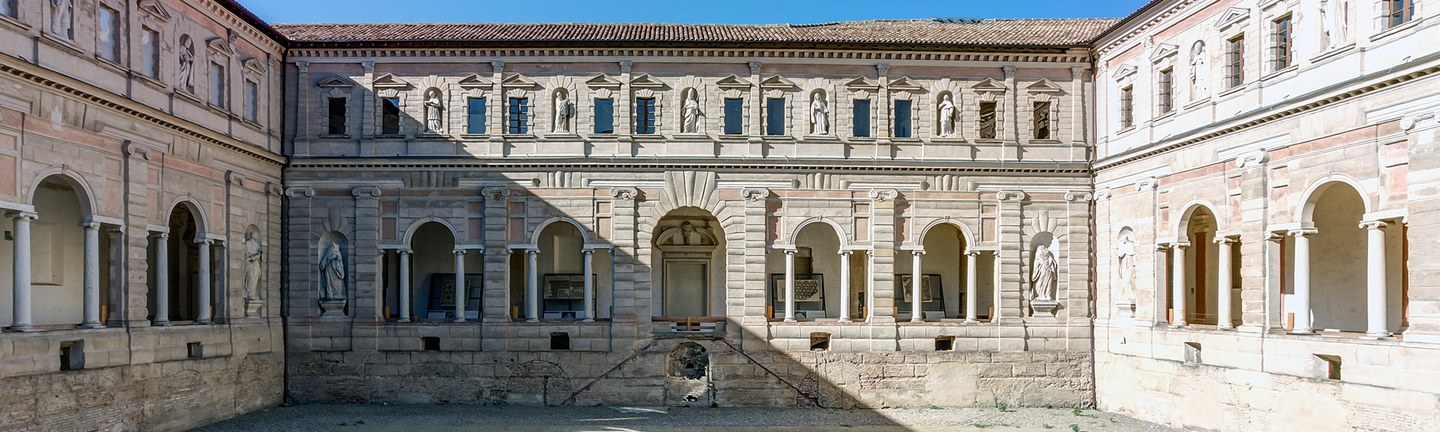
The Great Cloister, built some sixty years later by Prospero and Francesco Pacchioni, is of a completely different scale.
Here, the Mannerist style dominates: rusticated walls, tympanum windows and niches adorned with imposing statues of Benedictine saints, sculpted by the brothers Bernardo and Francesco da Lugano in the 17th century.
The monumental layout strongly evokes the elegance of Palazzo Te in Mantua, a clear testament to the influence of Giulio Romano.
The history of the complex took a new turn in 1783, with the suppression of the monastery.
The cloisters were first used as a military warehouse, then as the seat of the Court of Justice.
With the Restoration, the premises were converted into the Girls’ Boarding School: the architect Domenico Marchelli redesigned the façade on Via Emilia in a sober neoclassical style, definitively separating the monastery from the church and integrating the building into the new urban layout, which no longer featured porticoes.
After the Unification of Italy, the cloisters became barracks.
The arches of the Small Cloister were bricked up and the ancient vegetable gardens gave way to new military buildings.
The major contemporary restoration has restored the complex to its original charm, revealing the beauty of the spaces and the richness of the architectural styles that characterise it.
Now, the Cloisters of St Peter’s feature four distinct areas:
- Art in Chiostri: cultural exhibitions and international events.
- Lab in Chiostri: a place to foster cooperation and dialogue between different worlds.
- Work in Chiostri: a new co-working space for young professionals, freelancers and remote workers who want to develop innovative ideas in a stunning historic setting.
- Food in Chiostri: an authentic and wholesome dining area for breakfast, snacks, aperitifs and lunch.
The monumental complex is fully accessible to people with disabilities and mobility difficulties, thanks to the presence of dedicated lifts and ramps.
Prams and pushchairs can also access the spaces, subject to occasional restrictions due to the nature of the works on display.
Today, the Chiostri di San Pietro represent a multifunctional cultural hub open to the city and the world.
The spaces are available to public bodies, associations, companies and creative organisations for the organisation of exhibitions, displays, events and innovative projects with a high social and cultural impact.
Through a wide-ranging programme of guided tours, workshops and educational activities, the complex promotes awareness and appreciation of cultural heritage, whilst the Laboratorio Aperto brings the spaces to life through digital innovation, participation and new forms of collaboration.
Find out more about:
accessibility
spaces
guided tours
visitareggio
Contacts
Via Emilia San Pietro, 44/C - 42121 Reggio Emilia
- +39 0522 456233 - For information on visits, events and services at the Monumental Complex, please call during opening hours


