
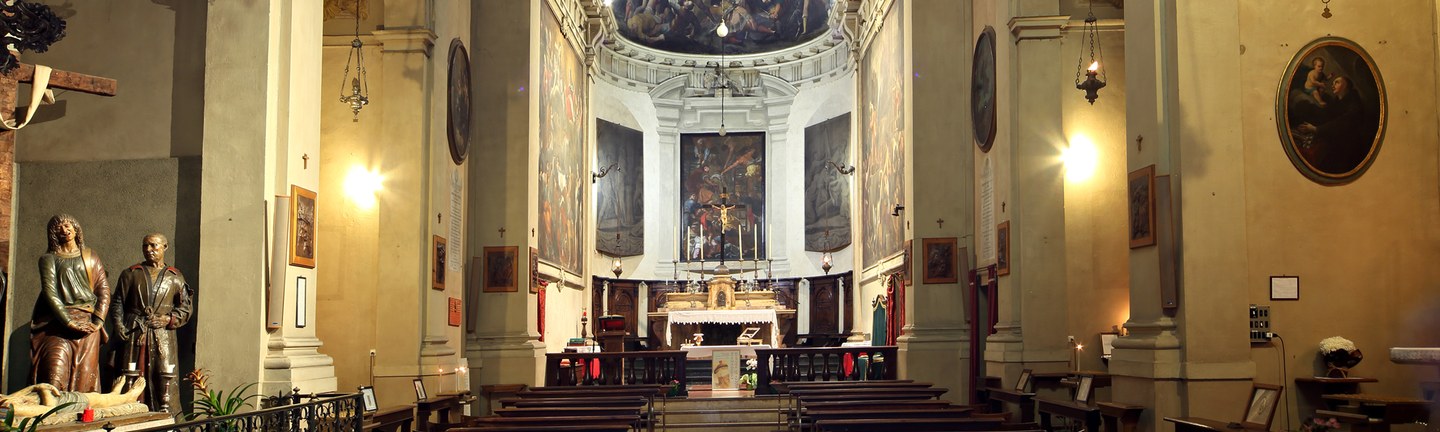
San Giovanni Church - San Giovannino
The Venerable Confraternity of the Immaculate Conception and St Francis of Assisi
Overlooking the picturesque little square of San Giovanni, the Church of St John the Evangelist, affectionately known as San Giovannino, is one of the finest examples of Renaissance architecture in Reggio Emilia.
The earliest records of the church date back to the 12th century, but only the outer walls remain of the original building.
The present structure was rebuilt in the 16th century to a design by Girolamo Casotti, who defined its elegant architectural layout.
Originally a parish church, San Giovannino underwent numerous transformations over the centuries.
In 1808, during the Napoleonic period, it was confiscated and sold to the merchant Luigi Trivelli, owner of the building opposite (now Palazzo Palazzi Trivelli).
The building served various purposes – even as a warehouse and workshop – before returning to its religious vocation.
In 1896, the church was entrusted in perpetuity to the Venerable Confraternity of the Immaculate Conception and St Francis of Assisi, the oldest surviving confraternity in Reggio Emilia.
The exposed brick façade, sober and unfinished, still retains a severe yet harmonious charm. A modern mosaic depicting Saint Anthony of Padua is set in a rectangular niche, a testament to the popular devotion that continues to endure over time.
Interior design and decorations
The interior of the church houses prestigious works created in the early decades of the 17th century, to the extent that this artistic project served as a testing ground for the artists who would soon be working on the Basilica della Ghiara.
Among the most important works:
- the frescoes in the tribune by Sisto Baldocchio, who also painted the large fresco on the dome, The Return of Christ (1613), inspired by Correggio’s famous work in Parma;
- the vault of the central nave, decorated with illusionistic perspectives by Tommaso Sandrini and frescoes by Lorenzo Franchi (1614) depicting St John writing the Apocalypse, The Angels of the Seven Trumpets and The Defeats of the Devil;
- two monumental canvases by Alessandro Tiarini (1624), situated on either side of the chancel and depicting The Death of St John and The Martyrdom of St John, considered among the greatest masterpieces of the Bolognese artist;
- in the apse, a fresco by Paolo Guidotti (1613) depicting the Resurrection of Christ;
- in the second chapel on the left, a striking polychrome terracotta sculptural group depicting the Lamentation over the Dead Christ, dating from the 15th century and attributed to Guido Mazzoni (with the figure of Christ dating instead from the 16th century).
Find out more at:
vistareggio


