
Beata Vergine della Ghiara Basilica
Timetable
Monday to Sunday
7:30 am – 12:00
4:30 – 7:30 pm
Tourist visiting hours (groups)
Monday to Saturday
10:00 am – 12:00
4:30 – 5:30 pm
Sundays and public holidays
4:30 - 5:30 pm
Visiting arrangements
Individual visits
The Basilica is open to visitors free of charge, with the lighting set to the standard configuration.
On request, the special lighting for visitors can be activated in the Sacristy, for a minimum contribution of € 5.00, to best highlight the artistic and architectural details of the site.
To make your visit even more engaging, we recommend watching the Basilica’s presentation video (duration approx. 30 minutes), available at the bottom of the page.
Group visits
To organise a group visit, please send a written request to the email address: basilica@basilicaghiara.it
If you do not receive a reply, please contact +39 0522 439707.
Guided tours for groups
If you’d like a more in-depth experience, you can book a group tour with a professional guide by consulting the list of tour guides available on our website.
For a contribution of € 1.00 per person, the lighting display is activated at its brightest setting, for an even more immersive and exciting visit.
The Basilica of the Madonna della Ghiara is one of Italy’s most important Marian shrines, an extraordinary symbol of faith, gratitude and beauty.
Born out of the devotion of the people of Reggio Emilia to the Virgin Mary, its history weaves together miracles, art and spirituality in a narrative that has spanned over four centuries.
The origins of the sanctuary are linked to the presence of the Servants of Mary, who were called to Reggio Emilia in 1313.
In the western part of the city, known as Ghiara or Giarra due to the gravelly soil of the ancient bed of the Crostolo river, the friars built their convent and a church dedicated to the Santissima Annunziata.
In 1517, a second, larger church dedicated to the Nativity of Our Lord was built, and an image of the Madonna and Child was painted on a wall of the convent garden, which soon became an object of veneration.
Over time, the fresco deteriorated, but popular devotion remained undiminished.
Thus, in 1569, Ludovico Pratissoli and the friars commissioned Lelio Orsi, a celebrated painter from Novellara, to create a new design.
The work, profoundly innovative, depicts the Madonna adoring the Infant Jesus, accompanied by the inscription “Quem genuit adoravit” (“She adored the One she bore”).
In 1573, Giovanni Bianchi, known as Bertone, translated the sketch into a fresco, giving the city an image destined to become sacred and beloved by generations of the faithful.
The shrine’s fame skyrocketed following an extraordinary event.
A young man named Marchino, a fifteen-year-old who had been deaf and mute from birth, entered the oratory to pray to the Virgin Mary.
Suddenly, he regained his hearing, his speech and his ability to speak.
News of the miracle spread rapidly: the whole town flocked there on pilgrimage.
Bishop Claudio Rangone set up a commission of inquiry and, following a thorough investigation, Pope Clement VIII officially recognised the miracle on 22 July 1596, authorising worship and pilgrimages.
A few days later, the Council of Reggio Emilia resolved to build a new and magnificent sanctuary, entrusting the city to the protection of the miraculous image.
The new temple
On 6 June 1597, in the presence of the Dukes of Este, the foundation stone of the new church was laid.
The design, based on a Greek cross plan, symbolised the perfection of the Virgin Mary.
The architects Alessandro Balbo and Francesco Pacchioni oversaw the work, which was completed in an extraordinarily short time.
The solemn consecration took place on 12 May 1619, giving rise to the historic Giarèda, a festival that still today fills the city with spirituality and tradition.
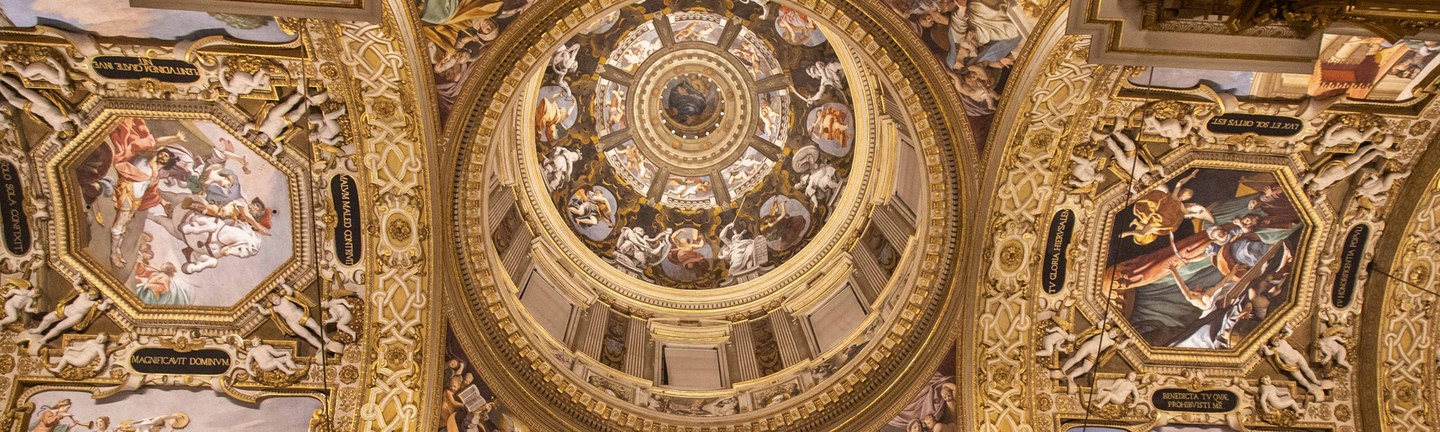
The basilica is a masterpiece of Counter-Reformation art, where every fresco and every altarpiece speaks to the hearts of the faithful.
The greatest artists of the era worked here: Leonello Spada, Alessandro Tiarini, Carlo Bononi, Camillo Gavassetti, Ludovico Carracci and the great Guercino, creator of the famous Crucifixion of Christ, commissioned by the City Council.
The decorations in the Ghiara are a veritable open-air museum of 17th-century Emilian art.
The vaults and domes depict scenes from the Old Testament through female figures that foreshadow the salvation brought by Mary:
- Eve and Adam in Paradise
- Rebecca at the Well
- Judith and Holofernes
- Esther and Ahasuerus
- Abigail and David
- The Apotheosis of Mary
The sacristy houses an ingenious 17th-century astronomical clock, the work of Father Cherubino Ranzani of Reggio Emilia, capable of indicating the day, the phases of the moon and the signs of the zodiac.
In the nearby Museo Tesoro della Basilica della Ghiara, within the small cloister, there is a precious collection of 17th- and 18th-century sacred gold and silverware from Reggio: reliquaries, chalices, liturgical vestments, the votive crown of the Senate and People of Reggio (1674) and the original sketch by Lelio Orsi.
Among the most admired treasures are the six silver candlesticks bearing the Este coat of arms, a gift from Duke Francesco I d’Este.
App Basilica della Ghiara
Explore the Basilica at your own pace!
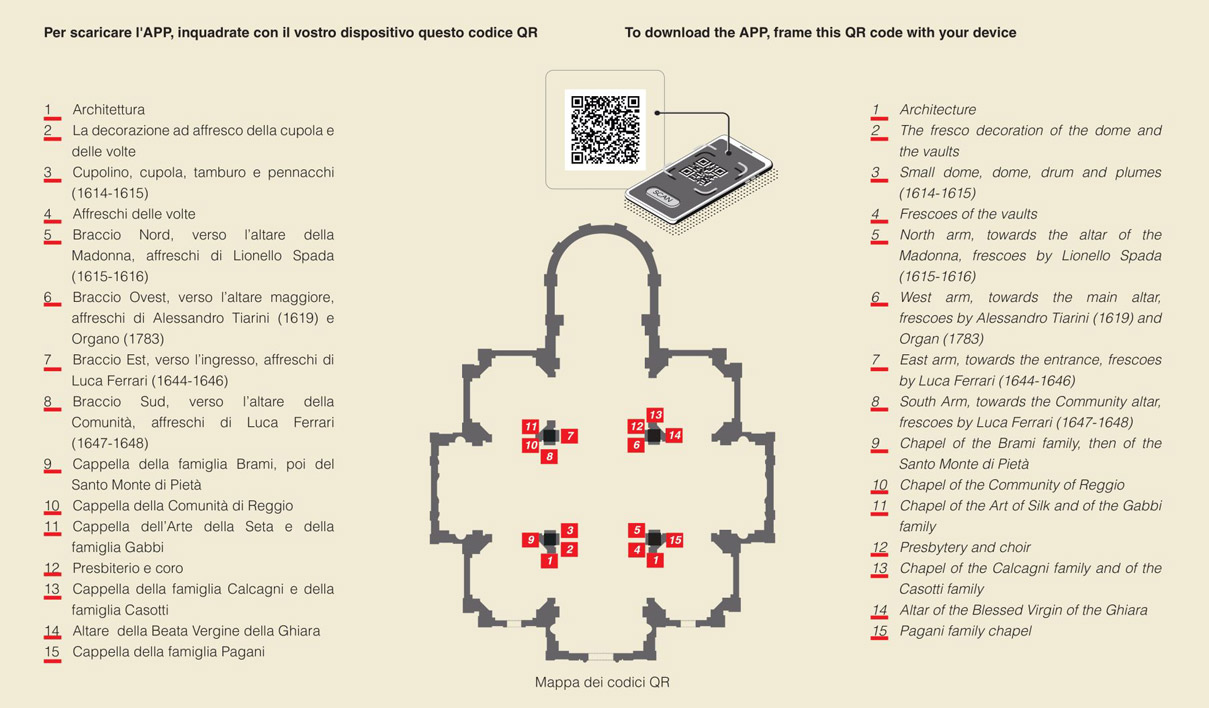
Thanks to the new (free) app and the QR codes placed around the interior pillars of the basilica, you can delve deeper into the historical and artistic aspects of the Basilica and view the paintings in a whole new light.
Video presentation of the Basilica


