
The route begins in Piazza Gioberti, home to the Palazzo Ducale, where the Passeggiata Settecentesca starts – a route of around 7 kilometres that still winds its way from the historic centre of Reggio Emilia to the Reggia di Rivalta, through the Crostolo Stream Riverside Park. The circular fountain surrounding the obelisk reflects the Este family’s fondness for water features, which can be found at the Reggia Ducale and in many other Este residences.
Sito ufficiale di informazione turistica del Comune di Reggio Emilia
EN
La Via delle Ville
Starting from
Reggio Emilia
Tour length
22 km
Duration
3 hours
Suitable for
Everyone
Transport methods
A 20-kilometre route that will take you from the hustle and bustle of the historic centre to the tranquillity of the Reggio Emilia countryside. Centred around the themes of water and the prestige of the d’Este family, the Via delle Ville is an invitation to slow down and rediscover the architectural and natural beauty of our city.
The route forms part of an extensive network of riverside paths and parks surrounding the city: the Crostolo path, the first of the riverside parks to be created, is now the leisure destination par excellence for the people of Reggio Emilia.
You can hire bikes from local retailers or through the RideMovi bike-sharing app. Further information is available at comune.reggioemilia.it.
Piazza Gioberti and Ducal Palace
Church and Oratory of Christ
Continuing along Corso Garibaldi, you come to another recently redeveloped square: Piazza Roversi, which is home to the 18th-century Church of the Christ. The stretch of water in front of the church is a reminder of the riverbed of the Crostolo stream that once flowed here, before it was diverted outside the city walls. The Basilica della Ghiara itself, situated along the street, owes its name to the ‘gièra’, the gravel that used to lie on the stream’s riverbed.
Viale Umberto I
The Porta Castello junction links the 18th-century promenade with the city’s most important tree-lined avenue: Viale Umberto I. Here too, water features accompany us along the route, from the winding course of Corso Garibaldi, to the two monumental fountains on the avenue, right up to the pools at the Reggia di Rivalta. Even today, the wide avenue is characterised by a neat row of large trees and by the pedestrian and cycle paths running alongside it. The route continues to the Crostolo Bridge, where we can admire two statues that once belonged to the Villa Ducale: the statues of the Secchia stream and the River Panaro, part of a trio that also included the statue of the Crostolo, now housed in the very central Piazza Prampolini.
Crostolo Cycling Path and Rivalta Royal Palace
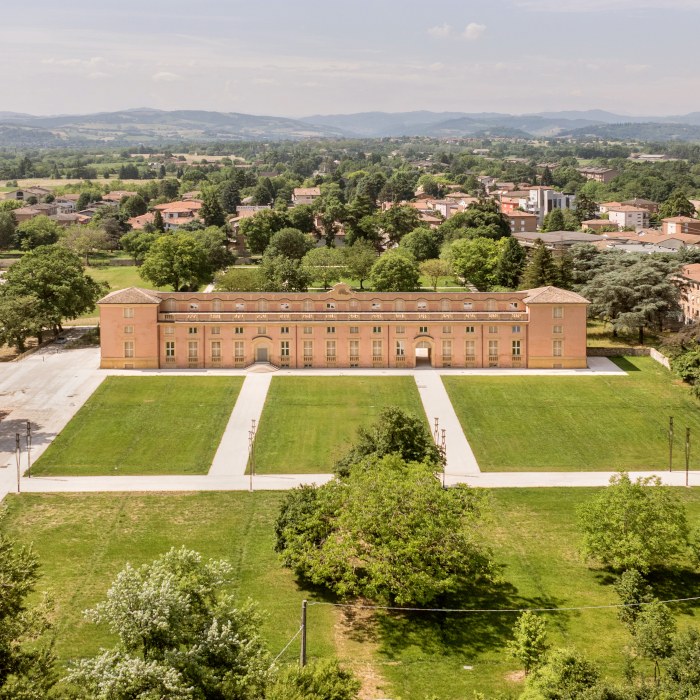
We now find ourselves in Reggio Emilia’s main (and most beloved) green space: we have entered Crostolo Park, commonly known as Parco delle Caprette due to the presence of a few Tibetan goats at the park’s entrance. A pleasant cycle ride alongside the city’s river will take us to the Ducal Villa of Rivalta, the magnificent country mansion built on the orders of Duke Francesco III at the request of the French princess Charlotte Aglaé d’Orléans. The villa, inspired by the Palace of Versailles, had a ‘U’-shaped layout with a stately central block flanked by wings on either side. Plundered and largely demolished during the Napoleonic occupation, only part of it remains visible today, probably the section intended for the servants.
Corbelli's Pond and Villa d'Este
The path along the Crostolo stream runs alongside the Ducal Villa of Rivaltella and continues on to Villa d’Este, where the palace and the reservoir – originally built as a fishing retreat for Duke Francesco III d’Este – formed part of the wider project comprising the Ducal Palace of Rivalta and its gardens. The oval pond collected the water needed to power the fountains of the Reggia, to which it was connected via underground pipes that still exist today. In turn, the pond was fed by the nearby Crostolo stream via a connecting canal which, originally, was also the only access route to the villa, navigable only by small boats. Today, Villa d’Este is open only for weddings and special events, but visitors can stroll along the oval basin and enjoy some well-deserved relaxation in the shade of the large trees.
Villa Levi
From the Vasca di Corbelli (Villa d’Este), once you have passed the Stradello delle Melmare, cross the SS63 and, heading up along the Rio della Vasca (CAI path no. 646 D), you arrive at Parco le Ginestre. Continuing along the road and through the Cavalla woods (an ancient military road used for troop movements), you reach Villa Levi, one of the most distinctive villas in the Reggio Emilia countryside, built in a distinctly neoclassical style. From 1888, the villa was home to Margherita Levi and, for a few years, her first husband, Baron Alberto Franchetti, who belonged to a noble Sephardic Jewish family. Their son, Baron Raimondo Franchetti, was the last of the great Italian explorers in Africa. His hunting trophies and artefacts from his travels are now housed in the Palazzo dei Musei in Reggio Emilia.
Consorzio Vacche Rosse and Villa Gastinelli
The route continues alongside the wall of the Coviolo cemetery and follows the cycle path on Via F.lli Rosselli as far as the Consorzio Vacche Rosse, a dairy which uses only Reggio Emilia red cow breed milk to produce their products, with a shop where you can visit the maturing cellars and buy some excellent locally sourced Parmigiano Reggiano. To the left of the dairy stands the 18th-century Villa Gastinelli, named in honour of a retired general who moved to Reggio from Piedmont in the 19th century. From here, continuing along Via F.lli Rosselli, you rejoin the Crostolo stream cycle path, forming a circular route that winds through the riverside parks and past the most beautiful villas in the province of Reggio.


