
Parco del Popolo
Piazza della Vittoria - Viale Allegri
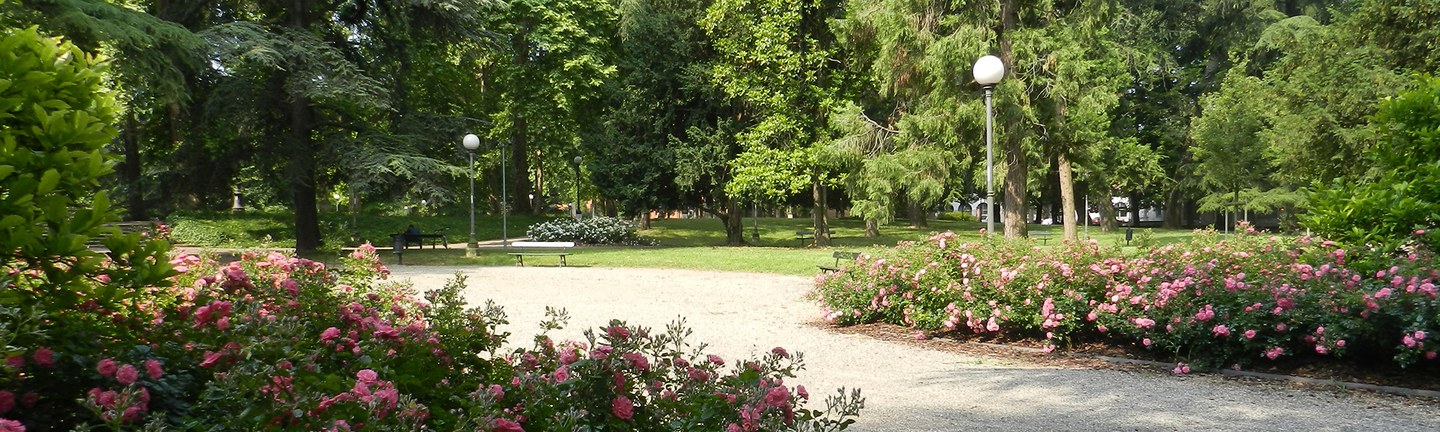
People's Park (also known as the Public Gardens) is situated in the historic city centre, specifically in the area where the ancient Gonzaga Citadel once stood, built in the first half of the 14th century on the site of the old San Nazario district.
La Cittadella
The Gonzaga Citadel housed the Lord’s Palace, barracks, storehouses, military facilities and the small fortress used as a prison.
Its layout remained unchanged in the centuries that followed, during which time the city came under the permanent rule of the Este family. In 1472, Nicolò Ariosto came to Reggio as Captain of the Citadel, and two years later, the city was the birthplace of the famous poet Ludovico Ariosto.
In memory of this, a commemorative stele now stands in the flowerbed where his home once stood. In 1848, following a popular uprising against the Este government, work began on the demolition of the walls and ramparts of the Citadel.
Of the buildings within it, only the stables and part of the Palace were spared.
The vast void left by the demolition of the Citadel prompted the government to design a new grand theatre, the Romolo Valli Municipal Theatre (1851–57), following the fire that destroyed the older Ariosto Theatre in 1851.
The Duke, supported by certain nobles, opposed its full public use.
It was not until 1861, with the annexation of the former Duchy of Este to the Kingdom of Italy, that the citizens finally succeeded in securing public use of the area, and work began on the construction of a racecourse.
The racecourse
The first redevelopment of the site previously occupied by the Citadel involved the construction of a racecourse, consisting of a circular track bordered by a promenade.
The first horse races were enthusiastically received by the people of Reggio and attracted thousands of visitors to the city.
In 1864, the first Public Baths complex was built, and in 1876 the City Council approved engineer Giuseppe Balzaretto’s project to redevelop the area in a neoclassical style, featuring five large arched flowerbeds and a star-shaped design at the centre.
In 1929, the racecourse was finally decommissioned (in the early 1900s it had also been adapted as a cycle track) and the park was modernised and enhanced with flowerbeds, avenues, seating, plants and statues.
The monuments
The Abate Ferrari Bonini Fountain
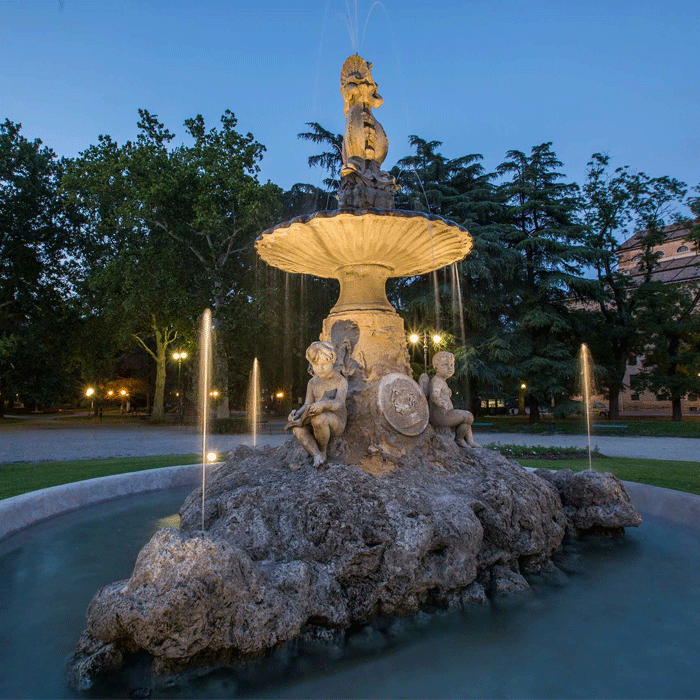
It was the first work commissioned specifically for the occasion in 1885, and was unveiled on 22 November to mark the completion of the city’s aqueduct.
The fountain was commissioned by Ulderico Levi, a distinguished politician from Reggio Emilia who was behind numerous initiatives for the benefit of the city.
The fountain consists of a large circular basin with a diameter of 10 metres, featuring a central rocky island from which rises a pedestal decorated with plant motifs, surmounted by three cherubs allegorically representing Fame, History and Gratitude.
On the sides of the base there are also three medallions: one features a bas-relief of the face of Abbot Ferrari Bonini, to whom the fountain is dedicated, whilst the other two, now lost, were commemorative metal plaques.
Resting atop the base is a second, smaller basin, featuring a series of sculptures depicting marine animals and plants, from which water gushes forth.
The Monument to the Concordi
The Tomb of the Concordi is an imposing funerary monument built almost two thousand years ago by a prominent Roman family who lived in the Brixellum (Brescello) area. Discovered in Boretto in 1929 during land reclamation works, it was subsequently transported to Reggio Emilia at the behest of the Fascist authorities.
This led to the hypothesis that the site of the discovery constituted one of the city’s two necropolises.
The construction of this imposing funerary monument gives us an insight into the desire of an important family of the Imperial era, the Concordi, to display to their fellow citizens the prestige and power of the office they had attained.
The structure of the monument, which is particularly striking, is known as ‘enclosed’ due to its characteristic square shape.
In the Reggio Emilia reconstruction of the 1930s, however, the rear section and part of the wings were omitted, resulting in an incomplete open form, as it still appears today.
Inside is the funerary stele bearing the inscription and portrait of the deceased, whilst at either end are two steles featuring the mythological figure of Attis, surmounted by two stone vases.
At the base of the stele are depictions of hunting scenes, various marine animals and an allegorical representation of the four seasons.
The War Memorial
In the period between the First and Second World Wars, a need arose throughout Europe to commemorate those who had died for their country through the construction of memorials. In Reggio too, in 1922, a competition was launched for the creation of a monument to those who had fallen in the First World War.
The winner was Alberto Buzzoni from Parma, and his monument was unveiled on 30 October 1927.
The monument has a granite base measuring sixteen metres across and stands fifteen metres high.
On the longer sides stand two large bronze statues, depicting an Infantryman (facing Piazza della Vittoria) and Winged Victory (facing the gardens).
The upper section is adorned with bronze bas-reliefs depicting the three Fates, a dying soldier supported by a female figure, a scene of work in the fields, and other figures of soldiers.
Other statues and fountains
Much of the sculpture collection in the Gardens was installed during the Fascist era.
Also during that period, the allegorical statues of the four seasons, originally from the ducal villa in Rivalta, were installed and have recently been relocated to Viale Umberto I.
In the 1930s, Mr and Mrs Parmeggiani donated several public works to the city for display in the public gardens.
Among these, two terracotta lion cubs stand out, placed on tall pedestals beside the fountain featuring a baby elephant (also donated by the couple, but unfortunately stolen in the 1980s and now represented only by a replica, created with the aid of historical photographs).
The Gardens also feature several works dedicated to illustrious figures who were born or active in the area.
The bust of Antonio Fontanesi, donated to the municipality in April 1937 by Anna and Luigi Parmeggiani, was created by the sculptor Marino Mazzacurati and was initially housed in their gallery.
A few years earlier, in 1934, the Parmeggiani couple donated another work, the bust of the painter Antonio Allegri, known as Correggio, created to mark the fourth centenary of his death.
The statues of Ludovico Ariosto and M.M. Boiardo, the work of the sculptor Riccardo Secchi, were created in 1916 for the Palazzo della Cassa di Risparmio in Reggio Emilia.
The series of illustrious figures concludes with the commemorative bust of the actress Maria Melato, who died in 1950.
The gardens also feature a replica of the famous Capitoline Wolf, a work dating from the 5th century BC.
A symbol of Rome, it became, in the interwar period, a symbol of Fascist Roman identity; during the regime, several replicas were produced and displayed in various Italian cities.
Historic trees
Most of the trees in the gardens are part of the original planting, and are therefore certainly over a hundred years old. The plane trees are, for the most part, those that formed the circular ring around the horse-riding track, and judging by their size, it is clear that a small number have been replaced.
The same applies to the Japanese pagoda trees, situated between the Municipal Theatre and the Ariosto. The majestic English oak growing near the Mercure Hotel and the American ash at the start of Viale Allegri were certainly also present by the end of the 19th century.
The botanical emblem of the gardens, however, is the great Lebanese cedar situated almost at the centre of the star-shaped layout.
Contacts
Piazza della Vittoria - 42121 Reggio Emilia


