
Villa Levi
Timetable
The villa is owned by the University of Bologna.
The interior can only be visited during events.
Villa Levi is one of the most evocative historical residences in the Reggio Emilia countryside.
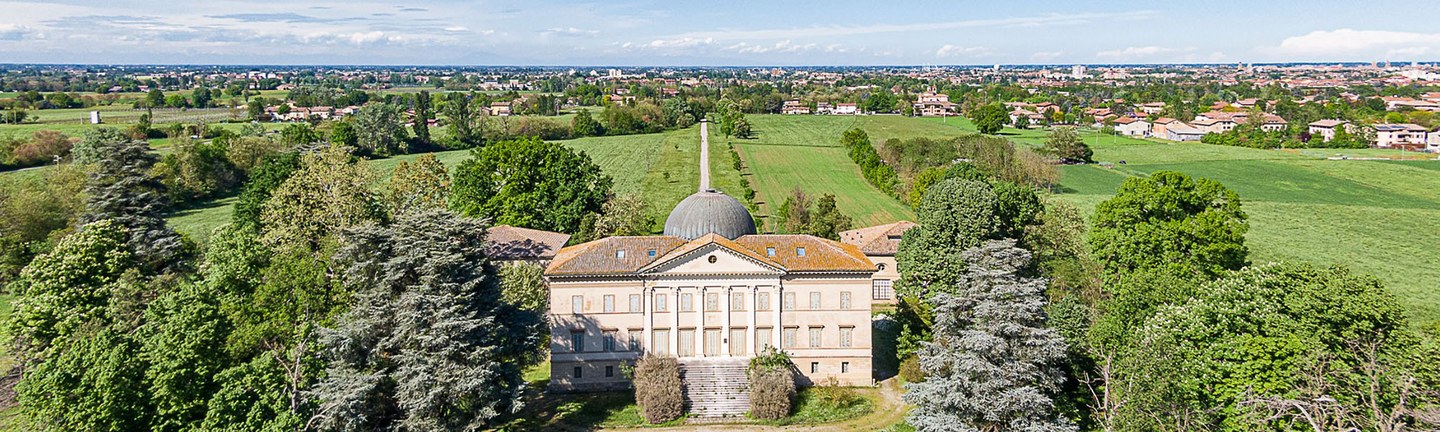
The villa stands out for its imposing metallic dome and the giant colonnade on the southern facade, while a long perspective avenue of about 680 meters.
Nestled in the Reggio countryside, Villa Levi is one of the most fascinating villas in the territory, blending history, art, and landscape into a single setting.
Surrounded by a park and an Italian-style garden, the villa is distinguished by its imposing metallic dome and the giant colonnade on the southern front, while to the north, a long perspective avenue of about 680 meters connects it to the surrounding landscape, giving it a central and scenographic role.
History and Architecture
Most likely built in the first half of the 17th century as a summer residence, Villa Levi was extensively renovated between 1790 and 1810 by the Besenzi family based on a design by architect Domenico Marchelli.
During this phase, the tympanum and the Italian-style garden were introduced, along with two service buildings for the caretaker and the stable.
In the 1830s, the engineer and architect Luigi Poletti added the famous dome supported by a giant circular colonnade, as well as the pronaos with a monumental staircase connecting the ground floor to the noble floor (piano nobile), giving the building a solid Palladian imprint.
The circular portico hosted outdoor parties and small performances, while beneath the dome lies a circular hall that opens onto the park through large windows.
In 1874, the villa passed to the Levi family, one of the most influential families in Reggio's Jewish community. The beginning of the 20th century brought elegant interior decorations in the Art Nouveau (Liberty) style, while in 1956 the villa was acquired by the Pelosi family, and in 1971 by the University of Bologna, which used it for its Animal Production Sciences degree program.
The interiors: the Aula Magna
The heart of Villa Levi is the University's Aula Magna (Great Hall), a majestic hemispherical room surrounded by 12 faux-marble columns with Corinthian capitals.
The double-shell dome, painted in blue, represents the sky and reflects the Masonic tradition of the Levi family, symbolically offering an opening toward the infinite.
The Dome
Villa Levi possesses two domes: the internal masonry one that forms the ceiling of the Aula Magna, and the external one, visible from the outside, made with a delicate framework of wooden planks covered in copper.
Beneath the external dome lies the evocative "hall of the two domes," where the floor is formed by the internal dome and the ceiling by the external one.
A walkway allows visitors to admire the painted starry sky and once served as an astronomical observatory.
The Park
The 4-hectare park stretches between Via Fratelli Rosselli and the Modolena stream.
The eastern area, in front of the villa, is an elliptical lawn surrounded by monumental trees, while the western part maintains a more natural appearance with rustic meadows and hedges along the stream.
Among the most notable species are cedars, ash trees, plane trees, lindens, and English oaks.
Figures and Curiosities
From 1888, the villa hosted Margherita Levi and her husband, Baron Alberto Franchetti, a well-known Verismo composer.
Their son Raimondo Franchetti, a famous explorer, died in a plane crash in Africa; many of the artifacts from his travels are preserved today at the Natural History Museum of Reggio Emilia.
During World War II, a tunnel in the park served as an air-raid shelter, and the villa was used by the Germans as a barracks.
Alfonso Chierici's historic theater curtain was also hidden here to save it from destruction.
Along the dirt avenue connecting Villa Levi to Coviolo, an air-raid tunnel dating back to World War II was recently discovered, used as a shelter during bombings.
In those dark years, Villa Levi was occupied by the Germans and used as a barracks. It was here that Alfonso Chierici's curtain was hidden, as it was at risk of being plundered and taken to Germany.
Contacts
Via Fratelli Rosselli, 107 - 42123 Reggio Emilia (RE)


