
San Giovanni Battista Baptistery
Timetable
Open for special events
Located next to the Cathedral, the Baptistery is one of the oldest and most fascinating sites in the city, bearing witness to almost a millennium of history and faith.
Its origins date back to around 1040–1049, when it was built on a Latin cross plan, with the baptismal font situated at its centre – the symbolic and spiritual heart of the building.
Over the centuries, the Baptistery underwent numerous alterations, but the most significant transformation took place at the end of the 15th century, under Bishop Bonfrancesco Arlotti, a key figure in the city’s Renaissance revival.
It is to him that we owe the elegant Renaissance façade, with the striking lunette above the portal depicting the Baptism of Christ, and the integration of the building into the nearby Bishop’s Palace.
Inside, there is a valuable series of paintings: the fresco of the Baptism of Christ, painted by Francesco Caprioli between 1497 and 1498, with the probable collaboration of the Milanese artist Cesare Cesariano for the refined painted architecture.
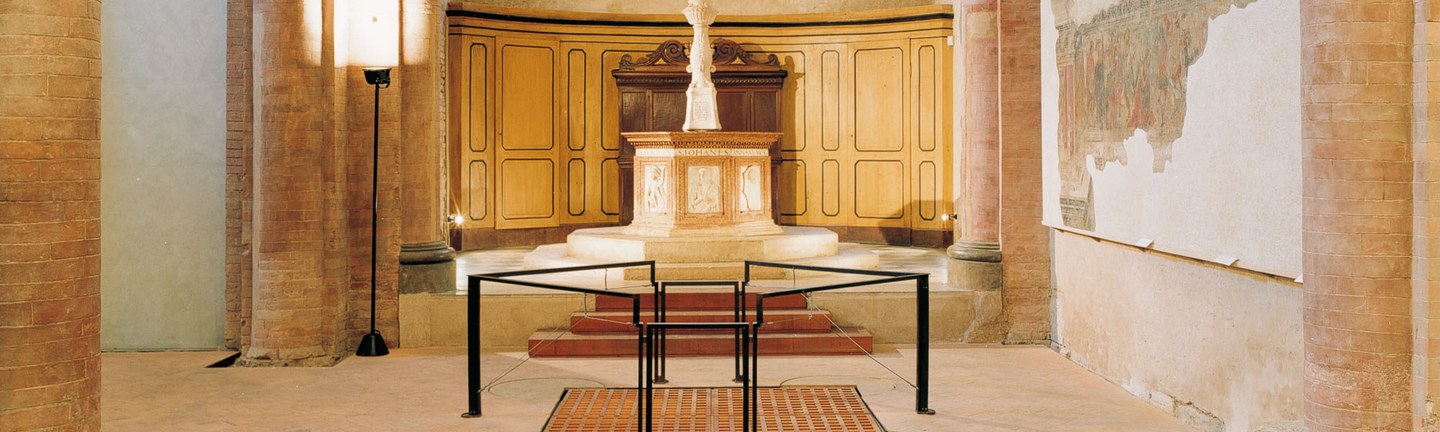
At the centre, the baptismal font in red Verona marble (1494), decorated with carved panels, bears witness to the artistic mastery and attention to detail that characterised Reggio Emilia’s art of the late 15th century.
A meticulous restoration, carried out in the 1980s, has brought to light large sections of the original medieval structures, which remained unknown until 1984.
Measures, legends and folk traditions
On the outside, on the left-hand column, two curious marks carved into the stone can still be seen today: the braccio reggiano (0.641 metres) and the pertica (3.846 metres, equivalent to six braccia), ancient units of commercial measurement used by merchants to ensure fair trade.
These measurements gave rise to a curious popular saying, handed down through the centuries: “San Giovanni reveals the deceptions” an ironic way of reminding merchants of their duty to be honest in trade.
With the introduction of the metric system in 1803, these ancient units fell into disuse, but the Reggio ‘biolca’, an agricultural measure equivalent to 0.2922 hectares, remains today a small fragment of history that continues to live on in the rural vernacular of the province.


