
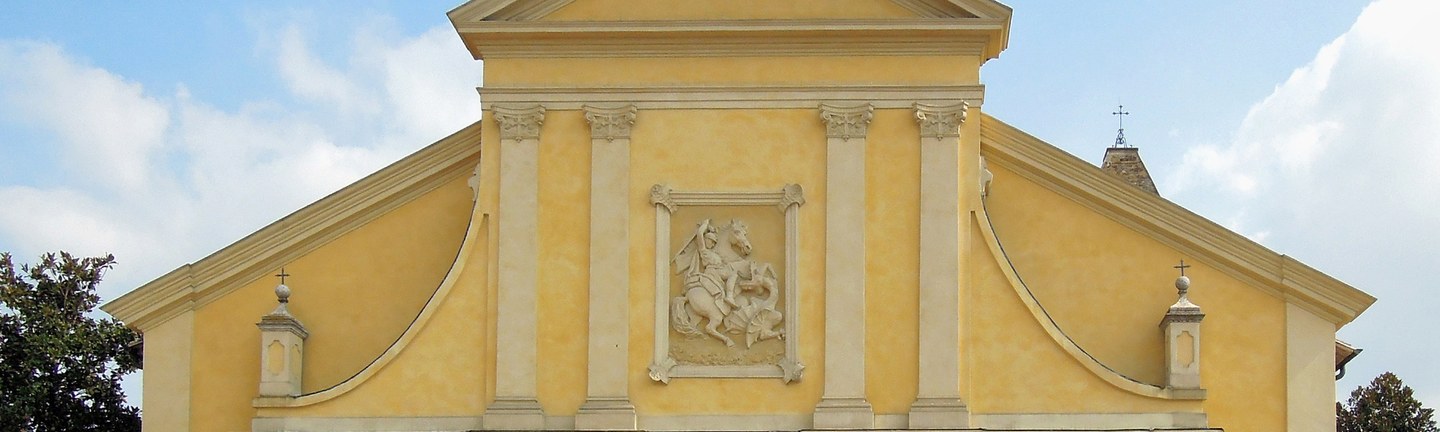
San Giorgio Parish Church
Luzzara
The Parish Church of San Giorgio is the spiritual and historical heart of Luzzara, a place steeped in over twelve centuries of faith, art and history.
A charter issued by Charlemagne in 781 first attests to its existence as an oratory in “Luciara”, donated to the Bishop of Reggio Emilia; a few decades later, Empress Angilberga granted it to the monastery of San Sisto in Piacenza.
In 1106, under Matilda of Canossa, the oratory officially became a parish with a baptismal font, whilst in the 16th century a long process of architectural and artistic transformations began.
In 1521, on the Bishop’s orders, major restoration work began and Bernardino Luini, the great Lombard master and pupil of Leonardo, was commissioned to paint the famous altarpiece in the apse, Madonna and Child between St George and St Jerome, which remains one of the most precious masterpieces housed in the church to this day.
The complex underwent numerous alterations over the centuries: in 1657, the architect Andrea Bassi reorganised the structure based on designs by Rostoni of Reggio Emilia, retaining the ancient Romanesque apse; in 1772, the church was reconsecrated following damage caused by the wars.
The bell tower, demolished in 1900 and subsequently rebuilt, together with the restoration of the façade and the repainting carried out in 1930, gives the building the harmonious appearance we know today.
The Baroque interior features a Latin cross plan with three naves, a transept, an octagonal dome and a deep Romanesque apse decorated with small arches and pilasters.
The side chapels house works of great value:
- Madonna and Child between St George and St Jerome by Bernardino Luini (16th century);
- Deposition (16th century);
- Pietà and Christ in Gethsemane (18th century);
- Annunciation on the altar frontal.
The high altar, in marble inlaid with floral motifs, is the work of the Columelli brothers of Florence, whilst the Gonzaga Chapel of Our Lady of the Rosary, linked to the nearby Gonzaga palace of La Macina, houses frescoes and stuccoes of exquisite craftsmanship.
Among the rarest treasures are also the 18th-century gold and silver altar cloths and chasubles, and the organ built in 1785 by Antonio Negri Poncini of Parma, which is still used today for concerts and liturgies.


