
Reggiolo Fortress
Timetable
External visiting only.
Mighty border fortress in the Bassa Reggiana
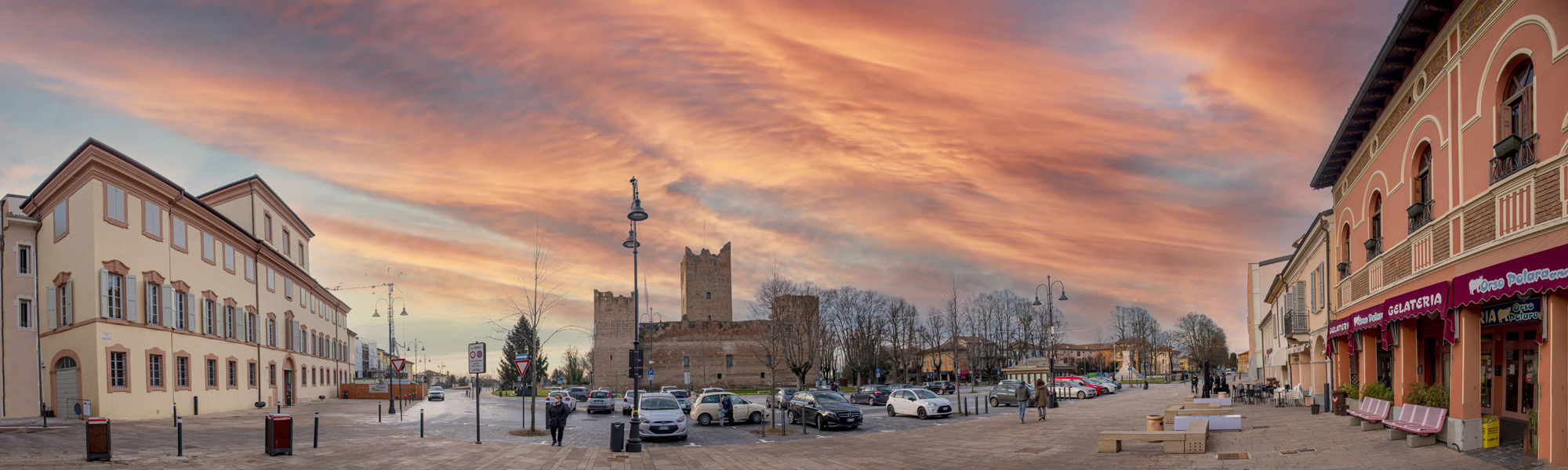
Standing in the heart of the historic center of Reggiolo is the imposing Rocca, one of the best-preserved medieval fortresses in the Bassa Reggiana plain.
It was erected in the first half of the 13th century by the Commune of Reggio Emilia as a defensive outpost to withstand frequent raids by the rival forces of Mantua, who launched numerous assaults against it.
The stronghold originally coalesced around an ancient medieval tower (mastio or central keep), constructed in 1242 on a modest artificial mound known as a mota.
Standing no higher than eight meters initially and ringed by a forty-meter curtain wall, this primitive core represents the oldest civic fortification commissioned directly by the authorities of Reggio.
Gonzaga expansion
Between the 14th and 15th centuries, under the rule of the Gonzaga dynasty, the fortress underwent major structural overhauls to adapt to evolving artillery warfare and defense against bombards.
Around 1370, the curtain wall was raised to a height of 14 meters and fortified with four corner towers rising nearly 20 meters high, two of which projected outward on the southern elevation.
Today, the vertical masonry seams separating the original medieval stonework from later additions remain clearly visible.
On the northern side opened the main gate, shielded by towers aligned with the walls and defended by a deep moat facing Mantuan territory.
These towers, open on their interior faces, were connected to the central keep via suspended walkways, evidence of which survives in the numerous joist holes piercing the walls.
Splayed loopholes (feritoie a strombo), wider on the inside and narrowing outward, enabled effective defense of the access routes.
Gates, moats, and ramparts
At the center of the southern facade lies a narrow gateway flanked by a fifth, central tower.
The vertical channels through which the portcullis (saracinesca) once slid are still visible along the jambs.
Preceding this gate stood an additional defensive work, a wooden battifredo (barbican), which served as a fortified vestibule between the entrance and the outer drawbridge.
Traces of this vanished structure can be discerned in the color variations of the bricks on the corner towers.
Guard patrols continuously paced the battlements along the entire perimeter.
Remnants of the ancient crenellations survive, likely square-topped (Guelf) during the early Reggio rule and later adapted into swallowtail (Ghibelline) merlons under the influence of Mantua.
Within the courtyard enclosures were soldier quarters, stables, storehouses, residences, a chapel dedicated to Santa Maria, and the seat of the local Governor or Vicar.
A unique defensive system
Externally, a wide moat encircled not only the fortress itself but also the fortified settlement (castello) to the north, which was linked to the stronghold via a secondary drawbridge.
Fed by the waters of the Tagliata canal, the moat described a grand figure-eight footprint, isolating and protecting the entire fortified system.
The outer town walls and towers were eventually demolished during the 18th century.
Art, mysteries, and restoration
In 1472, the Gonzaga family entrusted Florentine architect Luca Fancelli, a collaborator of Leon Battista Alberti, with remodeling the so-called "palazzo in rocca", decorating and plastering its stately halls.
Of these interior spaces, only a single large, stripped hall remains today on the eastern side. Despite attempts to transform it into a residential palace, the Rocca largely retained its stark military character, a rare occurrence among lowland strongholds.
Fancelli is also rumored to have designed secret subterranean passages: historical records mention underground escape routes heading toward Gonzaga and Villa Aurelia, a hypothesis corroborated by recent archaeological excavations.
Following significant damage sustained during the 2012 earthquake, the fortress is currently undergoing restoration. While interior access is restricted, the monument remains one of the most powerful symbols of military heritage in the region.
Contacts
Vicolo Castello, 2 - 42046 Reggiolo (RE)
Keep exploring