<?xml version="1.0" encoding="utf-8" ?>
<rdf:RDF xmlns:rdf="http://www.w3.org/1999/02/22-rdf-syntax-ns#" xmlns:dc="http://purl.org/dc/elements/1.1/" xmlns:syn="http://purl.org/rss/1.0/modules/syndication/" xmlns="http://purl.org/rss/1.0/">


<channel rdf:about="https://www.reggioemiliawelcome.it/en/search_rss">
  <title>English</title>
  <link>https://www.reggioemiliawelcome.it</link>

  <description>
    
            These are the search results for the query, showing results 1 to 15.
        
  </description>


  <image rdf:resource="https://www.reggioemiliawelcome.it/logo.png"/>

  <items>
    <rdf:Seq>
      
        <rdf:li rdf:resource="https://www.reggioemiliawelcome.it/en/reggio-emilia/flavours/food-and-wine-factories/wine-cellars"/>
      
      
        <rdf:li rdf:resource="https://www.reggioemiliawelcome.it/en/reggio-emilia/hotels-and-restaurants/where-to-eat/restaurants-pizzerias-holiday-farms/a-canali"/>
      
      
        <rdf:li rdf:resource="https://www.reggioemiliawelcome.it/en/reggio-emilia/discover-the-area/people-history-traditions/curiosities/the-story-of-palazzo-dei-musei"/>
      
      
        <rdf:li rdf:resource="https://www.reggioemiliawelcome.it/en/boretto/discover-the-area/routes-and-tours/cycling-mountain-biking/le-piccole-capitali-del-po"/>
      
      
        <rdf:li rdf:resource="https://www.reggioemiliawelcome.it/en/gattatico/discover-the-area/people-history-traditions/famous-people/cervi-brothers"/>
      
      
        <rdf:li rdf:resource="https://www.reggioemiliawelcome.it/en/reggio-emilia/discover-the-area/people-history-traditions/curiosities/the-patron-saint2019s-pardon"/>
      
      
        <rdf:li rdf:resource="https://www.reggioemiliawelcome.it/en/trade-fairs-and-convention-services/tourist-services/tourism-professionals/tourist-guide-taiani-valeria"/>
      
      
        <rdf:li rdf:resource="https://www.reggioemiliawelcome.it/en/santilario-denza/how-to-get-there/transports/by-train/santilario-denza-railway-station"/>
      
      
        <rdf:li rdf:resource="https://www.reggioemiliawelcome.it/en/reggio-emilia/events/events-and-initiatives/religious-festivals/san-prospero-patrono-di-reggio-emilia"/>
      
      
        <rdf:li rdf:resource="https://www.reggioemiliawelcome.it/en/boretto/discover-the-area/routes-and-tours/waterways/river-trips-lunches-and-dinners-while-sailing-aboard-motonave-stradivari"/>
      
      
        <rdf:li rdf:resource="https://www.reggioemiliawelcome.it/en/campagnola-emilia/hotels-and-restaurants/where-to-eat/restaurants-pizzerias-holiday-farms/ristorante-pizzeria-santo-stefano"/>
      
      
        <rdf:li rdf:resource="https://www.reggioemiliawelcome.it/en/reggio-emilia/hotels-and-restaurants/where-to-stay/room-rentals-inns/residence-via-mussini"/>
      
      
        <rdf:li rdf:resource="https://www.reggioemiliawelcome.it/en/discover-the-area/routes-and-tours/history-and-culture-routes/not-to-be-missed/reggio-emilia-a-city-of-art-and-culture"/>
      
      
        <rdf:li rdf:resource="https://www.reggioemiliawelcome.it/en/discover-the-area/routes-and-tours/history-and-culture-routes/not-to-be-missed/reggio-and-the-tricolour"/>
      
      
        <rdf:li rdf:resource="https://www.reggioemiliawelcome.it/en/discover-the-area/routes-and-tours/history-and-culture-routes/not-to-be-missed/reggio-and-contemporary-trends"/>
      
    </rdf:Seq>
  </items>

</channel>


  <item rdf:about="https://www.reggioemiliawelcome.it/en/reggio-emilia/flavours/food-and-wine-factories/wine-cellars">
    <title>Wineries</title>
    <link>https://www.reggioemiliawelcome.it/en/reggio-emilia/flavours/food-and-wine-factories/wine-cellars</link>
    <description>From the mountains to the plain (their border runs along the via Emilia), from the Grand Countess Matilde di Canossa to Gualtieri's naive painter Antonio Ligabue, the history and culture of this land have always revolved around the country and its fruits: foods, wisdom and values. The typical wine is called Lambrusco.
</description>
    <content:encoded xmlns:content="http://purl.org/rss/1.0/modules/content/"><![CDATA[<p>Today, the agricultural province of Reggio Emilia is in revolutionary ferment that is spreading from the barrels of wine to stir up the farmers, restaurant owners and the entire population and set everyone thinking. This ferment is called Lambrusco.</p>
<p style="text-align: left; "><span>It is </span><span>the wine of excellence from Emilia</span><span>, a unique expression of Italian wine culture.</span></p>
<p>It represents the most widely grown family of vines in the countryside that stretches east of Parma to include the territories of Reggio Emilia, Modena and those bordering on Mantua. An extremely agreeable sparkling wine is produced from these fragrant grapes and it is <span>the most widely exported around the world</span>.</p>
<p>The fans are divided between those who prefer the <span>sweet</span> or <span>dry varieties</span>, the aroma of violets or that of red fruits. The fine cooking of Emilia loses something of its character if not accompanied by this excellent sparkling wine.</p>
<p><a class="external-link" href="https://www.beverfood.com/cantine/re-reggio-emilia.html">https://www.beverfood.com/cantine/re-reggio-emilia.html</a></p>]]></content:encoded>
    <dc:publisher>No publisher</dc:publisher>
    <dc:creator>magnaf</dc:creator>
    <dc:rights></dc:rights>
    <dc:date>2014-04-16T13:15:00Z</dc:date>
    <dc:type>Page</dc:type>
  </item>


  <item rdf:about="https://www.reggioemiliawelcome.it/en/reggio-emilia/hotels-and-restaurants/where-to-eat/restaurants-pizzerias-holiday-farms/a-canali">
    <title>Trattoria "A Canali"</title>
    <link>https://www.reggioemiliawelcome.it/en/reggio-emilia/hotels-and-restaurants/where-to-eat/restaurants-pizzerias-holiday-farms/a-canali</link>
    <description>Trattoria con cucina tipica reggiana e bottega di prodotti dell’Appennino: pasta, olio, aceto, formaggi, conserve, miele, marmellate, tisane, ortaggi e tanto altro.</description>
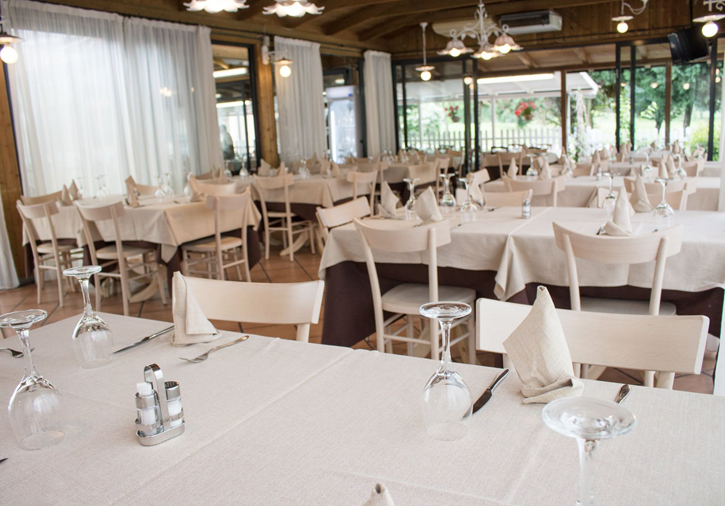
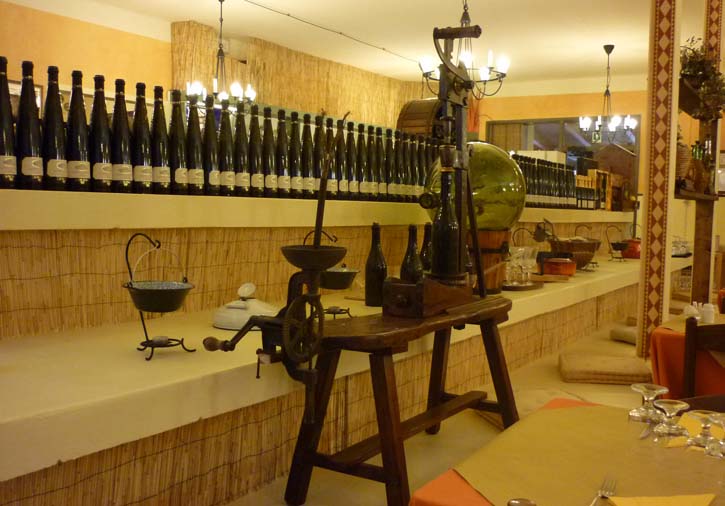
    <content:encoded xmlns:content="http://purl.org/rss/1.0/modules/content/"><![CDATA[<p><span style="height: 1.5em;"><a href="https://www.reggioemiliawelcome.it/en/reggio-emilia/hotels-and-restaurants/where-to-eat/restaurants-pizzerias-holiday-farms/restaurants-images/TrattoriaACanali.jpg" class="internal-link"><img src="https://www.reggioemiliawelcome.it/en/reggio-emilia/hotels-and-restaurants/where-to-eat/restaurants-pizzerias-holiday-farms/restaurants-images/TrattoriaACanali.jpg/@@images/550779d7-8ab2-45b4-9016-c39e5fb5973e.jpeg" alt="Trattoria &quot;A Canali &quot;, inside" class="image-inline" title="Trattoria &quot;A Canali &quot;, inside" /></a></span></p>
<p><span class="discreet"><strong>Tavern</strong></span></p>
<p>Groups are accepted. <br />Reservation recommended.</p>
<h4 class="subtitle">Opening times</h4>
<p><strong>Weekdays:</strong> <span class="muted"><strong>12.00 - 11.00 p.m. </strong></span><br /><strong>Sunday </strong>and <strong>holidays: </strong><span class="muted"><strong>12.00 - 11.00 p.m.</strong></span><br /><span style="height: 1.5em;"><strong> </strong></span></p>
<p><span style="height: 1.5em;"><strong>Weekly closure:</strong> </span><span class="muted"><strong>Monday</strong></span></p>]]></content:encoded>
    <dc:publisher>No publisher</dc:publisher>
    <dc:creator>magnaf</dc:creator>
    <dc:rights></dc:rights>
    <dc:date>2014-06-24T14:25:00Z</dc:date>
    <dc:type>DoveMangiare</dc:type>
  </item>


  <item rdf:about="https://www.reggioemiliawelcome.it/en/reggio-emilia/discover-the-area/people-history-traditions/curiosities/the-story-of-palazzo-dei-musei">
    <title>The story of Palazzo dei Musei</title>
    <link>https://www.reggioemiliawelcome.it/en/reggio-emilia/discover-the-area/people-history-traditions/curiosities/the-story-of-palazzo-dei-musei</link>
    <description>The story of the Palazzo San Francesco (St. Francis’ Palace) began in 1256, when the Franciscans, by authorisation of Bishop Guglielmo Fogliani, took up residence at the church of San Luca and the adjacent imperial palace, which had been used as an Episcopal centre since 1195.
In 1272, work began that resulted in the conversion of the palace into a convent and in the construction of a new church devoted to St. Francis. Final
transfer of the property was ratified in 1276 by Rudolph of Habsburg, the Emperor of the Holy Roman Empire. </description>
    <content:encoded xmlns:content="http://purl.org/rss/1.0/modules/content/"><![CDATA[<div id="bottomfooter">
<p style="text-align: justify; ">By the XV century, the convent was already structured over two floors, and a large porticoed cloister had been built close to the northern side of the church. As can be gathered from several views of the city dating back to the XVII and the XVIII centuries, the building was characterised by a large vegetable garden and by a boundary wall that extended to occupy part of the current via Spallanzani.<br />This configuration was subsequently modified during projects completed from 1700 to 1725 from a design by architect Giovanni Maria Ferraroni, also known as Brighi. Both the convent and the church were refinished, which partially conserved the arrangement of the buildings on the one hand, but completely changed the urban configuration and impact, with the buildings we now see in the city’s landscape being the final result.<br />In 1798, Palazzo San Francesco was also subjected to Napoleon’s suppression, and the Conventuals abandoned their domicile, never to return to Reggio Emilia. During the French occupation, the convent was used as a barracks and as a stall for horses.<br />After the Restoration, the Palazzo hosted the Royal Legal Finishing School or Law School on the first floor, and the Royal Lyceum of Chemistry and Physics on the ground floor. The presence of these scientific<br />schools was the very factor that lead to the decision, in 1830, to set up the private collection of Lazzaro Spallanzani (purchased from the municipal government in 1799 and previously displayed in Palazzo San Giorgio) in Palazzo San Francesco, at the exact same spot where it can be admired to this day.<br />In 1862, don Gaetano Chierici of Reggio Emilia founded the Gabinetto di Antichità Patrie (Cabinet of Antiquities of the Native Land of Reggio Emilia), which became the Museo di Storia Patria (Museum of Homeland History) in 1870. The new facility was divided into large core collections that privileged the gathering and conservation of material of local interest, yet placed them within the framework of national cultural tradition.<br />The Chierici Museum of Palethnology displays local prehistoric and protohistoric materials gathered by Chierici himself, accompanied by and compared with objects from the same period but from different geographic areas, especially in Italy.<br />The collection reflects the methods of the new discipline of palethnology, as Chierici himself was in the process of defining.<br />The Galleria dei Marmi (Marble Gallery), which was created and opened to the public in 1875, and subsequently restored and expanded in 1991, hosts stone artefacts and Roman epigraphs (mostly funerary in nature), remnants of architectural decorations, and epigraphs and sculptures from the Middle Ages to the XVIII Century. Roman architectural items in marble are also displayed outdoors in the adjacent Cloister.<br />The Atrio dei Musei (Atrium of the Museums) contains not only mosaics with geometric motifs from the Roman era, but also large fragments of mosaic art from floor decorations that date back to the XII-XIII Centuries and were taken from several churches in Reggio, including the Cathedral, San Prospero, San Giacomo and San Tommaso.<br />The collections from the 1800s are completed with naturalist collections of zoology (in Antonio Vallisneri Hall), anatomy (in Paolo Assalini Hall) and botany. They are accompanied by collections of ethnographic materials (in Giambattista Venturi Hall), which were given a new layout in 1999, when a core group of objects acquired from the Parma Museum of Antiquity was added.<br />The perfect expansion of and complement to the Chierici Museum is the Sala di Reggio Romana (Hall of the Roman City of Reggio, 1996-1998). It includes collections of stamps, epigraphs, sculptures, mosaics, architectural fragments, ceramics, gold and jewellery, and handicrafts dating from the founding of the city by Rome to the Barbarian Age.<br />In the naturalist field, the XIX Century collections have been supplemented over the years with collections devoted to geology (1989) and the fauna in the Reggio area (1992), and with a display of the remains of the Valentina Whale (2001), a 3.5 million year-old cetacean fossil found in the Reggio hills overlooking Secchia valley.<br />On the top floor of the building, the Museum of Prehistory and Protohistory (1992) displays archaeological collections included after the rearrangement by Chierici. Using artefacts found in the most recent digs and finds, it presents an exhaustive overview of the highly ancient civilisations that once inhabited our area.<br />The Antonio Fontanesi Gallery, which was created in 1902 and has been reordered, expanded and enhanced a number of times, documents artistic culture in Reggio from the XIV to the XX Centuries.<br />Worth special mention in the collection are sections devoted to deposits of works of art from the BIPOP-CARIRE banking institute and the Gaetano Chierici School of Art – Institute of Art; a hall containing paintings, sculptures, drawings and engravings by Antonio Ligabue; and a recent hall devoted to Marco Gerra.</p>
<p>via Spallanzani, 1<br />42121 Reggio Emilia<br />T. +39 0522 456816</p>
<p><strong>Website</strong>: <a href="http://www.musei.re.it/english-version/">http://www.musei.re.it/english-version/</a></p>
<p> </p>
</div>
]]></content:encoded>
    <dc:publisher>No publisher</dc:publisher>
    <dc:creator>magnaf</dc:creator>
    <dc:rights></dc:rights>
    <dc:date>2014-06-10T15:15:00Z</dc:date>
    <dc:type>Page</dc:type>
  </item>


  <item rdf:about="https://www.reggioemiliawelcome.it/en/boretto/discover-the-area/routes-and-tours/cycling-mountain-biking/le-piccole-capitali-del-po">
    <title>The small capitals of the Po River</title>
    <link>https://www.reggioemiliawelcome.it/en/boretto/discover-the-area/routes-and-tours/cycling-mountain-biking/le-piccole-capitali-del-po</link>
    <description>The 30 km that divide Reggio Emilia from the Great River help us discover the small Renaissance capitals along the Po river as well as an amazing historical and natural landscape.</description>
    <content:encoded xmlns:content="http://purl.org/rss/1.0/modules/content/"><![CDATA[<h4 class="subtitle">Route analysis</h4>
<p style="text-align: justify; "><strong>Route:</strong> Luzzara - Guastalla - Gualtieri - Boretto - Brescello<br /><strong>Time:</strong> 1:22 h<br /><strong>Length: </strong>20,73 km<br /><strong>Best time:</strong> spring through autumn</p>
<h4 class="subtitle">DESCRIption</h4>
<p style="text-align: justify; ">This route is based upon the long-distance trails <strong>Eurovelo 8</strong>, <strong>Po Cycling Path</strong> and <strong>VenTo Cycling Trail</strong> (Venice-Turin), and it has been developed following the Po river course: this trail crosses the floodplains, connecting the five Municipalities on the river banks. From the trail it is possible to reach the town centres, admiring some stunning natural and historical places, without even get off from the bike! We can also see the "lidi" (the strands and beaches along the river, nowadays used as summer nightlife establishments), the Enza river ending into the Po river, the touristic port of Boretto, and so much more!</p>
<p><strong><span class="rassegna">1st stage: Boretto</span></strong></p>
<p>Near the main embankment of the Po river, lies the town centre of <strong>Boretto</strong>. This "comune" is the most known when it comes to mentions the Po river here in Reggio Emilia. We can find the majestic <strong>Saint Mark Basilica</strong>, the most noticeable landmark that here <strong>Venetians </strong>used to trade and reside. Remembering this major moment in history, we can also notice the pillar with <strong>St. Mark's Lion</strong>, the most distinguishable trait of the Venetian Conquest. Slowly passing above the embankment, we can discover the ancient local tradition of fluvial shipbuilding, visiting the three local museums:</p>
<ul>
<li><strong>Museo del Po e della navigazione interna - PO432</strong>, hosting several boats and navigation materials; </li>
<li><strong>Casa dei Pontieri</strong>, created inside lateral structures of the pontoon bridge; </li>
<li><strong>Museo multimediale della bonifica dell’Emilia Centrale</strong>, located into the historical water management building, where we can discover the vital importance that water reclamation and management meant for these lands. </li>
</ul>
<p><span class="rassegna"><br /><strong>2nd stage - Brescello</strong></span></p>
<p>Fancy discover folklore characters? Here in <strong>Brescello </strong>you can live into a cinema set, that of <strong>Don Camillo and Peppone</strong>! Pick up your bike and get in Brescello via the cycling path on the Po embankment. Strolling around this town, we can see the Don Camillo Church, the "speaking" crucifix, the Sputnik bell, the Peppone's house, and you can discover more inside the two public museums, one dedicated to the legacy of these characters, and the other one dedicated to <strong>Giovannino Guareschi</strong> (the writer that created the two characters inside his books), the territory and the impact that cinema gave on this town. Historically speaking, Brescello had a Roman past and an impressive importance throughout history, that you can discover inside the <strong>Roman Archeological Museum</strong>, with findings of the ancient <strong>Brixellum</strong>.</p>
<p><span class="rassegna"><strong><br />3rd stage - Gualtieri</strong></span></p>
<p>Flanking the Great River, after a 40-min ride, we arrive in Gualtieri, beautiful example of little Capital of Northern Italy's Renaissance. The town follows the legacy of the Bentivoglio Family, that across two centuries in 1500 and 1600 built the main palace and the water reclamation in the surrounding marshes. North of the town, we can find the cycling path that borders the floodplain. Taking this road, we reach the place where once was the town port. Keeping this road we arrive in one of the most hidden naturalistic gem of the Pianura Padana: the <strong>Isola degli Internati</strong> (the Interned Island). This place, now a biodiversity oasis, has its name from a group of people that in 1945 had this piece of land. Those people were former prisoners during Second World War, and by giving this land, they were granted a job and a stable income by selling the wood of trees growing here. Between the Island and the port we can see some old and new pile dwellings, that in summer are lived by young people and animated by amazing events at the sunset.</p>
<p>Walking on the Interned Island during the dry season of Po River, we can find three shipwrecks that were bombed and sunk during a vicious fire attack in Second World War. In this misty landscape, among fog, poplars, and marshes, lived for a long time <strong>Antonio Ligabue</strong>, the painter and sculptor that here found refuge during his deep and tormented crises and was rejected by the Gualtieri community. If you want to discover more about this artist, you can find an <strong>impressive collection of Ligabue's works</strong> inside <strong>Palazzo Bentivoglio</strong>, and also inside his house, where he used to live, in Via Giardino.</p>
<p><strong><span class="rassegna"><br />4th stage - Guastalla</span></strong></p>
<p>Going back on the Po River strand, we follow the cycling path until <strong>Guastalla</strong>, where we can admire the large floodplain, with its <strong>biodiversity</strong>, with amphibians, small predators such as wild cats, foxes, birds of prey, hedgehogs and water birds. Here, there are many ecological zones, such as <strong>Isola del Peccato</strong> (Sin Island), i <strong>Saliceti Allagati</strong> (the Flooded Willows) and the mouth of Crostolo River inside the Po river. Following Via Lido Po, we can reach the town centre of Guastalla and visit the beautiful <strong>Palazzo Ducale</strong>, home of a branch of Gonzaga Family and many more places that represented the <strong>noble power on these counties. </strong></p>
<p><strong><span class="rassegna">5th stage - Luzzara</span></strong></p>
<p>We end this route in the last town of the Reggio Emilia Plain before the Province of Mantua. This town is <strong>Luzzara</strong>, hometown of <strong>Cesare Zavattini</strong>: screenwriter, journalist, writer, poet, painter and <strong>ineluctable character for Italian Neorealist cinema</strong>. Together with Paul Strand, he created the photography book "<strong>Un Paese - A Town</strong>", dedicated entirely to the <strong>ending rural community of Luzzara</strong>, at the end of the Sixties. At the centre of the town we can find the <strong>Civic Tower</strong>, with an estimated height of <strong>55 meters</strong> (said to be the tallest tower in the Reggio Emilia Plain, beating the Bell Tower of Novellara), also with the beautiful <strong>St. George's Church </strong>in Romanic style. Nearby, in the hamlet of Villarotta, we can find the <strong>Museo del Truciolo</strong>, that created straw hats for centuries. Into the floodplains we can surely admire the<strong> local biodiversity</strong> and have a taste of adrenaline, with <strong>River Park</strong>: a tree-climbing park with activities for all people, from kids-friendly to high-adrenaline moments.</p>
<p style="text-align: justify; "><strong><img alt="📍" src="https://static.xx.fbcdn.net/images/emoji.php/v9/t86/1.5/16/1f4cd.png" /><a class="external-link" href="http://www.terredipoedeigonzaga.it/itinerari/luzzara-brescello-in-bici/" target="_blank"> Itinerary stages</a></strong></p>
<p><iframe height="480" src="https://www.google.com/maps/d/u/3/embed?mid=17BO9m6mg4rbsnEzJgC3kydILZybbGEpQ" width="100%"></iframe></p>
<h4 class="subtitle">practical INFORMAtION</h4>
<p><strong>Tourist office: IAT Guastalla - (+39) 0522 839763.</strong></p>
<p><strong>Bicycle Rent: <br /></strong></p>
<ul>
<li><strong>Guastalla</strong>, <a class="external-link" href="https://www.guastallaculturaeturismo.it/servizi/noleggio-biciclette/" target="_blank">Locanda dei Pontieri, Viale Po 11/13</a></li>
<li><strong>Boretto</strong>, <a class="external-link" href="https://www.riverpassion.it/noleggio-bici.html" target="_blank">River Passion, Via Argine 17</a></li>
<li><strong>Gualtieri</strong><a class="external-link" href="https://www.prolocogualtieri.it/?p=1641" target="_blank">, Pro Loco, Piazza Bentivoglio.</a></li>
</ul>
<p>Before starting, download the free app "<strong>Terre di Po in Bici</strong>"<strong>:</strong> you can find the updated route and the map also available offline.</p>]]></content:encoded>
    <dc:publisher>No publisher</dc:publisher>
    <dc:creator>magnaf</dc:creator>
    <dc:rights></dc:rights>
    <dc:date>2014-04-09T11:55:00Z</dc:date>
    <dc:type>Page</dc:type>
  </item>


  <item rdf:about="https://www.reggioemiliawelcome.it/en/gattatico/discover-the-area/people-history-traditions/famous-people/cervi-brothers">
    <title>The seven Cervi Brothers</title>
    <link>https://www.reggioemiliawelcome.it/en/gattatico/discover-the-area/people-history-traditions/famous-people/cervi-brothers</link>
    <description>Cervi were a numerous family of tenant farmers, who lived in Praticello di Gattatico, composed of father Alcide, mother Genoveffa Cocconi, seven male sons (Gelindo, Antenore, Aldo, Agostino, Ferdinando, Ovidio, Ettore) and two female daughters (Diomira and Caterina). The seven male sons, fervently antifascist, were shot to death by the fascists in Reggio Emilia December 28, 1943, after their house was destroyed and they were arrested one month earlier.</description>
    <content:encoded xmlns:content="http://purl.org/rss/1.0/modules/content/"><![CDATA[]]></content:encoded>
    <dc:publisher>No publisher</dc:publisher>
    <dc:creator>magnaf</dc:creator>
    <dc:rights></dc:rights>
    <dc:date>2013-12-19T10:20:00Z</dc:date>
    <dc:type>Page</dc:type>
  </item>


  <item rdf:about="https://www.reggioemiliawelcome.it/en/reggio-emilia/discover-the-area/people-history-traditions/curiosities/the-patron-saint2019s-pardon">
    <title>The Patron Saint’s Pardon </title>
    <link>https://www.reggioemiliawelcome.it/en/reggio-emilia/discover-the-area/people-history-traditions/curiosities/the-patron-saint2019s-pardon</link>
    <description>November 24, St Prospero’s day, a condemned prisoner, chosen at random, was taken to the omonimous Basilica and pardoned. It was the tribute that the town gave its Patron Saint.
</description>
    <content:encoded xmlns:content="http://purl.org/rss/1.0/modules/content/"><![CDATA[<p>In the Middle Ages and the Renaissance era a very sad building occupied the current open-space <a href="https://www.reggioemiliawelcome.it/en/reggio-emilia/discover-the-area/art-and-culture/piazzas-loggias-and-historical-routes/piazza-antonio-casotti" class="internal-link">Piazza Casotti</a>: it was the building that hosted the local prisons. Here were detained all people who contravened the rules of the Council Regulations.</p>
<p>They were jailed with ferocious murderers, thieves, brigands, swindlers and also tax evaders unable to pay any of the many levies that were already in force at the time.</p>
<p>Justice at the time was very severe, and in front of the prison, in the current Via Arcipretura where you find paper and print shops, lived an esteemed public servant: the executioner.</p>
<p>November, St Prospero’s day, a condemned prisoner, chosen at random, was instead taken to the omonimous Basilica and pardoned. It was the tribute from the city to its Patron Saint.</p>
<p>- Attilio Marchesini -</p>]]></content:encoded>
    <dc:publisher>No publisher</dc:publisher>
    <dc:creator>magnaf</dc:creator>
    <dc:rights></dc:rights>
    <dc:date>2014-11-04T08:30:00Z</dc:date>
    <dc:type>Page</dc:type>
  </item>


  <item rdf:about="https://www.reggioemiliawelcome.it/en/trade-fairs-and-convention-services/tourist-services/tourism-professionals/tourist-guide-taiani-valeria">
    <title>Taiani Valeria</title>
    <link>https://www.reggioemiliawelcome.it/en/trade-fairs-and-convention-services/tourist-services/tourism-professionals/tourist-guide-taiani-valeria</link>
    <description>Tourist Guide and Tour Escort</description>
    <content:encoded xmlns:content="http://purl.org/rss/1.0/modules/content/"><![CDATA[<h4 class="subtitle"><span>Contacts</span></h4>
<p><span><img src="https://www.reggioemiliawelcome.it/copy2_of_icone-info/mobile" alt="Mobile" class="image-inline" title="Mobile" /> </span><span><strong>+39 349 4228665</strong><br /></span><img src="https://www.reggioemiliawelcome.it/icone-servizi/email.gif" alt="Email" class="image-inline" title="Email" /> <a class="mail-link" href="mailto:taianivaleria20@gmail.com" title="Opens the email address of: &quot;Taiani Valeria&quot;">taianivaleria20@gmail.com</a></p>
<h4 class="subtitle">Activity</h4>
<p>Tourist Guide and Tour Escort for Reggio Emilia and province</p>
<h4 class="subtitle">Reservation</h4>
<p>By phone and em<span>ail</span></p>
<h4 class="subtitle"><span> </span>Prices</h4>
<div class="td_converted_to_div"><strong>€ 140.00 </strong>- Full day - <span class="muted"><strong>up to 15 people</strong></span><br />
<p><strong>€ 90.00</strong> - Half a day - <span class="muted"><strong>up to 15 people</strong></span></p>
</div>
<p><span class="text-warning"><strong>Extras</strong></span><br /><strong>€ 2.00</strong> - Each additional person</p>
<h4 class="subtitle">Sphere of reference</h4>
<p>Historical - Artistic</p>
<h4 class="subtitle">Languages known</h4>
<p><span>English - French - German</span></p>
<p> </p>
<p> </p>]]></content:encoded>
    <dc:publisher>No publisher</dc:publisher>
    <dc:creator>magnaf</dc:creator>
    <dc:rights></dc:rights>
    <dc:date>2015-04-29T13:10:00Z</dc:date>
    <dc:type>Page</dc:type>
  </item>


  <item rdf:about="https://www.reggioemiliawelcome.it/en/santilario-denza/how-to-get-there/transports/by-train/santilario-denza-railway-station">
    <title>Sant'Ilario d'Enza Railway Station</title>
    <link>https://www.reggioemiliawelcome.it/en/santilario-denza/how-to-get-there/transports/by-train/santilario-denza-railway-station</link>
    <description></description>
    <content:encoded xmlns:content="http://purl.org/rss/1.0/modules/content/"><![CDATA[<h1></h1>

<p><a href="http:"></a><a href="http:"></a><a href="http:"></a></p>

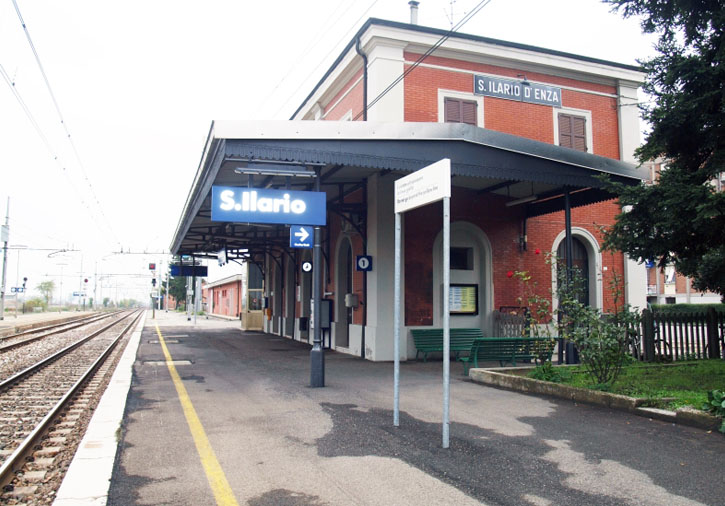
<p><span>Via Gramsci 3 - 42049 Sant'Ilario d'Enza</span><br /><img alt="Sito web - Website" class="image-inline" src="../../../../../icone-info-2/sito-web-website-1" title="Sito web - Website" /> <a style="width: 0px; border-radius: 3px;" href="https://www.reggioemiliawelcome.it/collegamenti/trenitalia" class="internal-link">Trenitalia</a></p>
<p><span style="height: 21px;"><a href="https://www.reggioemiliawelcome.it/en/santilario-denza/how-to-get-there/transports/by-train/StazioneSantIlario.jpg" class="internal-link"><img src="https://www.reggioemiliawelcome.it/en/santilario-denza/how-to-get-there/transports/by-train/StazioneSantIlario.jpg/@@images/2be0b534-aa87-4fed-a50e-12164e9f0708.jpeg" alt="Sant'Ilario d'Enza Railway station image" class="image-inline" title="Sant'Ilario d'Enza Railway station image" /></a></span></p>
<p><span style="height: 21px;">Railway station</span></p>
<h4 class="subtitle" id="content">Railway lines</h4>
<p><b>Parma - Bologna<br />Milano - Bologna</b></p>
<h4 class="subtitle">Information</h4>
<p id="content_tabschede"><img alt="Telefono -  Phone" class="image-inline" src="../../../../../copy2_of_icone-info/telefono-phone" title="Telefono -  Phone" /> <b><span>892 021</span></b>- Information about Trenitalia trains<br /><img alt="Telefono -  Phone" class="image-inline" src="../../../../../copy2_of_icone-info/telefono-phone" title="Telefono -  Phone" /> <strong>840 00 216</strong> - Information about urban and suburban buses: call center Seta <a style="width: 0px;" href="https://www.reggioemiliawelcome.it/collegamenti/seta-percorsi-extraurbani" class="internal-link">www.setaweb.it</a></p>
<p>The service is active <strong>Monday-Saturday</strong> from 07:00 a.m. to 07:00 p.m.; <strong>Sunday</strong> from 08:20 a.m. to 05:00 p.m.</p>
<div id="content_tabschede">
<p> </p>
</div>
<div id="content_tabschede">
<p> </p>
</div>
<p> </p>
<p> </p>
<p> </p>
<div id="content_tabschede">
<table>
<tbody>
</tbody>
</table>
</div>]]></content:encoded>
    <dc:publisher>No publisher</dc:publisher>
    <dc:creator>magnaf</dc:creator>
    <dc:rights></dc:rights>
    <dc:date>2013-12-13T10:40:00Z</dc:date>
    <dc:type>Page</dc:type>
  </item>


  <item rdf:about="https://www.reggioemiliawelcome.it/en/reggio-emilia/events/events-and-initiatives/religious-festivals/san-prospero-patrono-di-reggio-emilia">
    <title>San Prospero Patron Saint of Reggio Emilia</title>
    <link>https://www.reggioemiliawelcome.it/en/reggio-emilia/events/events-and-initiatives/religious-festivals/san-prospero-patrono-di-reggio-emilia</link>
    <description>November 24. Solemn religious ceremonies dedicated to Bishop Prospero, Patron Saint of Reggio Emilia. In piazza San Prospero and streets of the town centre.</description>
    <content:encoded xmlns:content="http://purl.org/rss/1.0/modules/content/"><![CDATA[<p>The Patron Saint, according to tradition, lived in the 5th century A.C. and was bishop of Reggio Emilia between 480 and 505, approximately. According to custom at the time, the Bishop was elected by the clergy and by the people united in a meeting - the example of St. Ambrogio is famous - choosing him from among the clergy and laymen who were most admired for their faith, culture and piety. This is what happened for San Prospero, who was certainly from Reggio and who merited not only the honour of being elected Bishop, but also being venerated as a Saint for his commitment in the diffusion and defence of the faith, as well as protector of the city. To understand the role of San Prospero in the life and history of the town and the diocese, it is necessary to be reminded of some of the events in those very difficult times. In 476 Odoacre, chief of the Eruli, first mercenary, then invader of the Western Roman Empire, had defeated and killed the Roman general Oreste at Pavia and deposed the last Emperor Romolo Augustolo. Odoacre then reigned Italy for many decades with the title of Roman Patrician, taking possession of a third of the lands to assign them to his soldiers and their families. In Italy there then followed a period of relative calm, apart from the easy abuses and episodes of violence which occurred, while the large and small land-owners were stripped of their lands and homes, often forced to flee or killed if they opposed the confiscation... But, it turned out that Odoacre's pacts and alliances with the Vandals from Africa, the Visigoths from Spain, the Franks and Burgundians from France, made Zenone, the Eastern Emperor, jealous. Thus, the latter, wishing also to free himself of Teodorico and his Ostrogoths, pushed them into invading Italy. The war between the Eruli and the Ostrogoths lasted almost four years; Odoacre was defeated in 489 on the Isonzo, then at Verona, then on the Adda and forced to take refuge at Ravenna. He resisted while being besieged here for three years, then in 493 surrendered and was killed for betrayal this meant. Four years of war and ravages and sackings the army. Four years of anarchy and violence throughout our region, while the wealthiest and most cultured citizens, the Roman magistrates fled to the south. The people abandoned the plain and took refuge in the hills and in the woods. In this situation it was the Bishops who had to assume the responsibilities of the magistrates, often also acting as judges and administrators of the cities. In the absence of others, and for the religious and moral authority with which they were invested, the Bishops had to exercise both religious and public functions, as true defenders of the city. San Prospero must have excelled in these arduous duties more than his seven predecessors, not only for his virtues and his learning, but above all for his spreading the Gospel, his protection of the weak and assistance to the bewildered. For these reasons the people of Reggio acknowledged his saintliness and invoked, even after his death, holy protection of the city. References permitting us to know about the life of the Patron Saint of Reggio in more detail, are scarce. San Prospero lived between 430 and 505 approximately, probably a true "Reggiano", he was elected by the clergy and the people and governed the diocese for 22 years; but practically all records from that time have been destroyed. This is due to the disastrous invasion of the Ungari-Magiari. In 899, after having invaded and sacked Veneto and Romagna, they came to Emilia where they destroyed the Monastery at Nonantola and at Reggio the Monasteries of S. Tommaso and S. Prospero, going as far as killing Bishop Azzo II. As a result, the first documents which tell us of the veneration of S. Prospero and the festival in his honour are a rent contract from the year 822 (eight years after the death of Carlo Magno) and two liturgical texts, "De vita" and " De traslatione", much later, but possibly dating back to the time of Bishop Tomaso (701/704), who transferred the Saint's remains from the church of S. Apollinare (now St Agostino) to the Church erected in his honour together with the monastery, which was later burnt down by the Ungari. After the transfer and subsequently a number of omens, his veneration spread widely in Emilia, Lombardia, Liguria, Tuscany and Umbria; but after the Council of Trento, which imposed the adoption of the Calendar and the Roman breviary, his veneration was gradually limited to the diocese of Reggio, Modena and Parma. To prevent the Saint's relics being lost or stolen in other calamities, Bishop Teuzone (979 - 1030) constructed a Basilica in his honour within the walls of the castle and transferred the venerated remains in the year 997; our Patron has resided in our town for the last one thousand years. Teuzone's Basilica, having become very old and ruined, the Town decided to honour the saint with a temple which was even larger and more magnificent: the present Cathedral. Later, in 1601, to cut short any dispute, bishop Claudio Rangone ordered an examination of the relics and it was established that they are properly preserved in the Basilica of the "Lions".</p>]]></content:encoded>
    <dc:publisher>No publisher</dc:publisher>
    <dc:creator>magnaf</dc:creator>
    <dc:rights></dc:rights>
    <dc:date>2013-12-14T11:50:00Z</dc:date>
    <dc:type>Event</dc:type>
  </item>


  <item rdf:about="https://www.reggioemiliawelcome.it/en/boretto/discover-the-area/routes-and-tours/waterways/river-trips-lunches-and-dinners-while-sailing-aboard-motonave-stradivari">
    <title>River trips, lunches and dinners aboard the Stradivari Motorboat</title>
    <link>https://www.reggioemiliawelcome.it/en/boretto/discover-the-area/routes-and-tours/waterways/river-trips-lunches-and-dinners-while-sailing-aboard-motonave-stradivari</link>
    <description>Navigations along the Po River with lunches and dinners aboard, private events.</description>
    <content:encoded xmlns:content="http://purl.org/rss/1.0/modules/content/"><![CDATA[<h4 class="subtitle">Information</h4>
<p>Via Argine Cisa - 42022 Boretto<br /><img src="https://www.reggioemiliawelcome.it/icone-info/website" alt="sito web" class="image-inline" title="sito web" /> <a style="width: 0px;" href="https://www.reggioemiliawelcome.it/en/boretto/how-to-get-there/getting-around/ports-and-docks/regional-tourist-port-on-the-po-river" class="internal-link">Boretto River Tourist Port<br /></a><img src="https://www.reggioemiliawelcome.it/copy2_of_icone-info/mobile" alt="Mobile" class="image-inline" title="Mobile" /><strong> +39 335 5293930</strong> (Claudia Rossi) - reservations of private events<br /><img src="https://www.reggioemiliawelcome.it/copy2_of_icone-info/mobile" alt="Mobile" class="image-inline" title="Mobile" /> <strong>+39 333 3616208</strong> (reservations)<br /><img src="https://www.reggioemiliawelcome.it/copy2_of_icone-info/mobile" alt="Mobile" class="image-inline" title="Mobile" /> <strong>+39 335 7590480</strong> (Captain)<br /><img src="https://www.reggioemiliawelcome.it/icone-info/website" alt="sito web" class="image-inline" title="sito web" /> <a href="mailto:info@motonavestradivari.it">info@motonavestradivari.it<br /></a><img src="https://www.reggioemiliawelcome.it/icone-info/website" alt="sito web" class="image-inline" title="sito web" /> <a class="external-link" href="http://www.motonavestradivari.it/">www.motonavestradivari.it</a></p>
<p> </p>
<p>Boarding area from the port of Boretto to visit the Wildlife Oasis of Internati (Prisoners) and enjoy the charm of the river landscape.</p>]]></content:encoded>
    <dc:publisher>No publisher</dc:publisher>
    <dc:creator>magnaf</dc:creator>
    <dc:rights></dc:rights>
    <dc:date>2015-05-23T15:45:00Z</dc:date>
    <dc:type>Page</dc:type>
  </item>


  <item rdf:about="https://www.reggioemiliawelcome.it/en/campagnola-emilia/hotels-and-restaurants/where-to-eat/restaurants-pizzerias-holiday-farms/ristorante-pizzeria-santo-stefano">
    <title>Ristorante Pizzeria Santo Stefano</title>
    <link>https://www.reggioemiliawelcome.it/en/campagnola-emilia/hotels-and-restaurants/where-to-eat/restaurants-pizzerias-holiday-farms/ristorante-pizzeria-santo-stefano</link>
    <description>Santo Stefano is a pizzeria restaurant serving traditional local dishes but also land and sea dishes. 150 inner and 40 seats outdoors.</description>
    <content:encoded xmlns:content="http://purl.org/rss/1.0/modules/content/"><![CDATA[<p>Via Vettigano, 26 - <span style="height: 1.5em;">42012 Campagnola Emilia<br />Phone 0039 0522 663922<br /><br /><a class="external-link" href="http://ristorantepizzeriasantostefano.it/">www.ristorantepizzeriasantostefano.it<br /></a><span>Facebook page </span></span></p>
<p><span style="height: 1.5em;"><a href="https://www.reggioemiliawelcome.it/en/campagnola-emilia/hotels-and-restaurants/where-to-eat/restaurants-pizzerias-holiday-farms/images-campagnola-ristoranti-pizzerie/RistoranteSantoStefano.jpg" class="internal-link"><img src="https://www.reggioemiliawelcome.it/en/campagnola-emilia/hotels-and-restaurants/where-to-eat/restaurants-pizzerias-holiday-farms/images-campagnola-ristoranti-pizzerie/RistoranteSantoStefano.jpg/@@images/354b32d3-e6c4-44a2-bf83-bc30c71cd4a6.jpeg" alt="Restaurant Pizzeria Santo Stefano" class="image-inline" title="Restaurant Pizzeria Santo Stefano" /></a></span></p>
<p>Restaurant - Pizzeria</p>
<h4 class="subtitle">Opening times</h4>
<p>from Tuesday to Friday 12:00 - 02:30 p.m.  /  06:00 - midnight<br />Saturday 12:00 - 14:30 p.m.  /  06:00 p.m. - 01:00 a.m.<br />Sunday 12:00 - 14:30 p.m.  /  06:00 p.m. - midnight<br /><span style="height: 1.5em;"><strong>Weekly closure</strong> Monday</span></p>
<h4 class="subtitle">Type of cuisine</h4>
<p>Tradizional local cuisine - Pizza - Fish</p>
<h4 class="subtitle">Wine list</h4>
<p>Yes</p>
<h4 class="subtitle">Average price</h4>
<p>€ 50.00<br /><span style="height: 1.5em;"><strong>Credit cards accepted</strong> Visa - Master Card - Maestro - CartaSi</span></p>
<p><strong><strong>Outside Seats</strong> </strong> 40<br /><strong>Rooms available</strong> <i> </i>2</p>
<p> </p>
<ul>
</ul>
<h4 class="subtitle">How to get there</h4>
<p>Campagnola Emilia</p>
<p>From Reggio Emilia: from viale Piave follow the road signs to Bagnolo in Piano. via Gramsci, via Provinciale Sud, turn right in via Enrico Fermi then in via Beviera. Turn left in via Stradella, then take via Canolo. Continue in the direction of Campagnola Emilia, then take via Provinciale Carpi-Guastalla/SP30.</p>
<h4 class="subtitle">Services and facilities</h4>
<p>Air conditioning<br />Car park</p>]]></content:encoded>
    <dc:publisher>No publisher</dc:publisher>
    <dc:creator>magnaf</dc:creator>
    <dc:rights></dc:rights>
    <dc:date>2014-02-10T14:40:00Z</dc:date>
    <dc:type>DoveMangiare</dc:type>
  </item>


  <item rdf:about="https://www.reggioemiliawelcome.it/en/reggio-emilia/hotels-and-restaurants/where-to-stay/room-rentals-inns/residence-via-mussini">
    <title>Residence Via Mussini</title>
    <link>https://www.reggioemiliawelcome.it/en/reggio-emilia/hotels-and-restaurants/where-to-stay/room-rentals-inns/residence-via-mussini</link>
    <description>Near the Ex Polveriera and not far from the town centre. Contacts: 0039 0522 550214 - info@residenceviamussini.it</description>
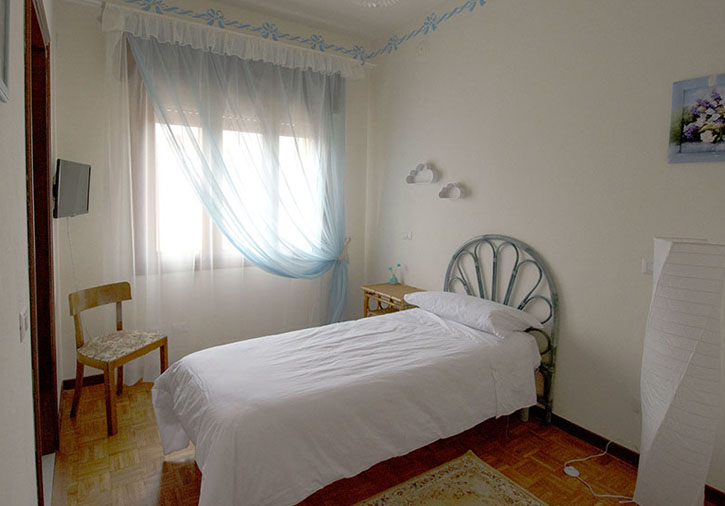
    <content:encoded xmlns:content="http://purl.org/rss/1.0/modules/content/"><![CDATA[<p><a href="https://www.reggioemiliawelcome.it/en/reggio-emilia/hotels-and-restaurants/where-to-stay/room-rentals-inns/room-rentals_images/residenceMUSSINI.jpg" class="internal-link"><img src="https://www.reggioemiliawelcome.it/en/reggio-emilia/hotels-and-restaurants/where-to-stay/room-rentals-inns/room-rentals_images/residenceMUSSINI.jpg/@@images/08b1e434-c36b-4161-8b4b-53777df06b33.jpeg" alt="Residence Via Mussini, room" class="image-inline" title="Residence Via Mussini, room" /></a></p>
<p><span class="discreet"><strong>Room &amp; Breakfast</strong></span></p>
<p>The guesthouse is located in a three-storied building with a garden nearby the town centre of Reggio Emilia, which is reachable with a 10-minute walk.<br />Each room is equipped with TV, free WI-FI and private bathroom with hair-dryer and spa-shower. Linen is included.</p>
<p><strong>Opening period:</strong><strong><span class="muted"> all year</span></strong></p>]]></content:encoded>
    <dc:publisher>No publisher</dc:publisher>
    <dc:creator>magnaf</dc:creator>
    <dc:rights></dc:rights>
    <dc:date>2016-03-09T14:25:00Z</dc:date>
    <dc:type>DoveDormire</dc:type>
  </item>


  <item rdf:about="https://www.reggioemiliawelcome.it/en/discover-the-area/routes-and-tours/history-and-culture-routes/not-to-be-missed/reggio-emilia-a-city-of-art-and-culture">
    <title>Reggio Emilia: town of art and culture</title>
    <link>https://www.reggioemiliawelcome.it/en/discover-the-area/routes-and-tours/history-and-culture-routes/not-to-be-missed/reggio-emilia-a-city-of-art-and-culture</link>
    <description></description>
    <content:encoded xmlns:content="http://purl.org/rss/1.0/modules/content/"><![CDATA[<p id="content" style="text-align: justify; "> </p>
<p style="text-align: justify; "><strong><span><a href="https://www.reggioemiliawelcome.it/en/reggio-emilia/discover-the-area/art-and-culture/museums-and-galleries/museum-palace" class="internal-link">Museum Palace </a></span></strong>Since 1830, the Civic Museums have been housed in “Palazzo San Francesco” (The Palace of Saint Frances). They contain collections dedicated to Archeology and Ethnography (Chierici Museum, Roman Museum, the Museum of Pre history and Proto-history), to the History of Art (Fontanesi Gallery,  Antonio Ligabue Hall, Marble Gallery, medieval mosaics) and to the History of Natural Science (Spallanzani Collection, and many zoological, anatomical, botanical, geo-mineralogical and paleontological collections).</p>
<p id="content" style="text-align: justify; "><strong><span><a href="https://www.reggioemiliawelcome.it/en/reggio-emilia/discover-the-area/art-and-culture/museums-and-galleries/parmeggiani-art-gallery" class="internal-link">Galleria Parmeggiani</a> </span></strong>Luigi Parmeggiani’s collection of art is housed within an unusual Gothic-Renaissance style building. It includes several valuable collections dating from the 1800’s consisting of paintings, furniture, textiles, works of art by Ignacio Leon Y Escosura and Cesare Detti, as well as a valuable collection of older artwork among which is “Il Salvatore Benedicente” (The Saviour) by El Greco. Also featured is a renowned collection of arms and handcrafted goldsmith’s art reproductions from Marcy’s in Paris dating from the 19th century.</p>
<p id="content" style="text-align: justify; "><strong><a href="https://www.reggioemiliawelcome.it/en/reggio-emilia/discover-the-area/art-and-culture/villas-historical-residences-and-theatres/romolo-valli-municipal-theatre" class="internal-link">Valli Theatre </a></strong>The theatre, surrounded by the public park, is a distinctive landmark located in the city centre. It was designed by architect Cesare Costa, and built between 1852 and 1857. Dedicated to the Reggio Emilia actor Romolo Valli, it offers a choice selection of opera, concerts and ballet every season.</p>
<p style="text-align: justify; "><strong><a href="https://www.reggioemiliawelcome.it/en/reggio-emilia/discover-the-area/art-and-culture/churches-baptisteries/cathedral" class="internal-link">The Cathedral </a></strong><span>According to sources of medieval history, the church in Reggio Emilia was not referred to as a Cathedral until just before the turn of the 11th century. Despite this, it is without a doubt that a church existed in this spot in 451, the year in which the Bishop of Reggio Favenzio took part in the Synod in Milan. Over the years, the church was adapted first to the Romanesque style, then to the Renaissance one, according to designs created at the end of the 6th century by Prospero Sogari, also known as “il Clemente”, although the upper portion remained unfinished. “Il Clemente” created the sculpture of Adam and Eve which is found under the lunette over the main door. It was Bartolomeo Spani, active from the late 1400’s to early 1500’s, who created the embossed and gilded copper sculpture of the Madonna sitting in a throne with the Christ child and the husband and wife couple, Fiordibelli, which decorates the octagonal overhanging of the facade. Inside the Cathedral you can find artwork by Guercino, Palma il Giovane, Passignano, Pomarancio, Cavalier d’Arpino, and other famous artists. Of particular interest is the crypt which dates from the 12th-13th century. The cathedral has recently undergone restoration and re-opened to the public with contributions by contemporary artists such as Kounellis, Spalletti, Nagasawa, Parmeggiani, and Pompili.</span></p>
<p id="content" style="text-align: justify; "><span> </span><strong>Basilica della Ghiara</strong>It owes its name, “Ghiara”, to the gravelly terrain on which is was built after the miracle that took place there: a deaf-mute boy, Marchino, was praying in front of a fresco painting of the Blessed Mother when he was healed. Built in 1597 from a design by the architect from Ferrara, Balbi, and completed by the Reggian, Francesco Pacchioni, it is one of the most interesting examples of Italian Baroque architecture, containing a true anthology of Italian paintings from the 1600’s. Among those whose artwork can be found inside are: Ludovico Caracci, Alessandro Tiarini, Orazio Talami, Alfonso Chierici, and Guericino (The Crucifixion). In the second chapel on the right, you can see the famous fresco of the Blessed Mother of the Ghiara painted by Bertone in 1569 to a drawing done by Lelio Orsi. Since its restoration, it has become a spectacular experience for whoever chooses to cross its threshold. The critic, Federico Zeri, defines it as “The most prominent monument of Reggio Emilia Mannerism”. Adjoined to the Basilica are the cloisters: the largest of which is now home of the youth hostel.</p>
<p id="content" style="text-align: justify; "><strong><a href="https://www.reggioemiliawelcome.it/en/reggio-emilia/discover-the-area/art-and-culture/churches-baptisteries/basilica-of-saint-prospero" class="internal-link">The Basilica of Saint Prospero</a> </strong>Built in 997, the church underwent its first major restoration in the early 1500s. It was during this period that the six lions carved out of red marble from Verona were put in place. The 18th century facade is the work by Giovanni Battista Cattani. Inside, with its three naves in the Latin cross form, are housed many paintings done by artists of the 16th century, among which are those by Giovanni Giarola and Ludovico Carracci. Also of interest is the 17th century altar piece done by Alessandro Tiarini. The presbitery is adorned with a noteworthy series of paintings dating back to the last part of the 16th century and done by Camillo Procaccini and Bernardino Campi.</p>]]></content:encoded>
    <dc:publisher>No publisher</dc:publisher>
    <dc:creator>magnaf</dc:creator>
    <dc:rights></dc:rights>
    <dc:date>2013-10-20T08:00:00Z</dc:date>
    <dc:type>Page</dc:type>
  </item>


  <item rdf:about="https://www.reggioemiliawelcome.it/en/discover-the-area/routes-and-tours/history-and-culture-routes/not-to-be-missed/reggio-and-the-tricolour">
    <title>Reggio Emilia and the Tricolour Flag</title>
    <link>https://www.reggioemiliawelcome.it/en/discover-the-area/routes-and-tours/history-and-culture-routes/not-to-be-missed/reggio-and-the-tricolour</link>
    <description></description>
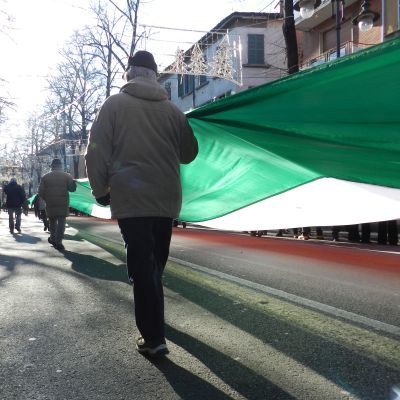
    <content:encoded xmlns:content="http://purl.org/rss/1.0/modules/content/"><![CDATA[<p>For those who love the Tricolour and what it has represented in the modern history of our country, Reggio Emilia will become a mandatory destination. <br />In particular, a visit to the Tricolour Flag Room and the annex Tricolour Flag Museum is absolutely necessary for discovering the true spirit of the city, a rebellious side that fought to rid itself of ancient servitude and to gain control of its future, a future of freedom and equality.<br />The Italian flag was created in Reggio Emilia January 7, 1797. That day, representatives from the four cities of Reggio Emilia, Modena, Bologna and Ferrara met in a Congress proposed by Giuseppe Compagnoni, and they officially adopted the red, white and green Tricolour as the national banner of the Cispadane Republic, the new state created under the protection of the French army.<br />This historic meeting took place inside the Municipal Palace, in the great room with splendid neoclassical architecture, which was built between 1772 and 1787, following a plan by Lodovico Bolognini, to house the general archives of the Duchy.<br />Later the great room would be named the Congress Room and then the Tricolour Flag Hall. Now it is the headquarters of the Municipal Board and of the most important civil events of the city.</p>
<p> </p>
<h3><a href="https://www.reggioemiliawelcome.it/en/reggio-emilia/discover-the-area/art-and-culture/museums-and-galleries/tricolour-hall" class="internal-link" target="_blank"><img src="https://www.reggioemiliawelcome.it/immagini-per-italiano-e-inglese/scopri-il-territorio/arte-e-cultura/img_musei/SalaTricolore2.jpg/@@images/63f04254-2697-45cb-824f-0b25b3e60a35.jpeg" alt="Reggio Emilia - Sala del Tricolore 400x400" class="image-left" title="Reggio Emilia - Sala del Tricolore 400x400" /></a><span class="text-success"> </span></h3>
<h3></h3>
<h3></h3>
<h3><span class="text-success">Tricolour Flag Hall</span></h3>
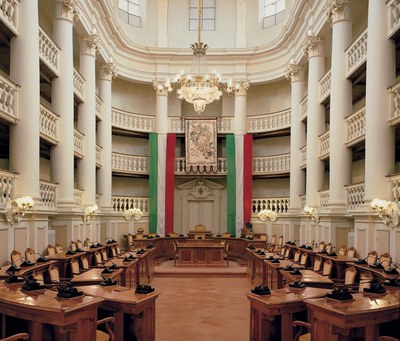
<p>It is inside the Town Hall Palace and was originally designed by the architect Ludovico Bolognini in 1774 as ducal archive. Here - January 7, 1797 - the representatives of Reggio Emilia, Modena, Bologna and Ferrara decided the birth of the Cispadana Republic and declared the Tricolor Flag as the flag of the newborn Republic. Originally it had horizontal green, white and red stripes and a quiver with four arrows in the centre.</p>
<p> </p>
<p> </p>
<p> </p>
<p> </p>
<p> </p>
<p> </p>
<p> </p>
<p> </p>
<h3><a href="https://www.reggioemiliawelcome.it/en/reggio-emilia/discover-the-area/art-and-culture/museums-and-galleries/tricolour-flag-museum" class="internal-link" target="_blank"><img src="https://www.reggioemiliawelcome.it/immagini-per-italiano-e-inglese/scopri-il-territorio/arte-e-cultura/img_musei/ReggioEmiliaMuseodelTricolore.jpg" alt="Reggio Emilia - Museo del Tricolore 400x400" class="image-left" title="Reggio Emilia - Museo del Tricolore 400x400" /></a><span class="text-success"> </span></h3>
<h3></h3>
<h3></h3>
<h3><span class="text-success">Tricolour Flag Museum</span></h3>
<p>Near the historic Room, the Tricolour Flag Museum documents with innovative storiographic criteria the historical and political context in which the Italian flag came to be. Along with historic documents, there are also modern audio-visual instruments which make reading the documents easier.<br />The exhibition on the Risorgimento in Italy has two parallel themes: the history of the national flag, from its origins to the independence and unification of the country, and the history of the political happenings in Reggio Emilia, from the creation of the Reggiana <br />Republic in 1796 to the documentation of the aid offered by Reggio Emilia’s people in the battle for national liberation.<br /><i>“Reggio Emilia today is not only the Capital of the Tricolour, but also a vital central part – through conviction and passion – of the effort to reinforce and re-launch the historic heritage of national Unity”</i>. (Giorgio Napolitano – January 7, 2011 – during the 150th celebration of Italy’s Unification).</p>
<p> </p>
<p> </p>
<p> </p>
<p> </p>
<p> </p>
<p> </p>
<p> </p>
<p> </p>
<h3><a href="https://www.reggioemiliawelcome.it/en/reggio-emilia/discover-the-area/routes-and-tours/history-and-culture-routes/tricolor-flag-tour?set_language=en" class="external-link" target="_blank"><img src="https://www.reggioemiliawelcome.it/immagini-per-italiano-e-inglese/scopri-il-territorio/itinerari-culturali-reggio/Itinerariotricolore.jpg/@@images/8124e9a4-f1c1-48f7-91c5-b2493157a0db.jpeg" alt="" class="image-left" title="" /></a><span class="text-success"> </span></h3>
<h3></h3>
<h3></h3>
<h3><span class="text-success">Tricolour tour</span></h3>
<p>Reggio Emilia is known troughout Italy, and beyond, as the town where the Tricolor flag, the national italian flag, was born. But why Reggio Emilia? What prompted the members of the cities of Reggio Emilia, Modena, Bologna e Ferrara to meet in Congress in the former ducal archive, then Tricolor Hall?<br />Let's discover this tour! Step by step you will understand how the political events of Reggio Emilia are deeply linked to the evolution of the monuments and buildings of the historical centre. About 1 hour walking to discover those ideals of freedom and independace that leaded Italy towards its full confirmation as Nation.</p>
<p> </p>
<p> </p>
<p> </p>
<p> </p>
<p> </p>
<p> </p>
<p> </p>
<p> </p>
<p> </p>
<h3><img src="https://www.reggioemiliawelcome.it/immagini-per-italiano-e-inglese/Gadget.jpg" alt="" class="image-left" title="" /><span class="text-success">Tricolour gadgets</span></h3>
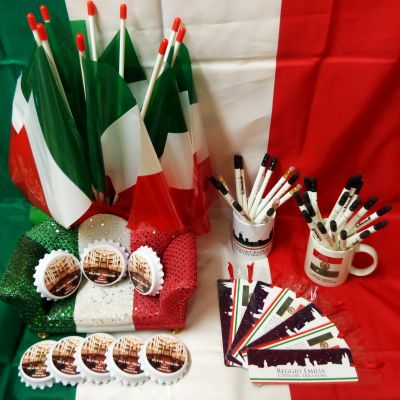
<p>At the <a href="https://www.reggioemiliawelcome.it/en/reggio-emilia/trade-fairs-and-convention-services/tourist-services/information-centres/tourist-information-office?set_language=en" class="external-link" target="_blank">Tourist information office</a> you will find many gadgets inspired by the Tricolour flag:</p>
<p>- Tricolour magnets-bottle openers.......................................... 3.00 Euros<br />- Tricolour magnet.......................................... <br />2.00 Euros<br />- Skyline magnet.......................................... <br />2.50 Euros<br />- Skyline mug......................................................................... 5.00 Euros<br />- Tricolour mug......................................................................... 5.00 Euros<br />- Tricolour knapsack...................................................................<br />4.00 Euros<br />- Small light...................................................................<br />3.00 Euros<br />- Pen...................................................................<br />1.50 Euros                        <br />- Pencil................................................................................... <br />2.00 Euros<br />- Bookmark............................................................................  <br />2.00 Euros<br />- Tricolour little flag................................................................... <br />1.00 Euros<br />- Tricolour Flag..........................................................................<br />5.00 Euros<br />- "Reggio Emilia" Tricolour flag..................................................<br />6.00 Euros<br />- Marked flag..................................................<br />6.00 Euros</p>]]></content:encoded>
    <dc:publisher>No publisher</dc:publisher>
    <dc:creator>magnaf</dc:creator>
    <dc:rights></dc:rights>
    <dc:date>2013-10-20T08:00:00Z</dc:date>
    <dc:type>Page</dc:type>
  </item>


  <item rdf:about="https://www.reggioemiliawelcome.it/en/discover-the-area/routes-and-tours/history-and-culture-routes/not-to-be-missed/reggio-and-contemporary-trends">
    <title>Reggio Emilia and contemporary trends</title>
    <link>https://www.reggioemiliawelcome.it/en/discover-the-area/routes-and-tours/history-and-culture-routes/not-to-be-missed/reggio-and-contemporary-trends</link>
    <description>Installations of international artists, the Bridges and the Highspeed train Station designed by Calatrava, Tecnopolo, Spazio Gerra, Maramotti Collection: contemporary signs characterizing the changes of the modern Reggio Emilia.</description>
    <content:encoded xmlns:content="http://purl.org/rss/1.0/modules/content/"><![CDATA[<h3><span class="text-success"><img src="https://www.reggioemiliawelcome.it/immagini-per-italiano-e-inglese/scopri-il-territorio/arte-e-cultura/img-architettura-moderna/Pontic..jpg" alt="" class="image-left" title="" />The bridges</span></h3>
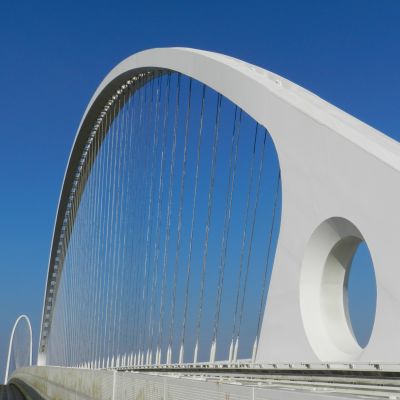
<p><a href="https://www.reggioemiliawelcome.it/en/reggio-emilia/discover-the-area/art-and-culture/modern-architecture/architect-santiago-calatravas-bridges" class="external-link" target="_blank">The bridges</a>, which were built from a design by the Spanish architect Santiago Calatrava, now serve as the doorway to Reggio Emilia. They consist of three great white arches: architectural wonders that are best observed in motion, even while driving along the motorway, where you can appreciate their light, sinuous shapes. They represent XXI-century Reggio Emilia.</p>
<p> </p>
<p> </p>
<p> </p>
<p> </p>
<p> </p>
<p> </p>
<p> </p>
<p> </p>
<p> </p>
<p> </p>
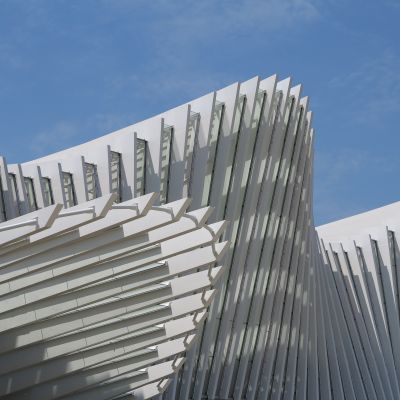
<h3><span class="text-success"><img src="https://www.reggioemiliawelcome.it/immagini-per-italiano-e-inglese/scopri-il-territorio/arte-e-cultura/img-architettura-moderna/StazioneMediopadanaKaiUwe_ShulteBunert.jpg" alt="" class="image-left" title="" />The High Speed Railway Station</span></h3>
<p>In addition to the bridges, the <a href="https://www.reggioemiliawelcome.it/en/reggio-emilia/discover-the-area/art-and-culture/modern-architecture/high-speed-mediopadana-railway-station" class="external-link" target="_blank">High Speed Railway Station, “Mediopadana”</a>, was added in 2013. It was built as exchanging hub for the area of almost 2 milion of potential users but it's definetly also a landmark.<br />It's a covered structure, completly realized with steel and glass, 483-m long. The width is variable, up to a maximum of 50 metres. It's the same for the height that can reach 20 metres. The cover is composed by the replayed succession of 13 portals, geometrically different, for a total of 457 portals.<br />The station is on two levels: the inferior one is the one of the entrance and houses the essencial services of the station; the upper one is for the platforms. The two levels are linked by 4 escalators on each side and 2 panoramic elevators.</p>
<p> </p>
<p> </p>
<p> </p>
<p> </p>
<p> </p>
<p> </p>
<p> </p>
<p> </p>
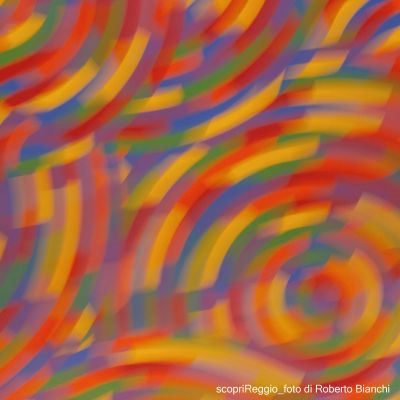
<h3><span class="text-success"><img src="https://www.reggioemiliawelcome.it/immagini-per-italiano-e-inglese/scopri-il-territorio/arte-e-cultura/img-architettura-moderna/BianchiRoberto007.jpg" alt="" class="image-left" title="" />Invitation to....</span></h3>
<p>With the realization of four permanent works of art by <a href="https://www.reggioemiliawelcome.it/en/reggio-emilia/discover-the-area/art-and-culture/artistic-works/the-araba-fenice-luciano-fabro" class="external-link" target="_blank">Luciano Fabro</a>, <a href="https://www.reggioemiliawelcome.it/en/reggio-emilia/discover-the-area/art-and-culture/artistic-works/whirls-and-twirls-1-sol-lewitt" class="external-link" target="_blank">Sol LeWitt</a>, <a href="https://www.reggioemiliawelcome.it/en/reggio-emilia/discover-the-area/art-and-culture/artistic-works/dance-of-planets-and-stars-eliseo-mattiacci" class="external-link" target="_blank">Eliseo Mattiacci</a> and <a href="https://www.reggioemiliawelcome.it/en/reggio-emilia/discover-the-area/art-and-culture/artistic-works/less-than-robert-morris" class="external-link" target="_blank">Robert Morris</a> situated in historical areas of the town, Reggio Emilia has planned to give a new look to the urban fabric, upgrading it by creating a dialogue between art and architecture. <br />A new kind of museum where artworks live in constant dialogue with its surroundings. Author and administrator of <a href="https://www.reggioemiliawelcome.it/en/reggio-emilia/discover-the-area/art-and-culture/museums-and-galleries/invitation-to-1" class="external-link" target="_blank">the project</a> is the artist Claudio Parmiggiani.</p>
<p> </p>
<p> </p>
<p> </p>
<p> </p>
<p> </p>
<p> </p>
<p> </p>
<p> </p>
<p> </p>
<h3><span class="text-success"><img src="https://www.reggioemiliawelcome.it/immagini-per-italiano-e-inglese/scopri-il-territorio/arte-e-cultura/img-architettura-moderna/2016collezionemaramotti2.jpg" alt="" class="image-left" title="" />The Maramotti Contemporary Art Collection</span></h3>
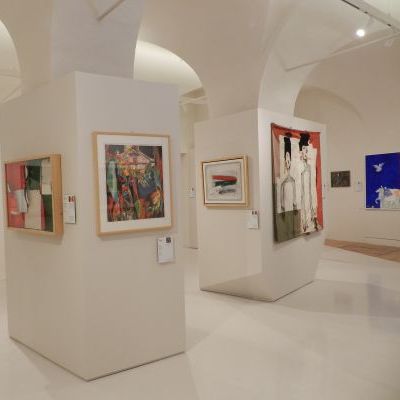
<p>What was previously the first headquarters of Max Mara, today houses the important <a class="external-link" href="http://www.collezionemaramotti.org/en" target="_blank">collection of contemporary art of the founder of the group</a>. There are over 200 works of art permanently on display, dating from the 1950s to the present (Bacon, Fontana, Burri, Kounellis, Licini, Schifano, Merz, Parmiggiani, Cucchi, Chia, Kiefer, Baselitz, Richter, Basquiat, Salle, Katz, Fischi and many more). You can also visit the many temporary exhibitions and projects that are on display throughout the year.</p>
<p> </p>
<p> </p>
<p> </p>
<p> </p>
<p> </p>
<p> </p>
<p> </p>
<p> </p>
<p> </p>
<p> </p>
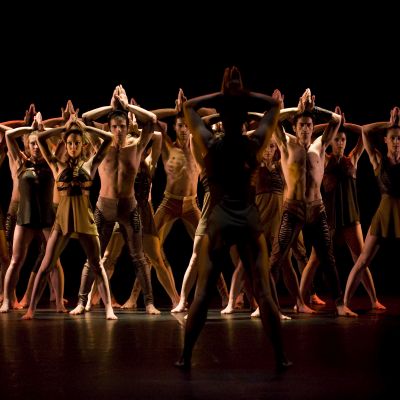
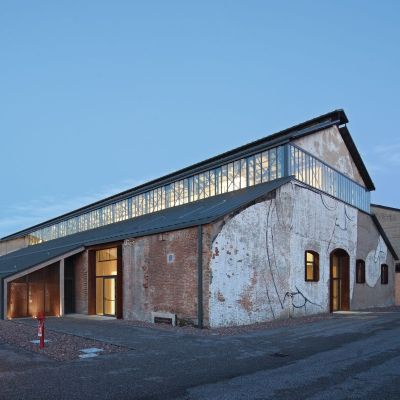
<h3><span class="text-success"><img src="https://www.reggioemiliawelcome.it/immagini-per-italiano-e-inglese/scopri-il-territorio/arte-e-cultura/img-archeologia-industriale/LeSacre_Aterballetto_c_StephanieSchweigert.jpg" alt="" class="image-left" title="" />Aterballetto</span></h3>
<p>In what was previously known as the headquarters of the Lombardini foundry, today houses the <a class="external-link" href="http://www.aterballetto.it/en.htm" target="_blank">National Dance Foundation “Aterballetto”</a>. It is the main dance production company in Italy, is at the head of its field in ballet, and has gained international recognition.</p>
<p> </p>
<p> </p>
<p> </p>
<p> </p>
<p> </p>
<p> </p>
<p> </p>
<p> </p>
<p> </p>
<p> </p>
<p> </p>
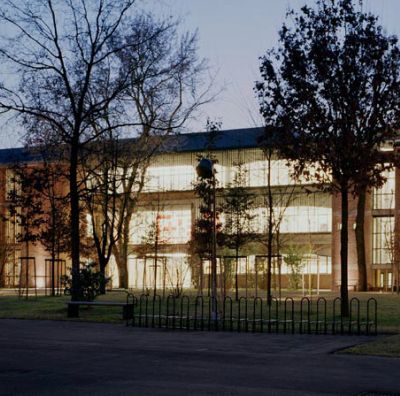
<h3><span class="text-success"><img src="https://www.reggioemiliawelcome.it/immagini-per-italiano-e-inglese/scopri-il-territorio/arte-e-cultura/img-archeologia-industriale/TecnopoloREA.OlivaKUSB0014.jpg" alt="" class="image-left" title="" />Tecnopolo</span></h3>
<p>It is a centre for Research in mechanics, mechatronics, construction, agro-business, energy &amp; environment. <a href="https://www.reggioemiliawelcome.it/en/reggio-emilia/discover-the-area/art-and-culture/industrial-archaeology/officine-reggiane-tecnopolo" class="external-link" target="_blank">The Tecnopole</a> has been created to produce and disseminate knowledge, attract hi-tech and know-how, and serves as an incubator for start-ups and spin-offs.</p>
<p> </p>
<p> </p>
<p> </p>
<p> </p>
<p> </p>
<p> </p>
<p> </p>
<p> </p>
<p> </p>
<p> </p>
<h3><span class="text-success"><img src="https://www.reggioemiliawelcome.it/immagini-per-italiano-e-inglese/top-10-reggio-emilia/copy_of_Appunti.jpg" alt="" class="image-left" title="" />European Photography</span></h3>
<p><a class="external-link" href="http://www.fotografiaeuropea.it/en/" target="_blank">Fotografia Europea</a> is an international cultural festival dedicated to contemporary photography, created in 2006.<br />Fotografia Europea uses photography as a tool to reflect upon the complexity of the contemporary.<br />The festival takes place in different locations of the city, both public and private, formal and informal, and it consists of a central core of exhibitions among which new ad hoc commissioned productions, related to a specific theme identified every year by the Scientific Committee.<br />The exhibitions are accompanied by a rich program of events, conferences, screenings, workshops, portfolio reviews and site specific performances.<br />The program is also enriched by the <a class="external-link" href="http://www.fotografiaeuropea.it/off2018/" target="_blank">OFF circuit</a>: the free and independent section of Fotografia Europea, that springs from the spontaneous initiative of individuals, galleries, associations and public and private institutions, and that offers exhibitions and events all over the territory.<br />Fotografia Europea is also an ongoing project: since its first edition it has acquired more than 1,000 works, which are <a class="external-link" href="http://archivio.fotografiaeuropea.it/fe2009bis/ArchivioFotografico.jsp?idSezione=105" target="_blank">available on-line</a> and stored in the photo library of the Biblioteca Panizzi.</p>
<p> </p>
<p> </p>
<p> </p>
<p> </p>
<p> </p>
<h3><span class="text-success"><img src="https://www.reggioemiliawelcome.it/immagini-per-italiano-e-inglese/top-10-reggio-emilia/download.jpg" alt="" class="image-left" title="" />Aperto Festival</span></h3>
<p>Many events as many expression of today in the ways that the live show allows and that other forms of communication no longer allow: stop, reflect, exercise criticism, inhabit a dream, or a nightmare, and overthrow it. New productions, absolute first and first Italian dance, music, performance. This is<a class="external-link" href="http://www.iteatri.re.it/VisualizzaEventi.jsp?idS=15&amp;idT=117" target="_blank"> Aperto Festival</a>.</p>
<p> </p>
<p> </p>
<p> </p>
<p> </p>
<p> </p>]]></content:encoded>
    <dc:publisher>No publisher</dc:publisher>
    <dc:creator>magnaf</dc:creator>
    <dc:rights></dc:rights>
    <dc:date>2013-10-20T08:00:00Z</dc:date>
    <dc:type>Page</dc:type>
  </item>


</rdf:RDF>