<?xml version="1.0" encoding="utf-8" ?>
<rdf:RDF xmlns:rdf="http://www.w3.org/1999/02/22-rdf-syntax-ns#" xmlns:dc="http://purl.org/dc/elements/1.1/" xmlns:syn="http://purl.org/rss/1.0/modules/syndication/" xmlns="http://purl.org/rss/1.0/">


<channel rdf:about="https://www.reggioemiliawelcome.it/en/rubiera/discover-the-area/tourist-locations/all-files-of-rubiera/RSS">
  <title>all files of Rubiera</title>
  <link>https://www.reggioemiliawelcome.it</link>

  <description>


  </description>


            <syn:updatePeriod>daily</syn:updatePeriod>
            <syn:updateFrequency>1</syn:updateFrequency>
            <syn:updateBase>2015-02-11T00:28:36Z</syn:updateBase>


  <image rdf:resource="https://www.reggioemiliawelcome.it/logo.png"/>

  <items>
    <rdf:Seq>
      
        <rdf:li rdf:resource="https://www.reggioemiliawelcome.it/en/rubiera/how-to-get-there/transports/by-train/rubiera-railway-station"/>
      
      
        <rdf:li rdf:resource="https://www.reggioemiliawelcome.it/en/rubiera/how-to-get-there/getting-around/public-transports/public-out-of-town-and-railway-transport-services"/>
      
      
        <rdf:li rdf:resource="https://www.reggioemiliawelcome.it/en/rubiera/how-to-get-there/maps/province-map"/>
      
      
        <rdf:li rdf:resource="https://www.reggioemiliawelcome.it/en/rubiera/discover-the-area/tourist-locations/rubiera"/>
      
      
        <rdf:li rdf:resource="https://www.reggioemiliawelcome.it/en/rubiera/discover-the-area/art-and-culture/abbeys-monasteries-sanctuaries/ospitale"/>
      
      
        <rdf:li rdf:resource="https://www.reggioemiliawelcome.it/en/rubiera/discover-the-area/art-and-culture/churches-baptisteries/church-of-annunziata"/>
      
      
        <rdf:li rdf:resource="https://www.reggioemiliawelcome.it/en/rubiera/discover-the-area/art-and-culture/churches-baptisteries/romanesque-parish-church-of-saints-faustino-and-giovita"/>
      
      
        <rdf:li rdf:resource="https://www.reggioemiliawelcome.it/en/rubiera/discover-the-area/art-and-culture/churches-baptisteries/church-of-s-agata-a-casale"/>
      
      
        <rdf:li rdf:resource="https://www.reggioemiliawelcome.it/en/rubiera/discover-the-area/art-and-culture/churches-baptisteries/parish-church"/>
      
      
        <rdf:li rdf:resource="https://www.reggioemiliawelcome.it/en/rubiera/discover-the-area/art-and-culture/chapels-oratories-tabernacles/oratory-of-san-nicola"/>
      
      
        <rdf:li rdf:resource="https://www.reggioemiliawelcome.it/en/rubiera/discover-the-area/art-and-culture/villas-historical-residences-and-theatres/palazzo-civico"/>
      
      
        <rdf:li rdf:resource="https://www.reggioemiliawelcome.it/en/rubiera/discover-the-area/art-and-culture/villas-historical-residences-and-theatres/palazzo-rainusso"/>
      
      
        <rdf:li rdf:resource="https://www.reggioemiliawelcome.it/en/rubiera/discover-the-area/art-and-culture/villas-historical-residences-and-theatres/palazzo-sacrati"/>
      
      
        <rdf:li rdf:resource="https://www.reggioemiliawelcome.it/en/rubiera/discover-the-area/art-and-culture/villas-historical-residences-and-theatres/herberia-theatre"/>
      
      
        <rdf:li rdf:resource="https://www.reggioemiliawelcome.it/en/rubiera/discover-the-area/art-and-culture/castles-towers-bell-towers/the-fortress"/>
      
    </rdf:Seq>
  </items>

</channel>


  <item rdf:about="https://www.reggioemiliawelcome.it/en/rubiera/how-to-get-there/transports/by-train/rubiera-railway-station">
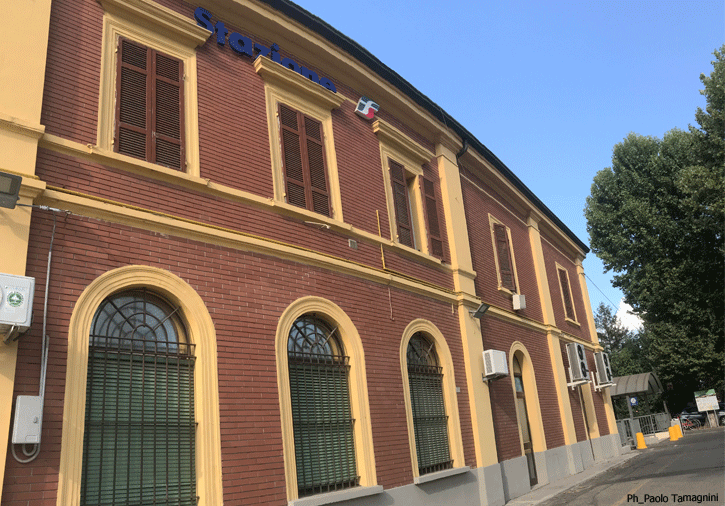
    <title>Rubiera  Railway Station</title>
    <link>https://www.reggioemiliawelcome.it/en/rubiera/how-to-get-there/transports/by-train/rubiera-railway-station</link>
    <description></description>
    <content:encoded xmlns:content="http://purl.org/rss/1.0/modules/content/"><![CDATA[<p><span>Viale Stazione - </span><span style="height: 1.5em;">42048 Rubiera<br /><img alt="Sito web - Website" class="image-inline" src="../../../../../icone-info-2/sito-web-website-1" title="Sito web - Website" /> <a href="https://www.reggioemiliawelcome.it/collegamenti/ferrovie-emilia-romagna-orari-treni" class="internal-link">Ferrovie Emilia Romagna</a><br /><img alt="Sito web - Website" class="image-inline" src="../../../../../icone-info-2/sito-web-website-1" title="Sito web - Website" /> <a href="https://www.reggioemiliawelcome.it/collegamenti/trenitalia" class="internal-link">Trenitalia</a></span></p>
<p><a href="https://www.reggioemiliawelcome.it/en/rubiera/how-to-get-there/transports/by-train/RubieraRailwaystationPhPAOLOTAMAGNINI.jpg" class="internal-link"><img src="https://www.reggioemiliawelcome.it/en/rubiera/how-to-get-there/transports/by-train/RubieraRailwaystationPhPAOLOTAMAGNINI.jpg/@@images/6d604f6d-d885-4e5a-a552-b2fae54f40b0.jpeg" alt="" class="image-inline" title="" /></a></p>
<p>Railway Station</p>
<h4 class="subtitle">Railway lines</h4>
<p><strong>Milano - Bologna<br />Milano - Ancona<br />Genova Brignole - Ravenna</strong></p>
<h4 class="subtitle">Information</h4>
<p><img src="https://www.reggioemiliawelcome.it/copy2_of_icone-info/phone" alt="Phone" class="image-inline" title="Phone" /> <strong>892 021</strong>- Information about Trenitalia trains<br /><img src="https://www.reggioemiliawelcome.it/copy2_of_icone-info/phone" alt="Phone" class="image-inline" title="Phone" /> <strong>840 00 216</strong> - Information about urban and suburban buses: call center Seta www.setaweb.it</p>
<p>The service is active <strong>Monday-Saturday</strong> from 07:00 a.m. to 07:00 p.m.; <strong>Sunday</strong> from 08:20 a.m. to 05:00 p.m.</p>
<p> </p>
<p> </p>
<p> </p>
<p> </p>]]></content:encoded>
    <dc:publisher>No publisher</dc:publisher>
    <dc:creator>Fioranna Magnanini</dc:creator>
    <dc:rights></dc:rights>
    <dc:date>2020-04-28T12:18:10Z</dc:date>
    <dc:type>Page</dc:type>
  </item>


  <item rdf:about="https://www.reggioemiliawelcome.it/en/rubiera/how-to-get-there/getting-around/public-transports/public-out-of-town-and-railway-transport-services">
    <title>Public out-of-town and railway  transport services</title>
    <link>https://www.reggioemiliawelcome.it/en/rubiera/how-to-get-there/getting-around/public-transports/public-out-of-town-and-railway-transport-services</link>
    <description></description>
    <content:encoded xmlns:content="http://purl.org/rss/1.0/modules/content/"><![CDATA[<p>42048 Rubiera</p>
<p><img src="https://www.reggioemiliawelcome.it/icone-info/website" alt="sito web" class="image-inline" title="sito web" /> <a href="https://www.reggioemiliawelcome.it/collegamenti/seta-percorsi-extraurbani" class="internal-link">Timetable of extra-urban routes</a></p>
<p>Transport service</p>
<h4 class="subtitle">Phone</h4>
<p><strong><img src="https://www.reggioemiliawelcome.it/copy2_of_icone-info/phone" alt="Phone" class="image-inline" title="Phone" /> 840 000 216</strong> - Contact Center Seta (Monday-Saturday from 07:00 a.m. to 07:00 p.m.; Sunday from 09:00 a.m. to 05:00 p.m., closed on weekday holidays)<br /><strong><img src="https://www.reggioemiliawelcome.it/copy2_of_icone-info/phone" alt="Phone" class="image-inline" title="Phone" /> 840 151 152</strong> - Railway Call Center</p>
<p>Tickets can also be purchased in the tobacconist shops (tabaccheria).</p>
<p> </p>
<p> </p>
<p> </p>
<p> </p>
<div id="content_tabschede">
<div align="center"></div>
</div>]]></content:encoded>
    <dc:publisher>No publisher</dc:publisher>
    <dc:creator>Massimo Campobianchi</dc:creator>
    <dc:rights></dc:rights>
    <dc:date>2020-04-30T14:02:09Z</dc:date>
    <dc:type>Page</dc:type>
  </item>


  <item rdf:about="https://www.reggioemiliawelcome.it/en/rubiera/how-to-get-there/maps/province-map">
    <title>Province Map</title>
    <link>https://www.reggioemiliawelcome.it/en/rubiera/how-to-get-there/maps/province-map</link>
    <description></description>
    <content:encoded xmlns:content="http://purl.org/rss/1.0/modules/content/"><![CDATA[<p id="_mcePaste"> </p>
<p>Here are <a href="https://www.reggioemiliawelcome.it/en/rubiera/how-to-get-there/interactive-map" class="internal">the maps </a>of the 32 Municipalities of the local editorial staff of Reggio Emilia:</p>
<div id="_mcePaste"></div>
<div id="_mcePaste">
<p>Reggio nell'Emilia<br />Albinea<br />Bagnolo in Piano<br />Bibbiano<br />Boretto<br />Brescello<br />Cadelbosco Sopra<br />Campagnola Emilia<br />Campegine<br />Casalgrande<br />Castellarano<br />Castelnovo Sotto<br />Cavriago<br />Correggio<br />Fabbrico<br />Gattatico<br />Gualtieri<br />Guastalla<br />Luzzara<br />Montecchio Emilia<br />Novellara<br />Poviglio<br />Quattro Castella<br />Reggiolo<br />Rio Saliceto<br />Rolo<br />Rubiera<br />San Martino in Rio<br />San Polo d'Enza<br />Sant'Ilario d'Enza<br />Scandiano<br />Vezzano sul Crostolo</p>
<p> </p>
<p> </p>
<p> </p>
<p> </p>
<p> </p>
<p> </p>
<p> </p>
<p> </p>
<p> </p>
<p> </p>
<p> </p>
</div>]]></content:encoded>
    <dc:publisher>No publisher</dc:publisher>
    <dc:creator>magnaf</dc:creator>
    <dc:rights></dc:rights>
    <dc:date>2013-11-20T09:00:00Z</dc:date>
    <dc:type>Page</dc:type>
  </item>


  <item rdf:about="https://www.reggioemiliawelcome.it/en/rubiera/discover-the-area/tourist-locations/rubiera">
    <title>Rubiera</title>
    <link>https://www.reggioemiliawelcome.it/en/rubiera/discover-the-area/tourist-locations/rubiera</link>
    <description>Rubiera is a small town located at the intersection of Via Emilia with the Secchia River. It is an important industrial town and corresponds to the ancient "Corte de Herberia” dating back approximately to the 11th century.</description>
    <content:encoded xmlns:content="http://purl.org/rss/1.0/modules/content/"><![CDATA[<h4 class="subtitle">Information</h4>
<p><strong>Altitude:</strong> 53 m<br /><strong>Inhabitants: </strong>14,759 (updated to October 31, 2023)<br /><strong>Postal code: </strong>42048<br /><strong>Weekly market day:</strong> Saturday<br /><strong>Patron Saint: </strong>San Biagio (February 3)<br /><strong>Hamlets:</strong> Fontana, San Faustino, Sant’Agata</p>
<h4 class="subtitle">CONTACTS</h4>
<p><img src="https://www.reggioemiliawelcome.it/copy2_of_icone-info/phone" alt="Phone" class="image-inline" title="Phone" /> <strong>0039 0522 622202</strong> - Public Relation Office of the Municipality<br /><img src="https://www.reggioemiliawelcome.it/icone-info/website" alt="sito web" class="image-inline" title="sito web" /> <a class="external-link" href="http://www.comune.rubiera.re.it/" target="_blank" title="Opens the external link to: &quot;Comune di Rubiera&quot;  (Rubiera Municipality)">Municipality of Rubiera</a></p>
<h4 class="subtitle">How to get there</h4>
<p>Rubiera</p>
<p><span class="text-warning"><strong>By car</strong></span><br />From Reggio Emilia: drive along Via Emilia (SS9) in the direction of Modena.</p>
<p><span class="text-warning"><strong>By train</strong></span><br />From the Reggio Emilia Railway Station: <a href="https://www.reggioemiliawelcome.it/collegamenti/trenitalia" class="internal-link" title="Opens the external link to: &quot;Trenitalia&quot;">Trenitalia regional train</a>.</p>
<p><span class="text-warning"><strong>By bus</strong></span><br />Public transport service <a href="https://www.reggioemiliawelcome.it/collegamenti/seta-percorsi-extraurbani" class="internal-link" title="Opens the external link to the website of the bus connections">bus No. 2</a>.</p>
<h4 class="subtitle">What to see</h4>
<div id="_mcePaste" style="width: 1px; height: 1px; overflow: hidden;">In the town centre, whose main street is flanked by porticoes, is the Renaissance Palazzo Sacrati - formerly belonging to the Boiardo family -, in typical Ferrara-style, now the seat of the Town Hall. Also well worth a visit: the former Monastery of Minor Convent Friars, dating back to the XVI century, now Palazzo Rainusso; the Clock Tower and the Bell Tower (XVI century); the Annunziata Church, an oratory dating back to the XVIII century; the parish Church of the Saints Donnino and Biagio, a religious building dating back to the XVIII century renovated at the beginning of the XX century, and the Herberia Theatre, a typical late Art Nouveau construction.</div>
<div></div>
<p>In the town centre, whose main street is flanked by porticoes, is the Renaissance <a href="https://www.reggioemiliawelcome.it/en/rubiera/discover-the-area/art-and-culture/villas-historical-residences-and-theatres/palazzo-sacrati" class="external-link"><strong>Palazzo Sacrati</strong></a> - formerly belonging to the Boiardo family -, in typical Ferrara-style, now the seat of the Town Hall. Also well worth a visit: the former Monastery of Minor Convent Friars, dating back to the 16th century, now <a href="https://www.reggioemiliawelcome.it/en/rubiera/discover-the-area/art-and-culture/villas-historical-residences-and-theatres/palazzo-rainusso" class="external-link"><strong>Palazzo Rainusso</strong></a>; the Clock Tower and the Bell Tower (16th century); the <a href="https://www.reggioemiliawelcome.it/en/rubiera/discover-the-area/art-and-culture/churches-baptisteries/church-of-annunziata" class="external-link"><strong>Annunziata Church</strong></a>, an oratory dating back to the 18th century; the <a href="https://www.reggioemiliawelcome.it/en/rubiera/discover-the-area/art-and-culture/castles-towers-bell-towers/apse-and-bell-tower" class="external-link"><strong>parish Church of the Saints Donnino and Biagio</strong></a>, a religious building dating back to the 18th century renovated at the beginning of the 20th century, and the <strong><a href="https://www.reggioemiliawelcome.it/en/rubiera/discover-the-area/art-and-culture/villas-historical-residences-and-theatres/herberia-theatre" class="internal-link">Herberia Theatre</a></strong>, a typical late Art Nouveau construction.</p>
<h4 class="subtitle">Not to be missed</h4>
<p>The monumental complex of the <a href="https://www.reggioemiliawelcome.it/en/rubiera/discover-the-area/art-and-culture/abbeys-monasteries-sanctuaries/ospitale" class="external-link"><strong>Corte Ospitale</strong></a> (15th century) was built for the refreshment of travellers and pilgrims near the ford of the Secchia River. <br />Located at the crossroads between the road and the river, the hospice saw the continuous passage of pilgrims and travellers on the via Emilia, but it was also an important route which, running parallel to the water course, led to Sassuolo and Frassinoro and also passed, through the Apennines, to Lucca and Rome.</p>
<p>The Corte Ospitale is also an important theatre production centre, which organizes workshops and performances.</p>
<h4 class="subtitle">Keeping fit</h4>
<p>The Secchia River Park was established in 1996 between Rubiera and the province of Modena, with notable naturalistic qualities. A visit can be made on foot, by bicycle or on horseback, preferably in spring and autumn in order to appreciate the nature  features, and in winter for <a href="https://www.reggioemiliawelcome.it/en/reggio-emilia/discover-the-area/routes-and-tours/nature-routes/birdwatching?set_language=en" class="external-link">birdwatching</a>.</p>
<p>The <a href="https://www.reggioemiliawelcome.it/en/rubiera/discover-the-area/nature-and-environment/parks-and-natural-reserves/the-secchia-river-floodplain?set_language=en" class="external-link"><strong>Secchia River Floodplain</strong></a> is a nature area from artificial origin characterized by humid areas with an environmental education centre. The Secchia River Floodplain is located between the provinces of Reggio Emilia and Modena, in the areas of the towns of Rubiera, Campogalliano and Modena and, therefore, in the medium-high area of the Po River Plain.</p>
<h4 class="subtitle">In the vicinity</h4>
<p>The Romanesque <a href="https://www.reggioemiliawelcome.it/en/rubiera/discover-the-area/art-and-culture/churches-baptisteries/romanesque-parish-church-of-saints-faustino-and-giovita" class="external-link"><strong>parish Church of the Saints Faustino and Giovita</strong></a>, one of the oldest Romanesque parish churches of the diocese, is mentioned in a document as far back as 945.</p>
<h4 class="subtitle">Events</h4>
<p><span class="text-warning"><strong>June Festival</strong></span> - <span class="muted"><strong>Second Sunday of June</strong></span><br />Traditional festival with funfair, stalls, markets and musical performances.</p>
<p><span class="text-warning"><strong>September Festival</strong></span> - <span class="muted"><strong>Last Sunday of September</strong></span><br />Sporting, commercial, cultural and exhibition events.</p>
<h4 class="subtitle">Historical study</h4>
<p>Today’s municipality of Rubiera covers the territory that was known in ancient times as the <em>“Corte</em> (Princely Estate) <em>de Herberia”</em>. In 1033, the Estate of Rubiera was seized by Adalberto, Marquis of Tuscany, who intended to bestow it to the Monastery of Castiglione. However, when the Marquis of Tuscany went over to the House of Canossa, the family also became Lords of the Estate of Rubiera. A castle had probably been first erected in the centre of the holding, in the vicinity of the Secchia River. In Roman times, the emperors Gallienus and Valerian had built a bridge on the course of the river and though it was torn down several times, traces of the feet of the original piers still survive on the riverbanks (approximately 100 metres north of the present bridge). A memorial stone commemorating the destruction of the bridge by fire in 257 was discovered on the site and is now held at the Modena museum of inscribed stones.</p>
<p>During the struggles between Matilda, Countess of Canossa, and the Emperor Henry IV, the latter conquered Rubiera and entrusted the estate to his son Azzo, Marquis of the House of Este. Subsequently, Matilda regained it and placed it under the custody of her captains. From 1099, the Da Herberia family became well-known and some of its members took part in a court assembly held by Matilda. Upon Matilda’s death, the Fathers Superior of the Monastery of San Salvatore put forward their claim to the estate. Pope Eugene III resolved the issue in 1146 by granting half the estate to them and the rest to the Bishop of Reggio Emilia.</p>
<p>Around the year 1190, the Municipality of Reggio Emilia had a new castle built in Rubiera. In 1202, ownership of this new castle passed to Pico Manfredi, who successfully defended it against forces from Modena at war with Reggio for the waters of the Secchia River. The Municipality of Reggio Emilia soon decided to erect walls around the castle and built the first settlements inside the castle walls.</p>
<p>In 1284, the castle of Rubiera belonged to the Boiardi family (descendants of the Bianchi family from the Lunigiana area). It then became the property of Obizzo d’Este in 1290, and of the Municipality of Reggio Emilia in 1315. In 1326, the castle was occupied by the Apostolic Delegate, then conquered in 1329 by imperial representatives from Parma and Reggio Emilia who imprisoned the commander of the garrison Gherardo Boiardi in the castle.</p>
<p>When Reggio Emilia fell under the rule of the Gonzaga family in 1345, Rubiera became the property of the Boiardi family who successfully defended it against Modena. In 1354, the family sought the protection of the Visconti family and had one of their garrisons stationed inside the castle. In 1362, however, they drove out the garrison in order to receive the representatives of the Church and of the House of Este. As a result of these changes, the Boiardis established their rule over the whole territory of Rubiera and took part in the war against the Visconti family and Ottobono Terzi. Terzi was killed by deception near Pontalto, in the countryside just south of Rubiera near Bagnolo, by a bridge bearing the same name as the one in Rubiera. The Pontalto Bridge most probably crossed the Via Emilia over the Tassarola channel, a ditch that collected the waters draining in from the countryside south of the Via Emilia.</p>
<p>In 1423, the Boiardi exchanged Rubiera with Scandiano, and Rubiera came to be part of the estate of the House of Este, ruled directly by the Duke of Este and the community of Ferrara. In 1512, the Popes conquered Rubiera, entrusting it to Albert Pious of Carpi, but lost it again in 1523 to the House of Este, who subsequently built such strong defences around it as to make it one of the safest fortresses in the Duchy. The last episode in the wars for the castle took place in 1706, during the Spanish war of succession. On that occasion, the French, who were lords of Modena at the time and were thus responsible for the defence of Rubiera, were forced to surrender to German troops.</p>
<p>When the castle was occupied by the House of Este, it was used as a state prison for those accused or suspected of crimes of lese majesty. The patriot Don Giuseppe Andreoli, after being condemned to death, languished in the very same prison before going on the scaffold in front of the castle October 17, 1822. At the time, the castle on the Via Emilia was a massive building with four towers, looming over the entrance to the town with its walls and bastions. It was encircled by deep moats, filled by the waters of the Tresinaro River via a canal called Della Cerca. The drawbridge was on the eastern side facing in the direction of Carpi. <br />The castle was sold at auction in 1873 and subsequently divided into two lots, one of which became private property and the other municipal property. For reasons of viability, the middle portion of the castle was removed from the castle in the first quarter of the XX century. In recent times, the side structures including the towers have been mostly turned into private accommodation and offices. In the present building, hardly any recognisable features of the original castle have survived. Even the historical parts, such as the prison where Don Andreoli and other patriots languished, have been sacrificed to modern requirements.</p>
<p>The main street is outlined by porticoes. For a time, the Town Hall was housed in the remains of the original bastions of the castle. Next to these is the war memorial, now sadly lacking the original bronze statue made by the sculptor Malagoli and inaugurated in 1925, melted down during the Second World War to make bombs and cannons.</p>
<p>In the town centre is the Palazzo which belonged first to the Boiardis and then to the Sacrati family who became feudal lords of the estate when the Boiardis moved to Scandiano. In 1445, the Sacrati renounced their title to the castle of Fusignano in the Ravenna area by the wishes of the House of Este and received the fiefdom of San Valentino in Castellarano in exchange. As a result, the Boiardi family, whose loyalty to the Lord of Ferrara was not particularly strong, found themselves squeezed between the estates of the Sacratis, who, by contrast, enjoyed the full trust of the Marquis of Ferrara.</p>
<p>After the Italian unification in 1860, the building was purchased by the state and used first as the premises of an elementary school and in 1962 as the Town Hall. The old civic building which now houses the municipal library, many parts of which date back to the 15th century, was abandoned shortly before the Second World War and donated to the poor. As a result, the building became seriously run down and in recent years has been subjected to intensive restoration work.</p>
<p>Opposite Palazzo Sacrati is the lay oratory of the Santissima Annunziata, built between 1710 and 1713 after power struggles with Governor Donelli (1701). On the right of the building, in the direction of Modena, is the Parish Church built by the monastic order of Minor Friars in 1704 and completed in 1722 on the site where the old XV-century oratory of the Santissima Annunziata (named San Bartolomeo until 1460) had originally stood.</p>
<p>Still on the southern part of the centre are the remains of the former Parish Church dedicated to the Saints Donnino and Biagio. The church has an interesting apsidiole with a bell tower rising above it, a reference to which appears in a deed dating as far back as 1302. Other buildings of interest in and around the town include the tower built in 1556 known as the bell tower, the clock tower built in 1537, the former monastery of the Minor Friars now called Palazzo Rainusso, and the magnificent complex known as <em>“La Corte Ospitale”</em>. All the work carried out to build the complex was done by local artisans in the mid-XV century.</p>
<h4 class="subtitle">Useful links</h4>
<ul>
<li><a href="https://www.reggioemiliawelcome.it/en/rubiera/discover-the-area/art-and-culture/abbeys-monasteries-sanctuaries/ospitale" class="internal-link" title="Opens &quot;The Corte Ospitale in Rubiera&quot; file">The Corte Ospitale</a></li>
<li><a href="https://www.reggioemiliawelcome.it/en/rubiera/discover-the-area/art-and-culture/churches-baptisteries" class="internal-link" title="Opens the &quot;Churches in Rubiera&quot; file">Churches in Rubiera</a></li>
<li><a href="https://www.reggioemiliawelcome.it/en/rubiera/hotels-and-restaurants/where-to-stay" class="internal-link" title="Opens the &quot;Where to stay in Rubiera&quot; file">Where to stay in Rubiera</a></li>
<li><a href="https://www.reggioemiliawelcome.it/en/rubiera/hotels-and-restaurants/where-to-eat" class="internal-link" title="Opens the &quot;Where to eat in Rubiera&quot; file">Where to eat in Rubiera</a></li>
<li><a href="https://www.reggioemiliawelcome.it/en/rubiera/discover-the-area/tourist-locations/all-files-of-rubiera" class="internal-link" title="Opens all files of Rubiera">All files of Rubiera</a></li>
</ul>]]></content:encoded>
    <dc:publisher>No publisher</dc:publisher>
    <dc:creator>IAT</dc:creator>
    <dc:rights></dc:rights>
    <dc:date>2025-05-06T13:51:09Z</dc:date>
    <dc:type>Page</dc:type>
  </item>


  <item rdf:about="https://www.reggioemiliawelcome.it/en/rubiera/discover-the-area/art-and-culture/abbeys-monasteries-sanctuaries/ospitale">
    <title>Ospitale</title>
    <link>https://www.reggioemiliawelcome.it/en/rubiera/discover-the-area/art-and-culture/abbeys-monasteries-sanctuaries/ospitale</link>
    <description>XVI-century monumental complex; it was built to give shelter to wayfarers and pilgrims along the Via Emilia near the ford formed by the Secchia river.  </description>
    <content:encoded xmlns:content="http://purl.org/rss/1.0/modules/content/"><![CDATA[<h4 class="subtitle">Address and contacts</h4>
<p>Via Fontana, 2 - 42048 Rubiera<br /><img src="https://www.reggioemiliawelcome.it/copy2_of_icone-info/phone" alt="Phone" class="image-inline" title="Phone" /> <strong>0039 0522 622238</strong> - Ufficio Cultura<br /><img src="https://www.reggioemiliawelcome.it/copy2_of_icone-info/phone" alt="Phone" class="image-inline" title="Phone" /> <strong>0039 0522 622201</strong> - Centralino Comune Rubiera<br /><img src="https://www.reggioemiliawelcome.it/icone-servizi/email.gif" alt="Email" class="image-inline" title="Email" /> <a class="mail-link" href="mailto:cultura@comune.rubiera.re.it">cultura@comune.rubiera.re.it</a><br /><img src="https://www.reggioemiliawelcome.it/icone-info/website" alt="sito web" class="image-inline" title="sito web" /> <a class="external-link" href="http://www.corteospitale.org/" target="_blank">La Corte Ospitale</a></p>
<h4 class="subtitle">Opening times</h4>
<p>The visit is possibile for group of at least 20 people, upon previous arrangement with the contacts above indicated.</p>
<h4 class="subtitle">How to get there</h4>
<p>Rubiera</p>
<p><span class="text-warning"><strong>By car</strong></span><br />From Reggio Emilia, drive along Via Emilia (SS9) in the direction of Modena.</p>
<p><span class="text-warning"><strong>By train</strong></span><br />From Reggio Emilia Railway Station: <a href="https://www.reggioemiliawelcome.it/collegamenti/trenitalia" class="internal-link">Trenitalia</a> regional train.</p>
<p><span class="text-warning"><strong>By bus</strong></span><br />Public transport service <a href="https://www.reggioemiliawelcome.it/collegamenti/seta-percorsi-urbani" class="internal-link">bus n° 2</a></p>
<h4 class="subtitle">Historical notes</h4>
<p>One of the most important pilgrims’ hospitals between Secchia and Enza, along the Via Emilia, was the one at Rubiera. At the intersection of the road and the river, the hospital looked out onto the constant coming and going of pilgrims and travellers along the Via Emilia but also along the other important road that followed the course of the river, leading to Sassuolo and Frassinoro, then on to Lucca and Rome. <br />The oldest hospital, administered by the Benedictines, already existed in 1179 but, after the attack from Duke Alfonso I d’Este in 1523, the original structure was destroyed. The noble Sacrati family, appointed as caretakers of the hospital, oversaw its reconstruction on their territory, near the river and at a point where navigation was easier. In 1531 construction began on the grand Renaissance complex and in 1535 the great painter Benvenuto Tisi “il Garofalo”, one of the most famous artists of the court of Ferrara, was commissioned to decorate the church of St. Mary with frescoes. The hospital offered shelter to pilgrims and travellers, contained an infirmary and dispensed alms. The possibility to cross the river was of utmost importance: the hospital, in fact, held the rights to the “Secchia pass”, in operation night and day and free of charge for the poor, pilgrims and holy orders. Everything came to an end, however, in 1765, when the Grand Duke of Modena, Francesco III, suppressed the operation of all the hospitals in his realm. Thus began the decline of the “court” of Rubiera, transformed into an agricultural estate and passed down from one generation to the next until, on the occasion of the Jubilee in 2000, it was restored by the City and given back to the people of Rubiera, travellers and religious pilgrims, as a meeting place and cultural landmark.</p>]]></content:encoded>
    <dc:publisher>No publisher</dc:publisher>
    <dc:creator>Fioranna Magnanini</dc:creator>
    <dc:rights></dc:rights>
    <dc:date>2022-12-12T11:32:15Z</dc:date>
    <dc:type>Page</dc:type>
  </item>


  <item rdf:about="https://www.reggioemiliawelcome.it/en/rubiera/discover-the-area/art-and-culture/churches-baptisteries/church-of-annunziata">
    <title>Annunziata Church</title>
    <link>https://www.reggioemiliawelcome.it/en/rubiera/discover-the-area/art-and-culture/churches-baptisteries/church-of-annunziata</link>
    <description>Oratory of the XVIII century, it was buitl at expenses of SS.Annunziata Brotherhood.   </description>
    <content:encoded xmlns:content="http://purl.org/rss/1.0/modules/content/"><![CDATA[<h4 class="subtitle">Address and contacts</h4>
<p><span>Via Emilia Est - 42048 Rubiera</span><br /><span>Phone 0039 0522 620203 - Parish church of Rubiera</span></p>
<h4 class="subtitle"><span>How to get there</span></h4>
<p>See the indication to reach <a href="https://www.reggioemiliawelcome.it/en/rubiera/discover-the-area/tourist-locations/rubiera" class="internal-link" target="_blank">Rubiera</a></p>
<h4 class="subtitle">Historical notes</h4>
<p>In 1710 the marquis Scipione Sacrati promoted the construction of a new Church sacred to SS. Annunciazione, just in front of his Sacrati Palace. The building was undertaken by Brotherhood of Annunziata upon a land which was sold by Sacrati family and together with houses. The construction began on august, the 24th of year 1710, and ended within three years. Its façade is due to generosity of Alessandro Berti in 175. In 1759 Berti itself provided to erect the main altar, placed at the right side and during same year all people of Rubiera, payed for completion of the altar dedicated to San Rocco. Originally the curch had no choir and had only two side altars. The main altar is made of chalk. In the left side altar a is a painting depicting San Rocco, and which belongs to the Municipality. In 1808 archpriest Chierici founded in Rubiera tha Brotherhood of Santissimo Sacramento (Holy Sacrament), that took place of former Annunziata in administration and ownership of the curch. After many events which brought to its closure (1799), or to its becoming a forage store (1915), after second world war, in different times some restoration works have been carred out.</p>
<p> </p>
<p> </p>]]></content:encoded>
    <dc:publisher>No publisher</dc:publisher>
    <dc:creator>Isotta Chiari</dc:creator>
    <dc:rights></dc:rights>
    <dc:date>2021-03-29T09:15:22Z</dc:date>
    <dc:type>Page</dc:type>
  </item>


  <item rdf:about="https://www.reggioemiliawelcome.it/en/rubiera/discover-the-area/art-and-culture/churches-baptisteries/romanesque-parish-church-of-saints-faustino-and-giovita">
    <title>Romanesque Parish Church of Saints Faustino and Giovita</title>
    <link>https://www.reggioemiliawelcome.it/en/rubiera/discover-the-area/art-and-culture/churches-baptisteries/romanesque-parish-church-of-saints-faustino-and-giovita</link>
    <description>One of the oldest Romanesque parish churches in the diocese, mentioned in a document dated 945.  </description>
    <content:encoded xmlns:content="http://purl.org/rss/1.0/modules/content/"><![CDATA[<h4 class="subtitle">Address and contacts</h4>
<p><span>Via S. Faustino - 42048 Rubiera</span><br /><span>Phones<br />0039 0522 620705 - Parish church of S. Faustino</span><br /><span>0039 0522 626865 - Parish church of Fontana</span><br /><a class="external-link" href="http://www.sanfaustino.org/index.html" target="_blank">Parrocchia San Faustino</a></p>
<h4 class="subtitle">Opening times</h4>
<p>Visitable upon arrangement</p>
<h4 class="subtitle">How to get there</h4>
<p>Rubiera</p>
<p><strong>By car</strong><br />distance from the Reggio Emilia exit of A1 motorway: 12 km - National Road 9, Via Emilia - from the centre of Rubiera, take Via Emilia and then turn left into Via F.lli Cervi following the signs to Correggio, then left in Via S. Faustino.</p>
<p><strong>By bus</strong><br />At the end of the<a href="https://www.reggioemiliawelcome.it/collegamenti/seta-percorsi-extraurbani" class="internal-link"><span> </span></a><span><a href="https://www.reggioemiliawelcome.it/collegamenti/seta-percorsi-urbani" class="internal-link">bu</a></span><span><a href="https://www.reggioemiliawelcome.it/collegamenti/seta-percorsi-urbani" class="internal-link">s n° 2 route</a>, turn left into Via F.lli Cervi following the signs for Correggio, then left in Via S. Faustino (about 3 km).</span></p>
<h4 class="subtitle">Historical notes</h4>
<p>According to tradition, the original primitive temple was built by order of Countess Matilde di Canossa, who possessed numerous holdings in the area. The church is one of the oldest in the diocese, mentioned in a document written by the bishop of Reggio Emilia in the year 945 and more explicitly cited in 980. The façade was reconstructed in 1870 in the Lombard style on the design by Professor Faccioli of Bologna. The arched portal is decorated with marble columns and a small temple surmounted by an ancient two-light mullioned window. Four octagonal spires with crosses are situated at the top of the façade. In the rear part, the three apses are visible, partitioned by pilaster strips and characterised by the sequence of arches; some trusses show geometric elements while others have depictions of symbolic animals. Also notable are the oblong windows with splayed jamb. The interior architecture has been extensively transformed, and only part of the elements of the ancient structure are visible. The tabernacle in Carrara marble holds a fine thirteenth-century fresco of the Madonna with Child and an eighteenth-century painting of the Saints Faustino and Giovita.</p>
<h4 class="subtitle">Useful link</h4>
<p><a class="external-link" href="http://www.uprubiera.org/orario-estivo-messe/" target="_blank">Holy mess times</a></p>
<p> </p>
<p> </p>]]></content:encoded>
    <dc:publisher>No publisher</dc:publisher>
    <dc:creator>Fioranna Magnanini</dc:creator>
    <dc:rights></dc:rights>
    <dc:date>2024-10-09T12:29:09Z</dc:date>
    <dc:type>Page</dc:type>
  </item>


  <item rdf:about="https://www.reggioemiliawelcome.it/en/rubiera/discover-the-area/art-and-culture/churches-baptisteries/church-of-s-agata-a-casale">
    <title>Church of S. Agata a Casale</title>
    <link>https://www.reggioemiliawelcome.it/en/rubiera/discover-the-area/art-and-culture/churches-baptisteries/church-of-s-agata-a-casale</link>
    <description>House of worship that dates to the 16th century.  </description>
    <content:encoded xmlns:content="http://purl.org/rss/1.0/modules/content/"><![CDATA[<h4 class="subtitle">Address and contacts</h4>
<p><span>Via Sant'Agata - 42048 Rubiera</span><br /><span>Phone 0039 0522 620203 - Parish church</span></p>
<h4 class="subtitle"><span>Opening times</span></h4>
<p><span>Visitable upon previous arrangement only</span></p>
<h4 class="subtitle"><span>How to get there</span></h4>
<p>See the indication to reach <a href="https://www.reggioemiliawelcome.it/en/rubiera/discover-the-area/tourist-locations/rubiera" class="internal-link" target="_blank">Rubiera</a></p>
<h4 class="subtitle">Historical notes</h4>
<p>Very little historical information is available about the church prior to the 16th century. The papal diploma of Eugene III of 1146 mentions the Chapel of Sant’Agata in the territory of the parish church of San Faustino. In the episcopal visitation of 1543, it seems to have been neglected, while in 1593 it appears along with the church of Stiolo. It was always dependent on the Parish of San Faustino. Also notable is the rural complex opposite the church which includes a large country house and the structure of an old cheese factory with a rectangular plan.</p>
<p> </p>
<p> </p>
<p> </p>]]></content:encoded>
    <dc:publisher>No publisher</dc:publisher>
    <dc:creator>Fioranna Magnanini</dc:creator>
    <dc:rights></dc:rights>
    <dc:date>2020-12-29T15:46:39Z</dc:date>
    <dc:type>Page</dc:type>
  </item>


  <item rdf:about="https://www.reggioemiliawelcome.it/en/rubiera/discover-the-area/art-and-culture/churches-baptisteries/parish-church">
    <title>Parish Church</title>
    <link>https://www.reggioemiliawelcome.it/en/rubiera/discover-the-area/art-and-culture/churches-baptisteries/parish-church</link>
    <description>A house of worship built in the 18th century and restructured in the early 1900s.  </description>
    <content:encoded xmlns:content="http://purl.org/rss/1.0/modules/content/"><![CDATA[<h4 class="subtitle">Address and contacts</h4>
<p><span>Via Emilia Est - 42048 Rubiera</span><br /><span>Phones 0039 0522 620203 or 0522 620705 - Parish church</span></p>
<h4 class="subtitle"><span>Opening times</span></h4>
<p><span>From 07:00 a.m. to 08:00 p.m.</span></p>
<h4 class="subtitle"><span>How to get there</span></h4>
<p><span>See the indication to reach Rubiera</span></p>
<h4 class="subtitle"><span>Historical notes</span></h4>
<p><span>The church was built by the Conventual Friars of Rubiera between 1704 and 1718. It was definitively handed over to the Archpriest and the collegiate chapter by order of Duke Rinaldo II on 4th October 1722, as attested by the inscription inside the building. The church was erected on the site of the previous Church of the Annunciation which had been demolished. In the early 1900s, the building was restructured, with the addition of elegant decorations by Professor Ernesto Manzini, who designed the apse and the vault as well as the facade. Professors Goldoni and Gaetano Bellei also contributed to the works. The interior has a composite style, with one nave, two chapels on each side, chancel at the southern end, and the main entrance on the Via Emilia preceded by a wide portico.</span></p>
<h4 class="subtitle"><span>Useful link</span></h4>
<p><span><a class="external-link" href="http://www.uprubiera.org/principale/parrocchia-di-rubiera/" target="_blank">Parish church of Rubiera</a></span></p>
<p> </p>
<p> </p>
<p> </p>
<p><span><br /></span></p>]]></content:encoded>
    <dc:publisher>No publisher</dc:publisher>
    <dc:creator>Fioranna Magnanini</dc:creator>
    <dc:rights></dc:rights>
    <dc:date>2021-05-28T13:24:54Z</dc:date>
    <dc:type>Page</dc:type>
  </item>


  <item rdf:about="https://www.reggioemiliawelcome.it/en/rubiera/discover-the-area/art-and-culture/chapels-oratories-tabernacles/oratory-of-san-nicola">
    <title>Oratory of San Nicola</title>
    <link>https://www.reggioemiliawelcome.it/en/rubiera/discover-the-area/art-and-culture/chapels-oratories-tabernacles/oratory-of-san-nicola</link>
    <description>The Oratory of San Nicola da Tolentino was built in 1687 by Nicola Solieri, the mayor of Rubiera.</description>
    <content:encoded xmlns:content="http://purl.org/rss/1.0/modules/content/"><![CDATA[<h4 class="subtitle" style="text-align: justify; ">Address and contacts</h4>
<p style="text-align: justify; ">Via della Resistenza - 42048 Rubiera<br /><img src="https://www.reggioemiliawelcome.it/copy2_of_icone-info/phone" alt="Phone" class="image-inline" title="Phone" /> <strong>0039 0522 620203</strong> - Parish church of Rubiera</p>
<h4 class="subtitle" style="text-align: justify; ">Opening times</h4>
<p style="text-align: justify; ">The oratory is <span class="muted"><strong>open only</strong></span> during <strong>May</strong> and on the <strong>10th September</strong></p>
<h4 class="subtitle" style="text-align: justify; ">How to get there</h4>
<p style="text-align: justify; ">Rubiera</p>
<p style="text-align: justify; "><span class="text-warning"><strong>By car</strong></span><br />From Reggio Emilia, drive along Via Emilia (SS9) in the direction of Modena.</p>
<p style="text-align: justify; "><span class="text-warning"><strong>By train</strong></span><br />From Reggio Emilia Railway Station: <a href="https://www.reggioemiliawelcome.it/collegamenti/trenitalia" class="internal-link" title="Opens the external link to: &quot;Trenitalia&quot;">Trenitalia regional train</a>.</p>
<p style="text-align: justify; "><span class="text-warning"><strong>By bus</strong></span><br />Public transport service <a href="https://www.reggioemiliawelcome.it/collegamenti/seta-percorsi-extraurbani" class="internal-link" title="Opens the external link to the website of the bus connections">bus No. 2</a></p>
<h4 class="subtitle" style="text-align: justify; ">Historical notes</h4>
<p style="text-align: justify; ">At the end of the 18th century Giuseppe Medici from Modena added the two small-naved wings to the church’s central body and redesigned the façade. These benefactors left instructions for their heirs and successors to continue with the celebration of the Feast of San Nicola and the blessing and distribution of bread.<br />The Oratory is only open during May and on 10 September, the Feast of San Nicola, which was celebrated year after year until 1949, when it had to be suspended because the building had become unsafe. It was then purchased and restored by private owners; the works included the addition of a small bell tower housing both the original bell and another donated one. The interior was restored to its present state and the small courtyard in front of the building was re-laid in 1973 with period cotto tiles, covering the old, still extant river-pebble paving. Three inscriptions from different periods in the 20th century confirm that the paving covers three burial sites.<br />The great stone in the centre of the paving once served as the closure of the tomb for the priests of the old parish church. It was then used to close the ossuary in the cemetery outside the city walls. When the cemetery was destroyed it became part of the paving of a private courtyard, from whence it was removed and laid in its present position in the oratory.</p>
<p style="text-align: justify; "> </p>
<p style="text-align: justify; "> </p>]]></content:encoded>
    <dc:publisher>No publisher</dc:publisher>
    <dc:creator>Fioranna Magnanini</dc:creator>
    <dc:rights></dc:rights>
    <dc:date>2023-06-22T14:54:20Z</dc:date>
    <dc:type>Page</dc:type>
  </item>


  <item rdf:about="https://www.reggioemiliawelcome.it/en/rubiera/discover-the-area/art-and-culture/villas-historical-residences-and-theatres/palazzo-civico">
    <title>Palazzo Civico</title>
    <link>https://www.reggioemiliawelcome.it/en/rubiera/discover-the-area/art-and-culture/villas-historical-residences-and-theatres/palazzo-civico</link>
    <description>The fifteenth-century Palazzo Civico now hosts the Municipal Library. </description>
    <content:encoded xmlns:content="http://purl.org/rss/1.0/modules/content/"><![CDATA[<div class="visualClear image-inline">
<h4 class="subtitle">Address and contacts</h4>
</div>
<div class="visualClear image-inline"><span>via Emilia Est, 11 - </span><span>42048 Rubiera</span></div>
<p><span>Phone 0039 0522 622255 - <span>Public Library</span></span></p>
<h4 class="subtitle">Opening times</h4>
<p><span>Monday, Wednesday and Saturday from 09:00 a.m. to 01:00 p.m.<br /></span><span>from Tuesday to Friday (and on first Saturday of each month) from 03:00 to 07:00 p.m.<br /></span><span><strong>Weekly closure</strong></span><span> </span><span>Sunday<br /></span><span><strong>Opening periods</strong> y</span><span>ear-round except for the month of August</span></p>
<h4 class="subtitle">How to get there</h4>
<p>Rubiera</p>
<p><strong>By car</strong><br />Rubiera is 12 km from the Reggio Emilia exit of the A1 motorway – National Road 9, Via Emilia –, is located on the Via Emilia and has a Train Station.<br />The Palazzo Civico is in the Town historical center</p>
<p><strong>By train</strong><br />From the Reggio Emilia railway station, <a style="width: 0px;" href="https://www.reggioemiliawelcome.it/collegamenti/trenitalia" class="internal-link">Trenitalia</a> regional train</p>
<p><strong>By bus</strong><br /><a href="https://www.reggioemiliawelcome.it/collegamenti/seta-percorsi-urbani" class="internal-link">Bus n. 2</a> for Rubiera</p>
<h4 class="subtitle">Historical notes</h4>
<p style="text-align: justify; ">Viewed from the outside, the building seems homogeneous due to the presence of a portico with four low, wide arches, but the structure is the actually the result of the joining and adaptation of pre-existing fifteenth-century houses, of which one can view on the inside several elegant windows and a frescoed coffered ceiling of the 15th century. Palazzo Civico is distinguished by a massive sixteenth-century tower. Following restoration, the building was inaugurated in 1988 as the Municipal Library. With the restructuring of Palazzo Sacrati in the second half of the 15th century, the residence of the Podesta seems to have been transferred to certain “houses of the Commune” which later information makes it possible to recognise as those subsequently transformed into the Podesta’s palace. In 1477, the meetings of the town council were held in the “houses of the Commune” in the “ground floor bed chambers” in line with the medieval custom of using the same room for various functions and considering the bedroom to be the most secure room of the house and the most suitable for conserving the family documents and riches, as well as the most appropriate place for meeting to discuss important business or to receive distinguished guests. <br />The central nucleus of the current building seems to be the oldest part and conserves, on the ground floor, a room with coffered ceiling decorated with late fifteenth-century wood-engravings glued onto wooden panels. Dating from the same period is the plant decoration painted only in the part of the ceiling in masonry because it was near the flue. The decoration attests to the transformation of the old private residence into a space suitable for public functions with the transfer, perhaps to the upper part, of the Podesta’s bedroom. However, it is not yet the “camera magna” that was used during the 16th century, probably created together with the tower, which was built starting from 1537 and apparently completed by January 1540. The form of the building’s façade does not correspond to the original one, but results from subsequent restructuring carried out between the 17th and 18th centuries, which extended the front of the building up to the street. In its original form, the façade was more recessed and situated in correspondence with the wall on which the entrances under the portico still open. The porticoes also existed in the original building but at that time did not support the series of rooms on the first floor facing onto the Via Emilia; according to the medieval model they were simply set against the wall of the façade. Mention is made of this transformation in a seventeenth-century document which speaks of a Town Council room “constructed above the portico.” In that period the façade was already significantly modified and extended with the construction of a series of rooms above the portico, up to the edge of the street. Previously the only masonry structure that extended to the Via Emilia was a “tribune” accessed from a room on the first floor of the building which that was probably used for the proclamation of edicts and sentences. Its dimensions must have been limited, as in 1615 it took only twenty-four bricks to re-pave it.<br />The extension of the façade must have almost completely hidden from view the sixteenth-century tower, whose height went just beyond the roof of the building. To return its value as a sign of a public building, the tower was raised it to its current height in the 17th century.</p>
<p style="text-align: justify; "> </p>
<p style="text-align: justify; "> </p>]]></content:encoded>
    <dc:publisher>No publisher</dc:publisher>
    <dc:creator>Fioranna Magnanini</dc:creator>
    <dc:rights></dc:rights>
    <dc:date>2020-12-31T10:24:52Z</dc:date>
    <dc:type>Page</dc:type>
  </item>


  <item rdf:about="https://www.reggioemiliawelcome.it/en/rubiera/discover-the-area/art-and-culture/villas-historical-residences-and-theatres/palazzo-rainusso">
    <title>Palazzo Rainusso</title>
    <link>https://www.reggioemiliawelcome.it/en/rubiera/discover-the-area/art-and-culture/villas-historical-residences-and-theatres/palazzo-rainusso</link>
    <description>Former convent of the 16th century transformed into a summer residence in the 18th century. </description>
    <content:encoded xmlns:content="http://purl.org/rss/1.0/modules/content/"><![CDATA[<h4 class="subtitle">Address and contacts</h4>
<p>Flli. Cervi, 20 - 42048 Rubiera<br />Phone 0039 0522 622209 - Municipal information office</p>
<h4 class="subtitle">Opening times</h4>
<p>Currently closed for restoration</p>
<h4 class="subtitle">How to get there</h4>
<p>Rubiera</p>
<p><strong>By car</strong><br />Rubiera is 12 km from the Reggio Emilia exit of the A1 motorway – National Road 9, Via Emilia –, is located on the Via Emilia and has a Train Station.<br />The Palazzo Civico is in the Town historical center</p>
<p><strong>By train</strong><br />From the Reggio Emilia railway station, <a style="width: 0px;" href="https://www.reggioemiliawelcome.it/collegamenti/trenitalia" class="internal-link">Trenitalia</a> regional train</p>
<p><strong>By bus</strong><br /><a href="https://www.reggioemiliawelcome.it/collegamenti/seta-percorsi-urbani" class="internal-link">Bus n. 2</a> for Rubiera</p>
<h4 class="subtitle">Historical notes</h4>
<p>Around the middle of the 16th century, Palazzo Rainusso was the site of the convent of the Conventual Friars of the Madonna, first mentioned in 1570. Little information is available, but it seems that the ancient Sanctae Marie Nove de Hyrberia church was located here, as cited in a document of 1342. The original nucleus seems to have been constituted by the church and the eastern and southern wings. The cloister was built in 1635. The various needs of the friars led to the further development of the structure, with the construction of new rooms and additional buildings around a new courtyard near the northern wing of the original cloister. In 1768, with the ecclesiastic suppressions of Francesco III, the complex was appropriated and subsequently sold to Count Greppi of Milan, who transformed it into a summer residence. During this period, massive restructuring works were carried out: the eastern face of the building assumed the typical architectural characteristics of the 18th century with broad windows, cornices and balustrades, with a precise and often forced symmetry that led to the sharp cutting of the church apse and the construction of the branch on the north-eastern corner.<br />Subsequently the complex was purchased by Cavalier Rainusso, from whom it takes its name. Of notable architectural interest, the palazzo has two floors and an inner cloister including arches, in part masonry, divided by terracotta pilasters.<br />Inside, the chapter-house and a large eighteenth-century hall are of particular interest, and numerous doors are decorated with ornamental motifs and landscapes. The wrought iron gates that close the historical park, with centuries-old trees of indubitable naturalistic importance, are a fine work attributed to the Modenese Giovan Battista Malagoli (1729-1797). Following the death of Cavalier Rainusso in 1906, the property was administered by the Charitable Institutes of Santa Margherita Ligure, who sold the building to the Municipality of Rubiera in 1979.</p>
<p> </p>
<p> </p>
<p> </p>]]></content:encoded>
    <dc:publisher>No publisher</dc:publisher>
    <dc:creator>Fioranna Magnanini</dc:creator>
    <dc:rights></dc:rights>
    <dc:date>2022-12-12T11:42:40Z</dc:date>
    <dc:type>Page</dc:type>
  </item>


  <item rdf:about="https://www.reggioemiliawelcome.it/en/rubiera/discover-the-area/art-and-culture/villas-historical-residences-and-theatres/palazzo-sacrati">
    <title>Palazzo Sacrati</title>
    <link>https://www.reggioemiliawelcome.it/en/rubiera/discover-the-area/art-and-culture/villas-historical-residences-and-theatres/palazzo-sacrati</link>
    <description>XV-century noble palace; it now hosts the Town Council. </description>
    <content:encoded xmlns:content="http://purl.org/rss/1.0/modules/content/"><![CDATA[<div class="visualClear image-inline">
<h4 class="subtitle">Address and contacts</h4>
</div>
<div class="visualClear image-inline">Via Emilia Est, 5 - <span>42048 Rubiera</span></div>
<p><span>Phone 0522 622211<br />Fax 0522 628978</span></p>
<h4 class="subtitle">Opening times</h4>
<p>Weekdays 08:30 a.m. - 01:00 p.m.<br />Tuesday 03:00 p.m. -  06:00 p.m.<br /><strong>Weekly closure</strong> Sunday<br /><strong>Opening periods</strong> all year</p>
<h4 class="subtitle">How to get there</h4>
<p class="mceContentBody documentContent"><span>Rubiera</span></p>
<p><strong>By car</strong><br />Rubiera is 12 km from the Reggio Emilia exit of the A1 motorway – National Road 9, Via Emilia –, is located on the Via Emilia and has a Train Station.<br />The Palazzo Civico is in the Town historical center</p>
<p><strong>By train</strong><br />From the Reggio Emilia railway station, <a style="width: 0px;" href="https://www.reggioemiliawelcome.it/collegamenti/trenitalia" class="internal-link">Trenitalia</a> regional train</p>
<p><strong>By bus</strong><br /><a href="https://www.reggioemiliawelcome.it/collegamenti/seta-percorsi-urbani" class="internal-link">Bus n. 2</a> for Rubiera</p>
<h4 class="subtitle">Historical notes</h4>
<p>Built by Boiardo in the fourteenth century, it was transformed by the Sacrati, from which it takes its name, around the mid-fifteenth century, according to the architectural models of the Ferrara palaces of the time.</p>
<p> </p>
<h4 class="subtitle">
<p class="subtitle"> </p>
</h4>]]></content:encoded>
    <dc:publisher>No publisher</dc:publisher>
    <dc:creator>Isotta Chiari</dc:creator>
    <dc:rights></dc:rights>
    <dc:date>2022-12-12T11:43:08Z</dc:date>
    <dc:type>Page</dc:type>
  </item>


  <item rdf:about="https://www.reggioemiliawelcome.it/en/rubiera/discover-the-area/art-and-culture/villas-historical-residences-and-theatres/herberia-theatre">
    <title>Herberia Theatre</title>
    <link>https://www.reggioemiliawelcome.it/en/rubiera/discover-the-area/art-and-culture/villas-historical-residences-and-theatres/herberia-theatre</link>
    <description>Municipal theatre of the 20th century, late Art Nouveau style. </description>
    <content:encoded xmlns:content="http://purl.org/rss/1.0/modules/content/"><![CDATA[<div class="image-inline visualClear">
<h4 class="subtitle">Address and contacts</h4>
</div>
<div class="image-inline visualClear">
<div class="visualClear image-inline">Piazza Gramsci, 1/B - 42048 Rubiera<br />Phone 0039 0522 622230</div>
<div>
<div class="td_converted_to_div">Fax 0039 0522 628978</div>
<div class="td_converted_to_div"></div>
<p class="td_converted_to_div"><a class="external-link" href="https://www.comune.rubiera.re.it">Municipality of Rubiera</a></p>
<h4 class="subtitle">How to get there</h4>
</div>
</div>
<p>Rubiera</p>
<p><strong>By car</strong><br />Rubiera is 12 km from the Reggio Emilia exit of the A1 motorway – National Road 9, Via Emilia –, is located on the Via Emilia and has a Train Station.<br />The Palazzo Civico is in the Town historical center</p>
<p><strong>By train</strong><br />From the Reggio Emilia railway station, <a style="width: 0px;" href="https://www.reggioemiliawelcome.it/collegamenti/trenitalia" class="internal-link">Trenitalia</a> regional train</p>
<p><strong>By bus</strong><br /><a href="https://www.reggioemiliawelcome.it/collegamenti/seta-percorsi-urbani" class="internal-link">Bus n. 2</a> for Rubiera</p>
<h4 class="subtitle">Historical notes</h4>
<div class="visualClear image-inline">The building was designed during the 1920s on the initiative of Professor Umberto Tirelli by the engineer Antonio Panizzi and the architect Italo Costa of Reggio Emilia.</div>
<p>Inaugurated on the evening of 7th January 1926, it was an autonomous building standing next to the ancient fort on the line of the city walls on a piece of public property sold to the municipal administration for a token price of one lira. A typical example of late Art Nouveau style, it has a projecting part with wide balcony which, on the ground floor, houses the foyer and two rooms used since the beginning as the cloak room and ticket office. The square plan stalls extended in the two side corridors marked by columns supporting the first gallery. The theatre had an orchestra pit, proscenium, and Italian-style stage in wood, and the basement dressing rooms were situated in the understage area. Access to the first and second galleries was by means of two stairways formed in the space between the foyer and the stalls. Adapted for use as a cinema in the 1950s, it underwent numerous changes such as the replacement of the original ceiling with eraclit panels. It remained unused for more than fifteen years and then, after long adversities, was finally purchased by the Municipality of Rubiera and subsequently restored, returned to its original function. Inaugurated on 18th December 1998, the theatre now embodies a balance between the historical-architectural heritage and the needs of contemporary performances. Modern technology has made it possible to find this balance, creating a space that offers innumerable staging possibilities, including the traditional “Italian-style theatre” with orchestra pit, the central layout style, and experimental theatre with the stalls level dedicated to stage settings.</p>
<p class="mceContentBody documentContent"> </p>
<div id="content_tabschede"></div>]]></content:encoded>
    <dc:publisher>No publisher</dc:publisher>
    <dc:creator>Fioranna Magnanini</dc:creator>
    <dc:rights></dc:rights>
    <dc:date>2022-12-12T11:45:02Z</dc:date>
    <dc:type>Page</dc:type>
  </item>


  <item rdf:about="https://www.reggioemiliawelcome.it/en/rubiera/discover-the-area/art-and-culture/castles-towers-bell-towers/the-fortress">
    <title>The Fortress</title>
    <link>https://www.reggioemiliawelcome.it/en/rubiera/discover-the-area/art-and-culture/castles-towers-bell-towers/the-fortress</link>
    <description>Only some of the elements of the ancient fortress, an important presence in the history of Rubiera, remain visible today.
After various transformations, only the remaining exterior walls are visible.


 </description>
    <content:encoded xmlns:content="http://purl.org/rss/1.0/modules/content/"><![CDATA[<h4 class="subtitle">Address and contacts</h4>
<p><span>Via Emilia ovest - 42048 Rubiera</span><br /><span>+39 0522 622211 - Municipality of Rubiera</span></p>
<h4 class="subtitle"><span>Opening times</span></h4>
<p><span>The fortress is not visitable inside but it houses a restaurant and other businnesses.</span></p>
<h4 class="subtitle">Fees</h4>
<p>N.d.</p>
<h4 class="subtitle">How to get there</h4>
<p>The fortress is in the town centre. See the indication to reach <a href="https://www.reggioemiliawelcome.it/en/rubiera/discover-the-area/tourist-locations/rubiera" class="internal-link" target="_blank">Rubiera</a> and the map above.</p>
<h4 class="subtitle">Historical notes</h4>
<p>The fortress presented a formidable fortified layout comprising a compact quadrangular structure with central courtyard, articulated in four imposing scarp wall bastions.</p>
<p>The fortress was surrounded by deep moats whose water was conveyed from the Tresinaro River by means of a canal called Cerca. Inside, there were the service areas, garrison lodging, and the gaols. The origin of this complex could more properly be traced to the works of fortification carried out after the definitive passage of the town under Este dominion in 1421, even though in 1200 the Commune of Reggio Emilia built the castle in Rubiera to defend the Via Emilia and the crossing of the Secchia River. Leonello d’Este ordered the start of construction of high walls which were then completed by Duke Borso in the period between 1441 and 1471. Other important works were carried out in 1491 with the participation of the architect Biagio Rossetti, who designed the Ferrarese “Herculean addition.”</p>
<p>No traces remain of the XV-century walls. According to the military practice of the time, the walls had to be surrounded by a deep moat, with tall rectilinear curtain walls interspersed with round or quadrangular towers, in a not particularly complex geometric layout, as can be seen in the plan of the fortifications of Rubiera designed in the XVII century. Restructuring works were carried out by Duke Alfonso II after the mid-XVI century for a more functional adaptation to the use of the artillery of the time, reinforcing the walls, building bulwarks, widening the moats, and creating a barricade zone free of buildings and trees around the residential quarter. The only intervention to redefine the design of the fortifications can perhaps be seen in the broad pentagonal bulwark erected to protect the fortress towards the west, the memory of which remains today in the triangular shaped area subdivided into two sectors of the Via Emilia in the access to the town centre.</p>
<p>The stronghold was visited by royals and princes including Francis I, King of France, and Lorenzo de' Medici. It not only garnered the admiration of heads of state and military men but was also the object of praise and study on the part of architects and builders. Unfortunately, it was also a place of suffering, as the Este family used it as a state prison for crimes of high treason. The cells were cold, dark, and unhealthy. Formed in the rock, they dripped with moisture during every season of the year. Here, Don Giuseppe Andreoli, the first hero of the Italian Risorgimento, was detained and then decapitated on 17th October 1822. In 1867, the fortress was closed to this function and left in a complete state of abandon, increasing its ruin. Almost all the bricks were removed, baring the powerful stone wall so that the people call it “Il Sasso” (the Stone). In 1873, the State placed it on auction and from that year the tower began its transformation and demolition. In subsequent years, the urban development which began with the creation of the railway line led to the sale of the area in front of the fort, with the moats filled in. In 1922 the central part of the fortress was demolished.</p>]]></content:encoded>
    <dc:publisher>No publisher</dc:publisher>
    <dc:creator>Fioranna Magnanini</dc:creator>
    <dc:rights></dc:rights>
    <dc:date>2021-12-30T13:11:44Z</dc:date>
    <dc:type>Page</dc:type>
  </item>


</rdf:RDF>